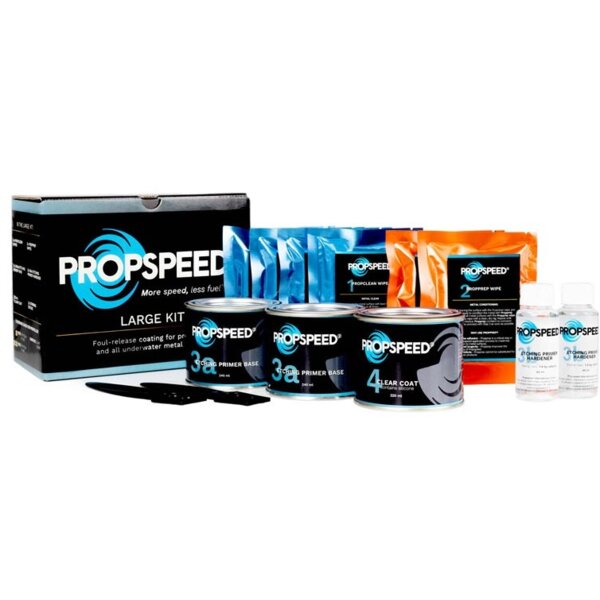
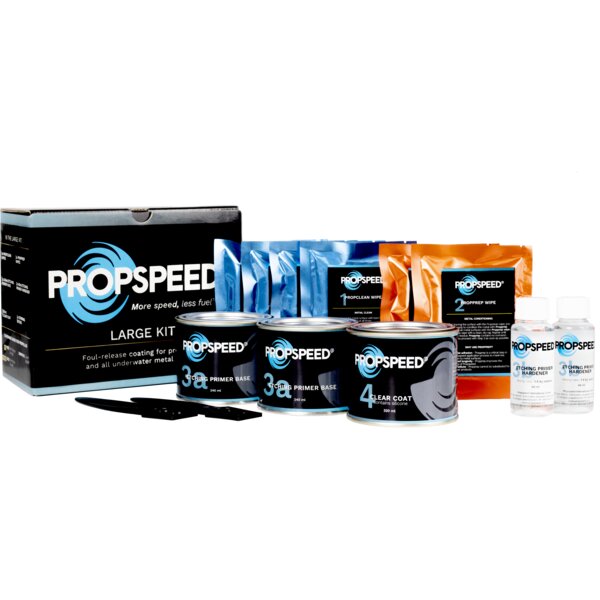
What Propspeed Etching Primer is and why choose it
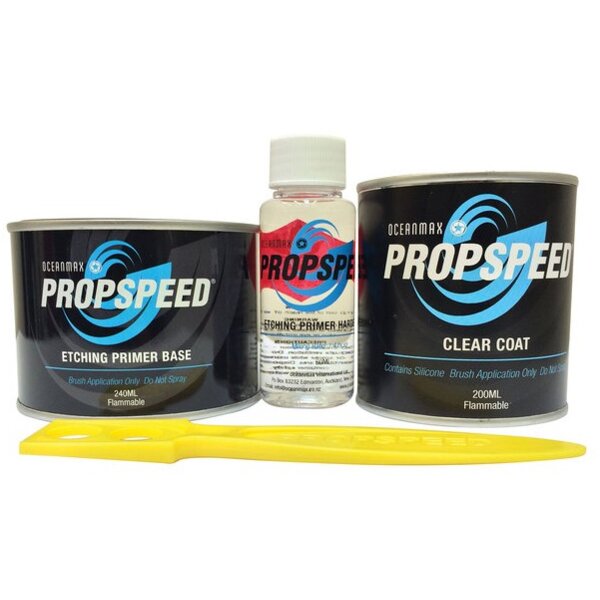
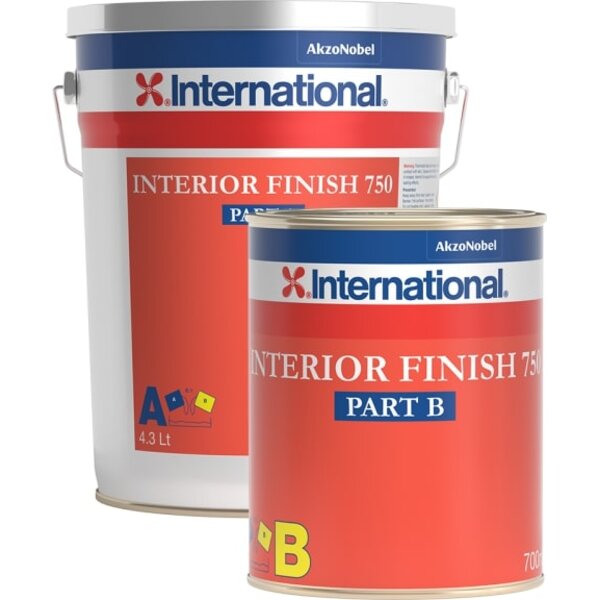
Propspeed Etching Primer is a two-component metal primer system designed as the key adhesion and corrosion-protection layer within the Propspeed coating system. It consists of the Etching Primer Base and the Etching Primer Hardener, which react chemically after mixing to form a thin, durable film that prepares underwater metal surfaces for subsequent coats such as Propspeed Clear.
Specifically developed for the marine industry, this primer is used on metal components such as propellers, shafts and rudders. It provides both corrosion protection and enhanced adhesion for the following coats, when applied in line with the dedicated Propspeed application process.
Main features
- Two-component etching system: Base plus hardener, chemically curing after mixing to create a tightly bonded, corrosion-resistant film.
- Designed for marine metals: Used as a pre-treatment primer on non‑ferrous metals such as bronze and aluminium, zinc, galvanised iron and blast‑cleaned steel plates.
- Optimised for Propspeed Clear: Specifically formulated to increase the adhesive properties of the subsequent Propspeed Clear coat when applied at the correct touch‑dry stage.
- Roller and brush application: Applied using the Propspeed Application Kit roller (PSAP4KIT, PSAP4‑10) or brush; no foam rollers for Clear Coat.
- Defined film build: Two generous coats of Etching Primer deliver a targeted wet and dry film thickness to achieve coverage and performance.
- Fast handling and overcoating: Short touch‑dry times allow rapid application of multiple coats and clear coat in a single, carefully planned operation.
- Part of a complete process: Backed by a detailed surface preparation and application method including Propclean and Propprep wipes, defined abrasive profile and controlled environmental conditions.
Key technical characteristics
Etching Primer system (Base + Hardener)
- Product line: Propspeed Etching Primer
- Type: Two-component etching primer, chemically drying by reaction of mixed components
- Main function: Protection against corrosion and improvement of adhesion for subsequent coats
- Typical substrates: Non‑ferrous metals (bronze, aluminium), zinc, galvanised iron, blast‑cleaned steel plates
Application properties
- Recommended application tools: Propspeed Application Kit roller (PSAP4KIT, PSAP4‑10), brush, foam roller (for primer only; Clear Coat applied with Propspeed roller)
- Number of Etching Primer coats: 2 generous coats
- Theoretical coverage: 11 m²/L (448 sq ft/US gallon)
- Wet film thickness: 90 microns (3–4 mils) per coat
- Dry film thickness: 8 microns (<1 mil) per coat
- Volume solids: 9 %
- Colour (base): Yellow
- Colour (additive/hardener): Clear
- Finish: Matte
- Mixing ratio (Base:Additive): 4:1 by volume (as supplied)
- VOC level: 676 g/L (5.64 lbs/US gallon)
- Specific gravity: 0.87–0.92 g/L
- Pot life: 8 hours @ 20 °C (68 °F)
- Shelf life: 2 years at 25 °C (77 °F)
- Solvents: Xylene, isopropyl alcohol and isobutyl alcohol blend
- Clean up: Acetone or Xylene
Drying and curing
- Touch dry: approx. 10 minutes @ 20 °C (68 °F) (temperature dependent)
- Hard dry: 1 hour @ 20 °C (68 °F)
- Painting interval: Apply Propspeed Clear when Etching Primer is just touch dry
- Product dry time between coats (application guide): 3–5 minutes at 27 °C (80 °F) between Etching Primer coats (longer in colder conditions, shorter in warmer or windy conditions)
- Clear Coat recoat window: Clear Coat must be applied as soon as the last Etching Primer coat is dry to the touch; if the primer is allowed to dry completely there is a risk of intercoat adhesion failure.
- System cure time before immersion: Minimum 8 hours at 27 °C (80 °F). In cold climates (10–16 °C / 50–60 °F) a minimum of 24 hours is recommended before launching.
Recommended application conditions
- Minimum ambient temperature for application: 10 °C (50 °F)
- Optimal temperature range for Etching Primer / Clear Coat application: 16–32 °C (60–90 °F)
- Relative humidity: Avoid application above 85 % relative humidity.
- Conditions to avoid: Direct sunlight, high humidity, inadequate ventilation.
Applications and use cases
Typical uses
- Propellers, shafts and rudders in the marine industry requiring an etching primer layer before Propspeed Clear.
- Non‑ferrous metal components such as bronze and aluminium parts below the waterline.
- Zinc and galvanised iron parts used in marine environments.
- Blast‑cleaned steel plates that need a pre‑treatment primer before receiving further coating layers.
Surface preparation and application overview
1. Planning and preparation
- Ensure all zinc anodes are installed and masked before coating.
- Have all tools and Propspeed products on hand: application kit (PSAP4KIT or PSAP4‑10), Propclean wipes, Propprep wipes, Stripspeed (for old Propspeed removal), dual action sander, 80‑grit abrasive, clean rags or microfibre towels.
- Avoid starting the coating sequence unless it can be completed without interruption; work in sections if necessary.
2. Removal of old coatings and metal conditioning
- Remove existing Propspeed using Stripspeed; as a last resort use a dual action sander.
- Always wear a dust mask when removing previous Propspeed layers; inhalation of residues can be harmful.
- Abrade metal surfaces to an 80‑grit profile to provide the required mechanical key.
3. Cleaning and chemical pre‑treatment
- Initial cleaning: Wear gloves at all times once metal has been abraded. Clean the surface with Propclean wipes and immediately wipe dry with a clean cloth. Repeat until no residue remains on the cloth.
- Chemical conditioning: Wipe the surface with Propprep wipes and immediately dry with a clean cloth. Repeat until clean. Propprep does not contain corrosion inhibitors; proceed to Etching Primer within a maximum of 4 hours.
4. Mixing and applying Propspeed Etching Primer
- Stir the yellow Etching Primer Base thoroughly for 2–3 minutes until no solids remain.
- Add the Etching Primer Hardener to the base and mix again thoroughly.
- Unused mixed product can be kept in a closed can, stored in the shade, for up to 6 hours.
- Apply using a 4" Propspeed roller from the Propspeed Application Kit.
- Apply two generous coats, ensuring coverage of all profiles; rotate propellers manually or with a wooden stick (always with gloves) to reach all surfaces.
- Wait approximately 3–5 minutes at 27 °C (80 °F) between coats, using the touch test (gloved finger leaves a slight fingerprint but no transfer) to confirm readiness for the next coat.
5. Applying Propspeed Clear Coat
- Apply Propspeed Clear as soon as the final Etching Primer coat is touch dry.
- Use a second Propspeed roller from the application kit (not foam).
- Apply a generous, even coat that does not run or drip; correct runs or sags within 5–10 minutes while the coating is still workable.
- Ensure the entire surface is uniformly glossy; dull patches indicate missed areas.
6. Drying, launching and maintenance
- Allow a minimum of 8 hours at 27 °C (80 °F) before launching the vessel; in colder climates (10–16 °C / 50–60 °F) allow at least 24 hours.
- Propspeed effectiveness is not reduced by remaining out of the water for extended periods in hot or cold climates.
- For cleaning coated surfaces, use only a soft cloth. Remove any shell fragments from the cloth before wiping to avoid damaging the coated surface. Do not use abrasive cleaning materials or high‑pressure water.
7. New propellers
- Abrade the metal surface to an 80‑grit profile.
- Pre‑condition with Propclean and Propprep prior to Etching Primer application.
8. Removal and recoating of an existing Propspeed system
- Remove old Propspeed using Stripspeed.
- Abrade to an 80‑grit profile and clean with Propclean and Propprep.
- Recoat following the same Propspeed instructions as for new application.
FAQ
-
On which metals can Propspeed Etching Primer be used?
It is designed as a pre‑treatment primer for non‑ferrous metals such as bronze and aluminium, as well as zinc, galvanised iron and blast‑cleaned steel plates.
-
How many coats of Etching Primer are required?
The Propspeed system requires two generous coats of Etching Primer, followed by one full coat of Propspeed Clear applied when the primer is just touch dry.
-
How long can I wait between Etching Primer coats?
At 27 °C (80 °F), the recommended waiting time is approximately 3–5 minutes. Use the touch‑test: if a gloved finger leaves a slight print but no primer on the glove, the next coat can be applied.
-
When should I apply Propspeed Clear over the Etching Primer?
Apply Propspeed Clear as soon as the final Etching Primer coat is touch dry. If the primer is allowed to fully dry, adhesion between coats can fail.
-
What is the minimum time before launching after application?
The coated surface should not be immersed for at least 8 hours. In colder climates (10–16 °C / 50–60 °F), a minimum of 24 hours before launching is recommended.
-
Which tools are recommended for application?
Use the Propspeed Application Kit roller (PSAP4KIT or PSAP4‑10) or brush for the Etching Primer. Clear Coat should be applied with a Propspeed roller from the same kit, not with foam rollers.
-
How should previously coated surfaces be prepared?
Remove the old Propspeed with Stripspeed, abrade the metal to an 80‑grit profile, then clean and chemically condition with Propclean and Propprep before reapplying Etching Primer and Clear Coat.
-
Does Propspeed Etching Primer contain heavy metals?
The Etching Primer Base contains zinc chromate and zinc hydroxide as hazardous ingredients. Appropriate handling, protective equipment and disposal procedures as described in the Safety Data Sheets must be followed.
Section 14 – Transport information
Propspeed Etching Primer (system)
Transport classifications are provided for the different components of the Propspeed Etching Primer system.
Etching Primer Base
- UN number: UN1263
- Proper shipping name: PAINT
- Transport hazard class: 3
- Packing group: II
- Environmental hazard (ADR/IMDG/IATA): 3YE
- Marine pollutant: No
- EmS (IMDG): F‑E, S‑E
- Limited Quantities statement: If the individual container is below 5 L or kg, it can be transported as non‑dangerous goods provided DG labelling is retained and the driver has safety information according to UNRTDG Chapter 3.4.
Etching Primer Hardener
- UN number: UN3469
- Proper shipping name: PAINT, FLAMMABLE, CORROSIVE
- Transport hazard class: 3(8)
- Packing group: II
- Environmental hazard (ADR/IMDG/IATA): No
- Hazchem code: 3WE
Etching Primer (general transport data)
- UN number: 1263
- Class: 3a
- Hazchem: 3(Y)E
- Packing group: II
Transport precautions for users (all components):
- Always transport in correct, secure packaging.
- Ensure personnel transporting the product are informed about measures to take in case of accident or accidental release.
Section 8 – Individual protection measures (PPE)
The following personal protective equipment requirements are drawn from the Safety Data Sheets for Propspeed Etching Primer Base and Propspeed Etching Primer Hardener. Selection and use must comply with local regulations and workplace risk assessments.
General hygiene and engineering controls
- Ensure adequate ventilation, especially in confined areas.
- Use explosion‑proof electrical, ventilation and lighting equipment when handling the Base or Hardener.
- Do not eat, drink or smoke while using the product; keep away from food, drink and animal feeding stuffs.
- Avoid any exposure for pregnant workers.
- Wash hands thoroughly before breaks and after work; remove all contaminated clothing immediately.
- Keep contaminated work clothing in closed containers until disposal or decontamination; do not take it out of the workplace.
- Ensure emergency eyewash is available close to the work area.
Eye and face protection
- Use tight‑fitting safety goggles or a face shield with side protection conforming to EN 166.
- Avoid the use of contact lenses; soft lenses can absorb irritants and all lens types can concentrate them.
Hand protection
- Wear chemical‑resistant protective gloves at all times when handling the Base or Hardener.
- Recommended material: Nitrile rubber protective gloves.
- Minimum thickness: > 0.4 mm.
- Breakthrough time: > 480 minutes (EN 374).
- Inspect gloves before use and follow glove manufacturer instructions on permeability and replacement frequency. Actual service time may be shorter than tested breakthrough time due to temperature and working conditions.
- Use proper glove removal techniques to avoid skin contact with contaminated surfaces; dispose of used gloves according to local regulations.
Skin and body protection
- Wear long‑sleeved, impervious protective clothing to prevent liquid or vapour contact.
- For the Etching Primer Base: wear flame‑retardant, anti‑static protective clothing suited to flammable liquids.
- For the Etching Primer Hardener: wear acid‑resistant protective clothing to avoid contact with corrosive components.
Respiratory protection
- Use an appropriate certified respirator when adequate ventilation cannot be ensured, when exposure limits are exceeded or when vapours/aerosols are generated.
- For the Etching Primer Hardener, a full‑face respirator with an ABEK gas filter (inorganic, organic and acidic gases and vapours, ammonia/amines) in accordance with standards such as NF EN 14387 is recommended.
- Observe maximum wearing times and follow manufacturer instructions for maintenance, cleaning and testing of respiratory protective devices.
*Contenido generado por IA