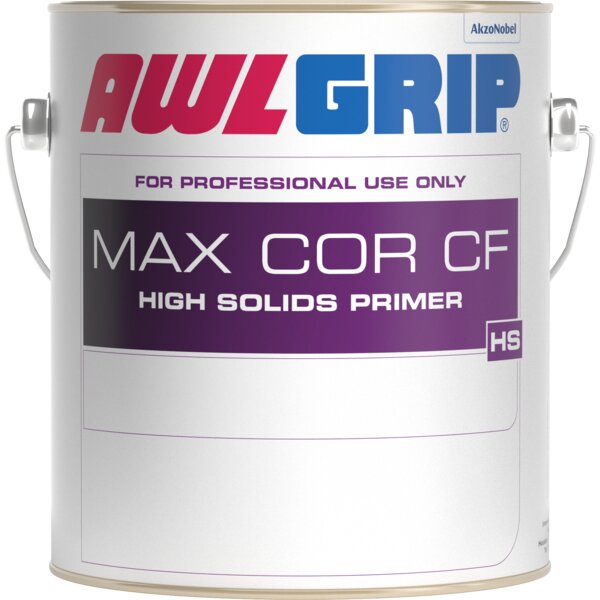
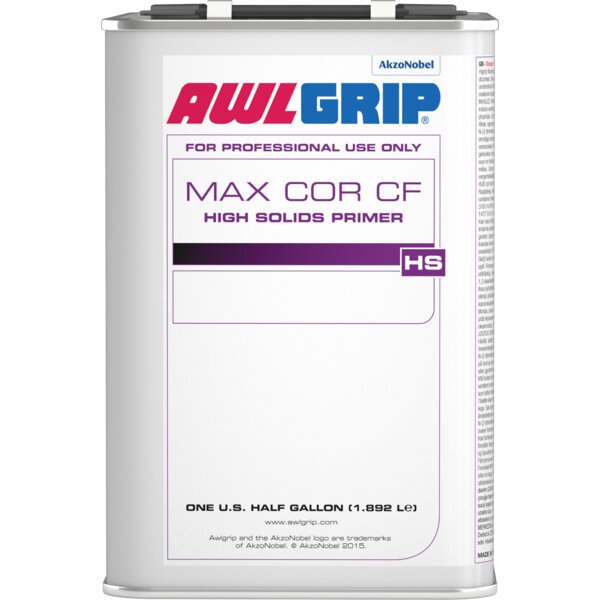
What is Awlgrip MAX COR CF High Solids Primer Base and why choose it?
Awlgrip MAX COR CF High Solids Primer Base (R4330) is a chromate-free, two-component epoxy polyamine primer designed for aluminum and steel surfaces above the waterline. Based on Controlled Fusion (CF) technology, it delivers high solids, excellent chemical and solvent resistance, and outstanding adhesion while eliminating the need for sanding between coats within specified overcoating windows. When mixed with the dedicated converter R3330, it provides a tightly fused intercoat layer that promotes long-term corrosion protection and coating durability.
Main features
- High-solids epoxy polyamine system for durable anti-corrosive protection on aluminum and steel.
- Chromate-free formulation for anti-corrosion performance without chromate pigments.
- Controlled Fusion (CF) technology allows extended recoat times and removes the need for sanding before applying compatible subsequent coats.
- Excellent chemical and solvent resistance for demanding marine and industrial environments above the waterline.
- Excellent substrate adhesion on properly prepared grit-blasted or power-ground steel and aluminum.
- Spray-applied system optimised for professional application with conventional or airless equipment.
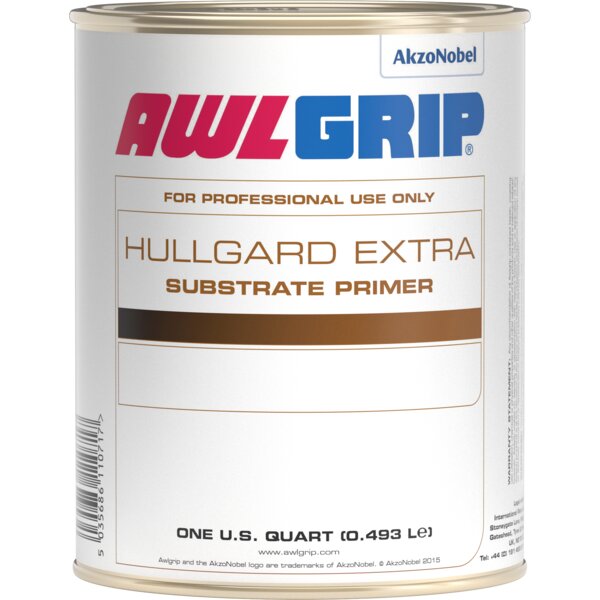
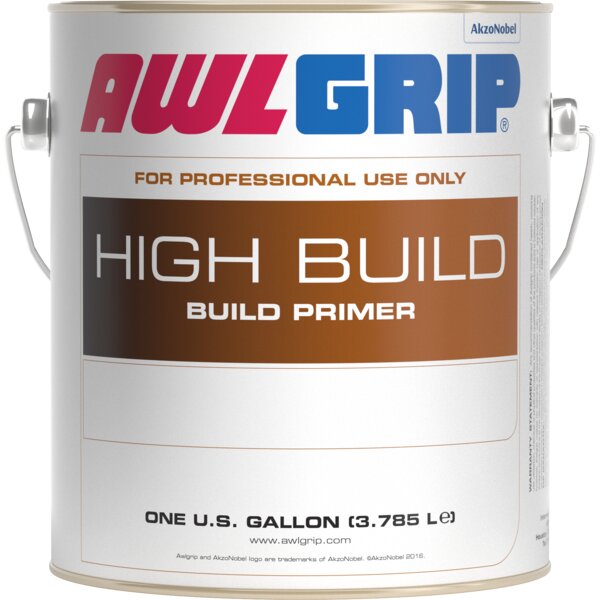
- Predictable overcoating schedule with Hullgard Extra Primer and High Build primers at a range of temperatures.
- Dedicated base and converter (R4330 base, R3330 converter) for controlled mixing and performance.
Technical specifications
- Product type: Epoxy Polyamine primer
- Brand: Awlgrip
- Colour: Green
- Use: For use above the waterline only
- Components: Base R4330 (this product) + Converter R3330
- Packaging (liquid system): Base in 1-gallon pack; converter in ½-gallon pack
- Mix ratio (by volume): 2 parts R4330 base : 1 part R3330 converter
- Theoretical coverage (mixed base + converter):
- Approx. 1138 ft²/gal (28.45 m²/L) at 0.8 mil (20 μm) dry
- Approx. 910–1518 ft²/gal (22.76–38.0 m²/L) at recommended dry film thickness
- Recommended wet film thickness: 0.8–1.4 mils (20–34 μm) per coat
- Recommended dry film thickness: 0.6–1.0 mils (15–25 μm) per coat
- Number of coats: 1 smooth wet coat
- VOC (unmixed):
- R4330 base: 2.12 lbs/gal (254 g/L)
- R3330 converter: 5.54 lbs/gal (628 g/L)
- Mixed R4330:R3330: 3.15 lbs/gal (378 g/L)
- Pot life (mixed at 77°F / 25°C, 50% RH): Approx. 2 hours
- Induction time after mixing: Not applicable (N/A)
- Application method: Spray only
- Recommended application equipment:
- Conventional spray (compliant): air cap 110, fluid tip 1.4 mm, 30–40 PSI (2.0–2.7 bar); pot pressure 11–12 PSI (0.8 bar)
- Conventional spray (suction/gravity): air cap 30 or 765, fluid tip 1.4 mm, 50–60 PSI (3.4–4.1 bar); pot pressure 11–12 PSI (0.8 bar)
- Gun #95 (siphon/cup system and pressure pot): fluid nozzles 66SS / 66BSS, fluid needles 665 / 663A, air nozzles 66Sk / 63PW, atomization 50–60 PSI (3.4–4.1 bar), pressure pot 8–12 PSI (0.55–0.83 bar)
- Airless: orifice 0.13", 60° angle
- Thinning: DO NOT THIN/REDUCE
- Cleaning of equipment: Reducers T0006 or T0002, or M.E.K.
- Recommended substrate profile: 2–3 mils (50–75 μm) on steel and aluminum
Recoat windows with compatible primers
Overcoating Max Cor CF with the following primers (under standard conditions):
| Overcoated by |
Temperature |
Minimum |
Maximum |
| Hullgard Extra Primer |
15°C / 59°F |
17 hours |
72 hours |
| Hullgard Extra Primer |
25°C / 77°F |
17 hours |
72 hours |
| Hullgard Extra Primer |
35°C / 95°F |
7 hours |
72 hours |
| High Build |
15°C / 59°F |
17 hours |
72 hours |
| High Build |
25°C / 77°F |
17 hours |
72 hours |
| High Build |
35°C / 95°F |
7 hours |
72 hours |
Important: If the maximum overcoating interval is exceeded, the Max Cor CF layer must be completely removed and reapplied. If it is likely the maximum interval will be exceeded, apply Hullgard Extra to provide up to 6 months overcoating without sanding.
Applications and use cases
Recommended substrates
- Aluminum – sandblasted or ground to 100% clean silver color with a 2–3 mil (50–75 μm) surface profile.
- Steel – grit-blasted steel in accordance with SSPC-SP10 or Sa2½ to a 2–3 mil (50–75 μm) profile, or power-ground with 16–36 grit abrasive to achieve equivalent profile.
Typical preparation steps
- Ensure surfaces are clean, dry and free from dirt, grease and oil.
- Use Awlgrip Wipe-Down Solvent (Awlprep T0008, Awlprep Plus T0115, or Surface Cleaner T0340) prior to priming.
- Confirm specified surface profile and cleanliness standard (SSPC-SP10 or Sa2½ for steel).
Application conditions
- Spray one smooth wet coat; the substrate may remain visible through the dry film.
- Do not exceed the maximum recommended dry film thickness (1.0 mil / 25 μm per coat).
- Apply only when surface temperatures are between 15°C/59°F and 40°C/105°F.
- Do not attempt to cure the product at temperatures below 15°C/59°F.
Typical use environments
- Marine and yachting applications above the waterline on aluminum and steel structures.
- Areas where extended recoat times and minimal sanding are desired within a multi-coat Awlgrip system.
FAQ – Max Cor CF High Solids Primer Base
-
Is Max Cor CF suitable for use below the waterline?
No. All available product data specify use above the waterline only.
-
Can I apply this primer without blasting the steel?
Max Cor CF may be applied to steel that is either grit-blasted to SSPC-SP10 / Sa2½ or power-ground with a 16–36 grit disc to achieve a 2–3 mil (50–75 μm) profile, provided the surface is clean and free of contaminants.
-
Do I need to sand Max Cor CF before overcoating?
Within the specified minimum and maximum overcoating times, sanding is not required before applying Hullgard Extra Primer or High Build. If the maximum interval is exceeded, the Max Cor CF layer must be removed and reapplied.
-
How should I mix the base and converter?
Mix by volume 2 parts R4330 base with 1 part R3330 converter. Ensure the base is uniformly dispersed before addition, then mix until a smooth, homogeneous mixture is obtained.
-
Can I thin the product for spraying?
No. The technical data specifically state DO NOT THIN/REDUCE. Use as supplied after proper mixing with the converter.
-
What is the pot life of the mixed product?
The anticipated pot life at 77°F (25°C) and 50% relative humidity is approximately 2 hours.
-
What happens if I ignore the overcoating times?
Failure to respect the required overcoating times can result in blistering and delaminating of the underlying Max Cor CF layer.
Section 14 – Transport information
The following summary is based on the safety data for Max Cor CF components shipped as paint.
- Proper shipping name (DOT/IMDG): PAINT
- UN/NA number: UN 1263
- Hazard class: 3 (flammable liquid)
- Packing group: II
- IMO/IMDG classification: Class 3.2 – Intermediate flashpoint flammable liquids
- CERCLA/DOT reportable quantity (example for R4330 component): 694 gal / 7701 lbs
Transport within the user’s premises should always be in closed, upright and secure containers, away from sources of ignition, with personnel informed of spill and emergency procedures.
Section 8 – Individual protection measures
The following protective measures are summarised from the available safety data and are intended for professional users.
Personal protective equipment (PPE)
- Respiratory protection: Use only with adequate ventilation. If eye watering, headaches or dizziness occur, or if monitoring shows dust, vapor or mist levels above applicable limits, wear a properly fitted, NIOSH-approved respirator suitable for the ingredients listed in the safety data. Follow the respirator manufacturer’s instructions.
- Eye and face protection: Avoid contact with eyes. Depending on conditions of use, wear safety glasses or chemical goggles, and if necessary additional head and face protection. Clean or replace eye protection after each use.
- Skin and hand protection: Wear protective gloves and suitable protective clothing (such as apron, boots, and face/ head protection) to prevent skin contact. Clean or discard contaminated PPE after each use.
Engineering and work practice controls
- Prevent vapor build-up by providing cross-ventilation (e.g. opening windows and doors).
- Keep away from heat, sparks and open flames. Do not smoke during application or until all vapors are gone.
- Ensure emergency eyewash fountains and safety showers are available near areas of potential exposure.
- Use good personal hygiene practices: wash hands before eating, drinking or using the toilet; promptly remove soiled clothing and wash thoroughly before reuse; shower after work using plenty of soap and water.
Contenido generado por IA