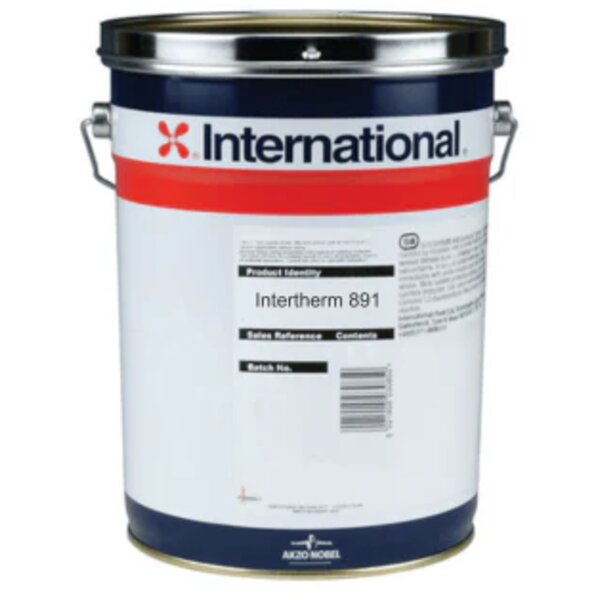
What is INTERTHERM 891 and why choose it?
INTERTHERM 891 is a one-pack oleoresinous aluminium coating designed as a light reflective finish for steel surfaces such as cargo holds and pipes. It is suitable for areas that are expected to reach dry heat temperatures up to 250°C, and up to 315°C when applied at a reduced dry film thickness of 15 µm. Formulated for solvent-borne application, it is intended for newbuilding, maintenance and repair, and on-board maintenance in marine and industrial environments.
Main features
- Heat-resistant finish: withstands dry heat up to 250°C, extendable to 315°C at 15 µm dry film thickness.
- Light reflective aluminium appearance: colour HTA002-Aluminium with a reflective metallic finish that helps improve visibility inside cargo spaces and enclosed areas.
- Single-pack oleoresinous technology: no mixing ratio or separate curing agent (Part B not applicable).
- Versatile application methods: can be applied by airless spray, conventional spray, brush or roller.
- Certified for specific cargo use: when part of an approved scheme, certified for Food Contact – Carriage of Grain (NOHA).
- Designed for professional marine use: suitable for new construction, maintenance and on-board maintenance under Worldwide Marine Specifications.
Key technical characteristics
- Colour: HTA002-Aluminium
- Finish/Sheen: Not applicable
- Product type: Oleoresinous aluminium, single pack
- Volume solids: 48% ±2% (ISO 3233:1998)
- Typical dry film thickness: 25 µm (equivalent to 52 µm wet)
- Theoretical coverage: 19.2 m²/litre at 25 µm DFT (allow for losses)
- Drying times (typical):
- 5°C: touch dry 18 h; hard dry 72 h
- 15°C: touch dry 12 h; hard dry 36 h
- 25°C: touch dry 8 h; hard dry 24 h
- 35°C: touch dry 6 h; hard dry 24 h
- Overcoating interval with INTERTHERM 891:
- 5°C: minimum 24 h, maximum extended
- 15°C: minimum 24 h, maximum extended
- 25°C: minimum 24 h, maximum extended
- 35°C: minimum 16 h, maximum extended
- Flash point (typical): 43°C (closed cup)
- VOC content (as supplied):
- 420 g/L (EPA Method 24)
- 456 g/kg of liquid paint (EU Solvent Emissions Directive 1999/13/EC)
- 395 g/L (Chinese National Standard GB23985)
- Density: 0.996 g/cm³ (DIN EN ISO 2811-1)
- Viscosity (kinematic): approx. 154 mm²/s at room temperature (153 mm²/s at 40°C)
- Solubility: Not soluble in cold water (OECD TG 105)
- Shelf life: 24 months at 25°C in dry, shaded storage away from heat and ignition sources
Technical specifications
- Product form: Single-pack coating (no separate curing agent)
- Heat resistance:
- Standard use: up to 250°C dry heat
- Maximum: 315°C dry heat when applied at 15 µm DFT
- If used over a primer system, overall heat resistance may be limited by the primer.
- Recommended primers: Consultar ficha técnica del fabricante.
- Application equipment:
- Airless spray: tip size 0.33–0.41 mm (13–16 thou); minimum 112 kg/cm² (1590 psi) fluid pressure at tip.
- Conventional spray: suitable proprietary equipment; thinning may be required.
- Brush and roller: suitable for small areas.
- Thinner/Cleaner: International GTA004 (thinning normally not required).
- Mixing: Thorough mechanical agitation with a power agitator before application.
- Storage conditions: store in tightly closed original containers, dry, cool, well ventilated, protected from direct sunlight and ignition sources; prevent moisture ingress to avoid pressure build-up.
- Available unit sizes (typical): 1 US gal, 5 US gal, 5 L, 20 L.
Applications and use cases
Typical uses
- Cargo holds: light reflective aluminium finish that helps visual inspection and provides heat-resistant protection when used in a suitable system.
- Pipes and process lines: external protection for steel pipework subject to elevated dry temperatures within the stated limits.
- Newbuild projects: final aluminium finish over an approved primer scheme in shipyards and industrial fabrication works.
- Maintenance and repair: suitable for maintenance and on-board maintenance over recommended primers and intact aged INTERTHERM 891 after proper cleaning.
Surface preparation (summary)
- Use in accordance with Worldwide Marine Specifications.
- All surfaces must be clean, dry and free from oil, grease and other contaminants.
- Remove oil/grease and soluble contaminants according to SSPC-SP1 solvent cleaning.
- For breakdown and damaged areas, prepare to Sa2½ (ISO 8501-1:2007) before re-priming and overcoating.
- For North American marine use, SSPC-SP10 may be used in place of Sa2½.
- Always apply INTERTHERM 891 over a compatible primer scheme and within the specified overcoating intervals.
Application notes
- Bring material to 21–27°C before mixing and application where possible.
- Ensure the substrate temperature is at least 3°C above the dew point.
- Maximum temperature resistance (315°C) is only achieved at 15 µm DFT; over-application can cause blistering at high temperature.
- When overcoating aged INTERTHERM 891, thoroughly fresh-water wash and degrease; remove loose or flaking coatings to a firm edge before repair and recoating.
FAQ – INTERTHERM 891
-
What type of coating is INTERTHERM 891?
It is a single-pack oleoresinous aluminium coating designed for use as a light reflective, heat-resistant finish over suitable primer systems.
-
What maximum temperature can it withstand?
It is suitable for surfaces likely to reach up to 250°C in dry heat. When applied at 15 µm dry film thickness, resistance can be extended up to 315°C, subject to the primer system used.
-
Can INTERTHERM 891 be applied by brush?
Yes. Airless spray, conventional spray, brush and roller are all suitable application methods. Brush and roller are mainly recommended for small areas.
-
Do I need to mix two components before use?
No. INTERTHERM 891 is a one-pack product with no separate curing agent. It must, however, be mixed thoroughly with a power agitator before application.
-
On which substrates can it be used?
It is intended for properly prepared and primed steel surfaces such as cargo holds, pipes and other marine and industrial structures, following the specified primer scheme.
-
What is the typical coverage?
The theoretical coverage is 19.2 m²/litre at 25 µm DFT. Actual coverage will be lower and depends on factors such as surface profile, application method and losses.
-
How long should I wait before overcoating?
At 25°C, the minimum overcoating interval with INTERTHERM 891 is 24 hours, with an extended maximum interval. At 35°C, the minimum is 16 hours.
-
Is the product suitable for use in grain cargo holds?
When used as part of an approved coating scheme, INTERTHERM 891 has certification for Food Contact – Carriage of Grain (NOHA).
-
What thinner should be used if required?
International GTA004 is specified as both thinner and cleaner. Thinning is normally not required and must not exceed local environmental legislation limits.
-
What is the shelf life?
The stated shelf life is 24 months at 25°C in dry, shaded storage away from heat and ignition sources, subject to reinspection thereafter.
Section 14 – Transport information (summary)
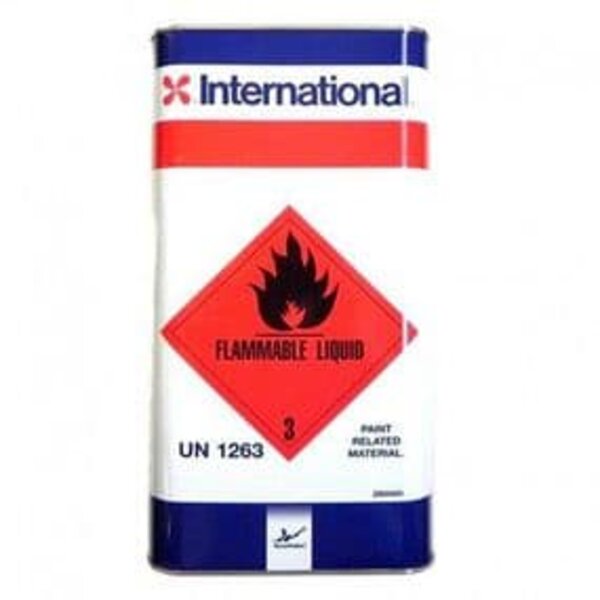
INTERTHERM 891 is classified as a flammable paint for transport. Key transport data are:
- UN number / ID number: UN1263
- UN proper shipping name: PAINT
- Transport hazard class: Class 3 (flammable liquids)
- Packing group: III
- Environmental hazards: Not classified as environmentally hazardous for ADR/RID, IMDG or IATA.
- ADR/RID tunnel restriction code: (D/E)
- IMDG emergency schedules: F-E, S-E
- Special precautions for the user: within user premises, always transport in closed, upright and secure containers; personnel should be instructed on actions to take in case of accident or spillage.
- Transport in bulk according to IMO instruments: Not applicable.
Section 8 – Personal protection measures (summary)
INTERTHERM 891 is a solvent-borne, flammable coating. Use only in accordance with relevant health, safety and environmental regulations and with appropriate personal protective equipment (PPE) as indicated in the safety data sheet.
Engineering controls
- Use only with adequate ventilation.
- Apply local exhaust ventilation or process enclosures to keep airborne concentrations below occupational exposure limits and below the lower explosion limit.
- Use explosion-proof ventilation equipment.
Personal protective equipment
- Eye and face protection: safety eyewear to an approved standard, such as safety glasses with side shields, when there is a risk of splashes, mists or vapors.
- Hand protection:
- Chemical-resistant, impervious gloves complying with EN374 or equivalent.
- For prolonged or frequently repeated contact, use gloves with protection class 6 (breakthrough time > 480 minutes). Recommended materials: Viton or nitrile, thickness ≥ 0.38 mm.
- For brief contact, gloves of protection class 2 or higher (breakthrough time > 30 minutes). Recommended: nitrile, thickness ≥ 0.12 mm.
- Replace gloves regularly and when damaged; consider manufacturer-specific data.
- Skin and body protection:
- Wear suitable protective clothing selected according to the task and risks.
- Where ignition from static discharge is possible, use anti-static protective clothing including overalls, boots and gloves (refer to EN 1149).
- Use appropriate footwear and any additional skin protection as determined by a risk assessment.
- Respiratory protection:
- Where ventilation is insufficient, wear a respirator conforming to EN140 with a type A/P2 filter or better.
- During dry sanding, flame cutting or welding of the dry film, provide local exhaust ventilation; if this is not possible, use suitable respiratory protective equipment.
Hygiene measures
- Wash hands, forearms and face thoroughly after handling and before eating, drinking or smoking.
- Remove contaminated clothing and protective equipment before entering eating areas.
- Ensure eyewash stations and safety showers are close to the work area.
*Contenido generado por IA