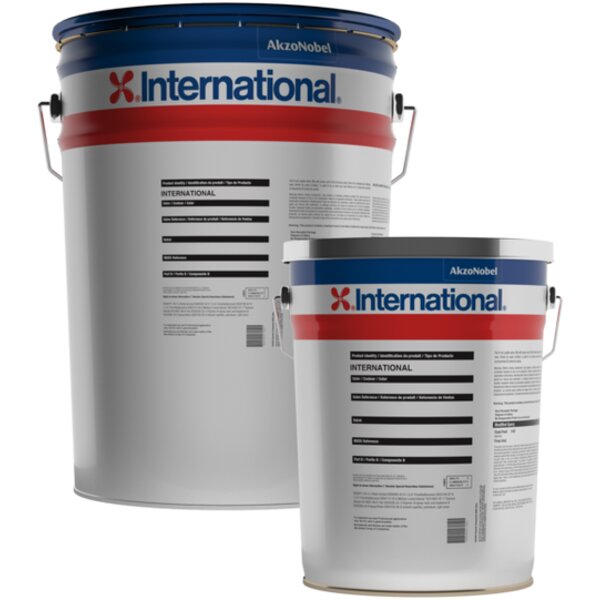
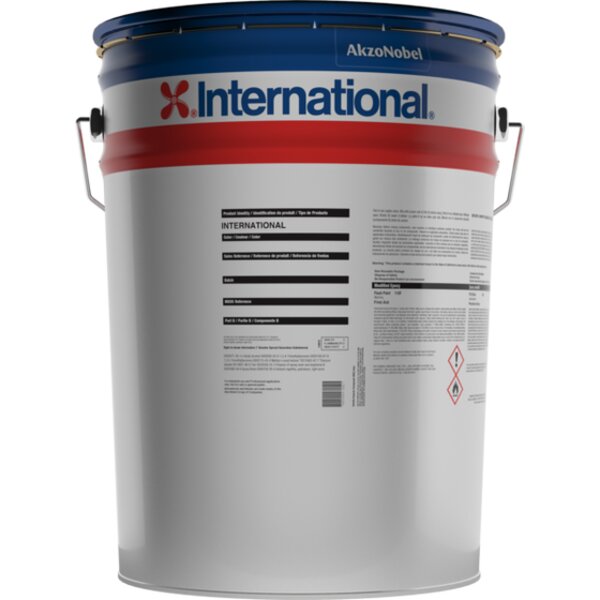
What is Interbond 201 Part A Indivisible Kit and why choose it?
Interbond 201 Part A Indivisible Kit is the base component of Interbond 201, a hard-wearing, two-pack epoxy primer/finish from International Marine Coatings. Designed for both temperate and low-temperature grades, it provides surface-tolerant, one-coat anticorrosive protection for decks, deck fittings and cargo holds in marine environments. When correctly mixed with its dedicated curing agent, it delivers high-build corrosion protection with excellent resistance to traffic and weathering, making it suitable for Maintenance & Repair or On Board Maintenance.
Main features
- Two-pack epoxy technology: Part A base for a high-solids epoxy primer/finish that cures with the specified Part B (KDA100 temperate or KDA200 low temperature).
- One-coat anticorrosive protection: Designed to provide corrosion protection in a single, high-build coat at 150 microns dry film thickness.
- Surface-tolerant and hard-wearing: Suitable for properly prepared blasted, hydroblasted or mechanically cleaned steel, with good resistance to traffic and abrasion.
- Dual temperature range: Available as temperate grade (for use above 5°C) and low-temperature grade (for use down to -5°C, using a separate curing agent).
- Semi-gloss finish: Provides a durable, semi-gloss appearance in a range of colours including Surf Grey, Storm Grey, Red and Signal Green (complete kit).
- Food-contact and fire certifications (system dependent): When used as part of approved schemes, Interbond 201 offers certifications for food-contact carriage of grain and, for the temperate grade, fire performance (surface spread of flame, smoke and toxicity, and Marine Equipment Directive compliance).
- High volume solids: 74% ±2% volume solids for efficient film build and reduced solvent emissions.
- Versatile application methods: Compatible with airless spray, brush and roller application.
Technical specifications
General product data (complete Interbond 201 system)
- Product type: Epoxy primer/finish (two-component)
- Typical areas: Decks, deck fittings, cargo holds (including ballast holds with approved schemes for temperate grade)
- Finish: Semi-gloss
- Volume solids: 74% ±2% (ISO 3233:1998)
- Typical dry film thickness: 150 microns (203 microns wet)
- Theoretical coverage: 4.93 m²/litre at 150 microns DFT (loss factors to be applied)
- Standard colours: Surf Grey (KDF684), Storm Grey (KDK724), Red (KDL274), Signal Green (KDL549)
- Mix ratio (by volume): 4 parts Part A to 1 part Part B
- Curing agents: KDA100 (temperate) or KDA200 (low temperature)
- Flash point (temperate grade): Part A 28°C; Part B 34°C; Mixed 29°C (different values apply for North American production, without impact on performance)
- Flash point (low-temperature grade): Part A 28°C; Part B 38°C; Mixed 32°C (North American variants slightly higher)
- VOC (temperate): 279 g/L as supplied (EPA Method 24); 229 g/kg as supplied (EU Directive 1999/13/EC); 274 g/L (Chinese GB23985)
- VOC (low temperature): 279 g/L as supplied (EPA Method 24); 212 g/kg as supplied (EU Directive 1999/13/EC)
Drying and pot life – low temperature grade
- Touch dry: 24 h at -5°C; 10 h at 5°C; 5 h at 15°C; 3 h at 25°C
- Hard dry: 60 h at -5°C; 24 h at 5°C; 11 h at 15°C; 10 h at 25°C
- Pot life: 8 h at -5°C; 5 h at 5°C; 2.5 h at 15°C; 1 h at 25°C
Drying, pot life and induction – temperate grade
- Induction period (KDA100): 30 minutes at temperatures below 25°C
- Touch dry: 9 h at 5°C; 7 h at 10°C; 4 h at 25°C; 3 h at 35°C
- Hard dry: 47 h at 5°C; 29 h at 10°C; 9 h at 25°C; 5 h at 35°C
- Pot life: 8 h at 5°C; 7 h at 10°C; 4 h at 25°C; 2 h at 35°C
Recommended application
- Application methods: Airless spray (recommended), brush and roller; conventional spray not recommended.
- Airless spray tip range: 0.53–0.84 mm (21–33 thou)
- Airless spray pressure: minimum 176–246 kg/cm² (2500–3500 psi) at the spray tip
- Thinner (temperate): International GTA220; thinning normally not required (do not exceed local environmental limits).
- Thinner (low temperature): Not recommended; use GTA220 only in exceptional cases and within local limits.
- Cleaner (all grades): International GTA220 or GTA822
Substrate preparation (steel)
- Major refurbishment: Abrasive blast to Sa2 (ISO 8501-1:2007). If oxidation occurs before coating, reblast to the specified standard.
- Hydroblasting: Acceptable to HB2 (or HB2½ for wet holds) with flash rust not worse than HB2M/HB2½L; recommended for cargo holds, topsides and above-water areas.
- Slurry blasting: To SB2 with flash rust not worse than SB2M; for topsides and above-water areas only.
- Repair/OBM exposed steel: Hand or power tool clean to at least St2, with local blast to Sa2 where necessary.
- Wet holds (temperate): Blast to Sa2½ or to Hydroblasting Standard HB2½ with limited flash rust.
- North America equivalence: SSPC-SP10 can be used in place of Sa2½; SSPC-SP6 in place of Sa2; SSPC-SP2 in place of St2.
Unit size and storage (Part A + Part B kits)
- Unit sizes: 20 L (16 L Part A + 4 L Part B); 5 US gal kit (4 US gal Part A + 1 US gal Part B)
- Typical shipping weight: 28.93 kg for 20 L unit; 59–59.4 lb for 5 US gal unit (approx.)
- Shelf life: Part A minimum 18 months at 25°C; Part B minimum 12 months at 25°C, subject to reinspection.
- Storage conditions: Store dry, in shade, away from heat and ignition sources. Keep containers tightly closed.
Applications and use cases
- Decks and deck fittings: Provides a durable, semi-gloss epoxy finish with high resistance to traffic and mechanical wear in marine environments.
- Cargo holds: Designed as a primer/finish for cargo holds, including grain carriage under approved food-contact schemes. When using in cargo holds, follow Interbond 201 Cargo Hold Application Guidelines.
- Ballast holds (temperate grade): Can be used as part of approved systems for ballast holds; the low-temperature grade is not suitable for ballast holds.
- Maintenance & Repair: Suitable for major refurbishment on blasted steel, as well as repair and overlap onto most aged coating systems, provided loose or flaking coatings are removed and correct preparation is performed.
- On Board Maintenance: Can be applied by airless spray, brush or roller for on-board touch-ups, stripe coating and complex structures, especially where surface tolerance and rapid return to service are required.
- Food-contact applications: When used as part of an approved scheme, provides certification for food-contact carriage of grain and, for the low-temperature grade, FDA compliance for dry foodstuffs (complete system).
FAQ – Interbond 201 Part A Indivisible Kit
-
Is Interbond 201 a primer or a finish?
It is an epoxy primer/finish. When correctly mixed with its curing agent, it can function as both anticorrosive primer and final semi-gloss finish in one coat.
-
Can Interbond 201 be applied at low temperatures?
Yes. The low-temperature grade, using curing agent KDA200, is suitable for application down to -5°C, with specific drying and overcoating times given for -5°C to 25°C.
-
What is the recommended film thickness?
The typical dry film thickness is 150 microns (203 microns wet), giving a theoretical coverage of 4.93 m²/litre, before allowing for losses.
-
Which application methods are recommended?
Airless spray is recommended for most areas. Brush and roller are suitable for small areas, touch-up and stripe coating of edges and complex structures. Conventional spray is not recommended.
-
Can I overcoat existing aged coatings with Interbond 201?
Yes, Interbond 201 is suitable for overlap onto most aged coating systems, provided loose or flaking material is removed, the surface is cleaned and prepared as specified, and film thickness is controlled.
-
Is Interbond 201 approved for cargoes such as grain or dry foodstuffs?
When used as part of an approved scheme, Interbond 201 systems are certified for food contact for carriage of grain (NOHH) and, for low-temperature grade, FDA-compliant dry foodstuffs. Consultar ficha técnica del fabricante.
-
Is the low-temperature grade suitable for ballast holds?
No. Interbond 201 low-temperature grade is not suitable for use in ballast holds.
-
How should I prepare the steel surface before application?
For major refurbishment, abrasive blast to Sa2 (or Sa2½ / HB2½ for wet holds, as specified). For repairs, at least St2 mechanical or hand cleaning, with local blasting to Sa2 where necessary. Surfaces must be clean, dry and free from contaminants.
-
What thinner and cleaner should I use with Part A?
Use International GTA220 for thinning where allowed and required (temperate grade) and GTA220 or GTA822 for cleaning application equipment. Thinning of the low-temperature product is generally not recommended.
-
Does Interbond 201 chalk in sunlight?
Yes. As with all epoxy-based coatings, Interbond 201 will exhibit film chalking on UV exposure. This is mainly cosmetic and does not necessarily indicate loss of anticorrosive performance.
Section 14 – Transport information
The following data are taken from the Safety Data Sheet for Interbond 201 Surf Grey Part A (classification may vary by region and packaging; always check current SDS before shipping):
- UN number / ID number: UN1263
- UN proper shipping name: PAINT
- Transport hazard class: Class 3 (Flammable liquid)
- Packing group: III
- Environmental hazards: Not classified as marine pollutant in the supplied data.
- ADR/RID tunnel code: (D/E)
- IMDG emergency schedules: F-E, S-E
- Special precautions for user: Within user premises, always transport in closed, upright and secure containers and ensure transport personnel know emergency procedures in case of accident or spillage.
- Bulk transport according to IMO instruments: Not applicable.
Section 8 – Personal protective measures
For safe handling and application of Interbond 201 Part A and mixed product, the Safety Data Sheets specify the following personal protection and exposure controls:
Engineering and hygiene controls
- Use only with adequate ventilation, employing process enclosures and/or local exhaust to keep airborne concentrations below occupational exposure limits and below lower explosive limits.
- Use explosion-proof ventilation and electrical equipment; avoid sources of ignition and control electrostatic discharges.
- Provide eyewash stations and safety showers near work areas.
- Wash hands, forearms and face thoroughly after handling; remove contaminated clothing and protective equipment before entering eating areas.
Eye and face protection
- Wear chemical splash goggles that comply with approved standards; where risk assessment indicates higher exposure (e.g. spraying), use a full face shield or respirator with full face-piece.
Hand protection
- Wear chemical-resistant, impervious gloves in accordance with EN374 or equivalent.
- For prolonged or frequently repeated contact: gloves with protection class 6 (breakthrough time > 480 min), recommended materials Viton or Nitrile, thickness ≥ 0.38 mm.
- For brief contact: gloves with protection class ≥ 2 (breakthrough time > 30 min), recommended Nitrile, thickness ≥ 0.12 mm.
- Replace gloves regularly and immediately if damaged; verify suitability with glove manufacturer data.
Body and skin protection
- Wear suitable protective clothing selected according to task and risk assessment, approved by a specialist prior to use.
- In areas with ignition risk from static electricity, wear anti-static protective clothing including overalls, boots and gloves in accordance with EN 1149.
- Use appropriate protective footwear and any additional skin protection as required by local conditions.
Respiratory protection
- When ventilation is insufficient or during spraying, wear a respirator conforming to EN140 with type A/P2 filter or better, as part of a respiratory protection program ensuring correct fit and training.
- During dry sanding, flame cutting or welding of the dry paint film, provide effective local exhaust ventilation or use suitable respiratory protection, as these operations generate dust and/or hazardous fumes.
Environmental exposure control
- Check emissions from ventilation or process equipment to ensure compliance with environmental regulations; install fume scrubbers, filters or engineering modifications where required.
*Contenido generado por IA