What it is and why choose it
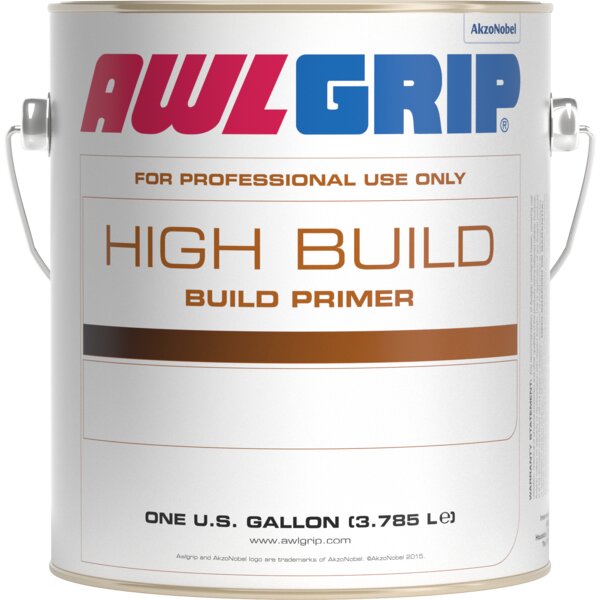
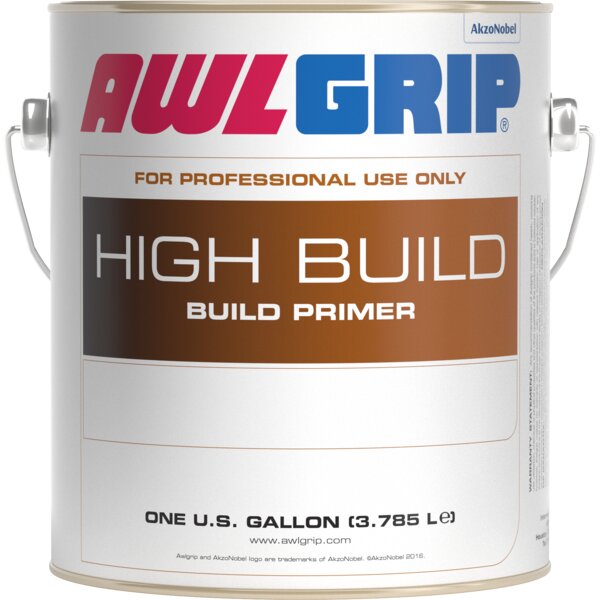
High Build Epoxy Primer Off White Converter by Awlgrip is a high-build, two-component epoxy polyamide surfacer designed for applications where substantial filling and surface levelling are required. Used in combination with the off white base D8002 and converter D3002, it creates a robust epoxy undercoat that can be sanded and overcoated with compatible Awlgrip primers and fairing compounds. It is intended for use above the waterline only.
This system delivers high film build per coat, excellent filling power and controlled recoat times, making it suitable for professional applications on properly prepared wood, gelcoat and fiberglass substrates, particularly as a surfacer over other Awlgrip primers and fairing products.
Main features
- High-build epoxy surfacer: Two-component epoxy polyamide designed to provide 100–125 microns dry film per coat, with 2–3 coats typically required.
- For filling and levelling: Formulated for use where significant build and filling are required prior to subsequent priming, fairing or topcoating.
- Above-waterline use: Specifically indicated as not for use below the waterline.
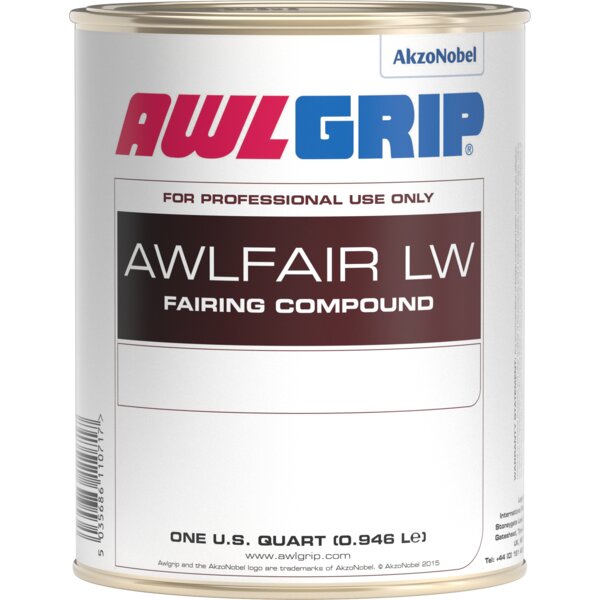
- Compatible system: Can be overcoated with Awlgrip 545 Epoxy Primer, ULTRA BUILD, Sprayable Fairing Compound, AWL®FAIR L.W. and AWL®QUIK.
- Controlled recoat windows: Recoatable with itself after 2 hours and with other compatible products after 12–24 hours, with a maximum of 24 hours without sanding.
- Professional spray application: Designed for conventional or airless spray with pressure-feed equipment; roll-and-tip application is not recommended.
- VOC information available: VOC values are specified for both the off white base D8002 and converter D3002, including VOC-exempt classification for D3002 in North America when used with reducer T0176.
Technical specifications
Product type and packaging
- Type: Epoxy polyamide.
- System components:
- Off white base: D8002.
- Converter: D3002.
- Optional yellow base: D9002 (system alternative).
- Packaging: Available in 3.78 L and 0.95 L containers.
COVERAGE AND FILM THICKNESS
- Theoretical coverage:
- 75.6 m² per mixed gallon at 25 microns (1 mil) dry film thickness.
- 10–15 m² at the recommended dry film thickness with two coats.
- Calculated for mixed base and converter reduced 20%.
- Recommended wet film thickness: 200–250 microns (8–10 mils) per coat.
- Recommended dry film thickness: 100–125 microns (4–5 mils) per coat; 2–3 coats may be required.
- Coverage notes: Calculations are based on a theoretical transfer efficiency of 100%. Actual coverage will vary with equipment, technique, part size and environment.
Recoatability and overcoating
- Recoat with itself: After 2 hours.
- Recoat with other products: After 12–24 hours.
- Maximum without sanding: 24 hours.
- Surface preparation between systems: Sanding is recommended before overcoating with other products.
- Compatible overcoats: 545 Epoxy Primer, ULTRA BUILD, Sprayable Fairing Compound, AWL®FAIR L.W., AWL®QUIK.
VOC data
- White base (D8002): 347 g/L (2.9 lbs/gal).
- Yellow base (D9002): 338 g/L (2.8 lbs/gal).
- Converter (D3002): 361 g/L (3 lbs/gal).
- Converter (D3002, North America only): 331 g/L (2.8 lbs/gal). In North America D3002 is classed as a VOC Exempt Converter; when used with reducer T0176 the mixed, ready-to-apply material has a VOC content of less than 340 g/L (2.8 lbs/gal).
Mixing, induction and reduction
- Mixing ratio (by volume): 1 part base (e.g. D8002) to 1 part converter (D3002), mixed to a smooth, homogeneous blend.
- Induction time after mixing: 15 minutes.
- Reduction: Reduce 10–20% with the appropriate reducer.
- Standard reducer for epoxy primers: T0006.
- Medium evaporating VOC exempt reducer (North America only): T0176.
- Example: 1 L base : 1 L D3002 : 0.4 L T0176.
- Anticipated pot life: 8 hours at 25°C (77°F) and 50% relative humidity. Higher temperatures may shorten pot life.
Application conditions
- Application method: Conventional spray or airless spray with pressure-feed equipment.
- Recommended temperature range for application:
- Do not apply to surfaces warmer than 41°C (105°F) or colder than 13°C (55°F).
- Do not attempt to cure products at temperatures below 13°C (55°F).
- Do not apply to surfaces less than 3°C (5°F) above dew point.
- Roll-and-tip: Not recommended.
Spray equipment
Conventional and HVLP spray (pressure pot system)
- Pressure pot system guns (Binks or equivalent):
- Spray gun: #95.
- Fluid nozzle: #68SS (0.110" orifice).
- Fluid needle: #668.
- Air nozzle: #68PB.
- Pressure pot gauge: 15–25 psi, set to deliver 16–20 oz (47–59 cl) product per minute.
- Atomizing pressure: 50+ lbs (> 22.7 kg).
- HVLP guns (SATAJET K3 HVLP or equivalent):
- Gun pressure: 35 psi.
- Fluid needle/nozzle: 1.6–2.0 mm.
Airless equipment
- Spray gun: Airless 1 (Binks or equivalent).
- Tip orifice size: 0.028"–0.043".
- Fan size and angle: 8" – 80°, or 6" – 60°.
- Typical pump pressures:
- 25:1 pump – 70–80 psi at the pump inlet.
- 40:1 pump – 50–60 psi at the pump inlet.
Equipment cleaning
- Recommended cleaners: Acetone, T0006, T0176, T0002 reducers or M.E.K.
Applications and use cases
- High-build surfacer over Awlgrip systems: Optimised for use as a surfacer over other Awlgrip primers and fairing compounds, providing a smooth, high-build base for subsequent coatings.
- Wood substrates: May be applied directly to properly prepared wood, finely sanded with P80–P100 grit paper, though best results are obtained when the surface is first sealed with 545 Primer.
- Gelcoat and fiberglass: Suitable for properly prepared gelcoat and fiberglass sanded with 100–150 grit (P100–P150) paper, ideally sealed with 545 Primer beforehand.
- Professional marine and industrial finishing: Intended for professional application where controlled film build, filling and compatibility with Awlgrip fairing and priming systems are required.
Surface preparation
- Best practice: Use as a surfacer over other Awlgrip primers and fairing compounds.
- Direct-to-substrate (where permitted):
- Gelcoat/fiberglass: Sand with 100–150 grit paper.
- Wood: Smooth sand with 80–100 grit paper.
- Sealing for optimum results: Best results are obtained when wood and fiberglass substrates are first sealed with 545 Primer.
Application instructions
- Spray even coats at 200–250 microns (8–10 mils) wet film thickness to achieve 100–125 microns (4–5 mils) dry film thickness.
- Apply 2–3 coats as required to achieve the desired build and surface profile.
- Respect minimum and maximum recoat times between coats and before overcoating with other products.
- Do not apply when substrate temperature is outside 13–41°C (55–105°F), or when the surface is less than 3°C (5°F) above dew point.
- Do not attempt to cure the coating at temperatures below 13°C (55°F).
- Roll-and-tip application is not recommended.
FAQ
-
Can High Build Epoxy Primer Off White be used below the waterline?
No. The product is specifically indicated as not to be used below the waterline.
-
What is the correct mixing ratio for the off white base and converter?
Mix 1 part off white base (D8002) with 1 part converter (D3002) by volume, then allow a 15-minute induction time.
-
How much thinner should be added?
Reduce the mixed material 10–20% with the appropriate reducer, such as T0006 or, in North America, VOC exempt reducer T0176.
-
What is the pot life of the mixed product?
The anticipated pot life is 8 hours at 25°C (77°F) and 50% relative humidity. Higher temperatures will shorten pot life.
-
How soon can I recoat High Build Epoxy Primer with itself?
It can be recoated with itself after approximately 2 hours.
-
How long can I wait before sanding or overcoating with other products?
When overcoating with other products, wait 12–24 hours. A maximum of 24 hours is allowed without sanding; sanding is recommended before applying other products.
-
Which substrates are suitable?
It is best used as a surfacer over Awlgrip primers and fairing compounds, and may also be applied to properly prepared wood or fiberglass/gelcoat, preferably sealed first with 545 Primer.
-
Is roll-and-tip application acceptable?
No. The product is not recommended for roll-and-tip application and is intended for spray application only.
-
What is the recommended film build per coat?
Apply 200–250 microns wet to achieve 100–125 microns dry per coat; usually 2–3 coats are required.
-
What cleaners should be used for equipment?
Clean application equipment with acetone, or reducers T0006, T0176, T0002, or M.E.K.
Section 14 – Transport information
- UN number: UN1263.
- UN proper shipping name: PINTURAS (PAINTS).
- Transport hazard class: Class 3 (flammable liquids) for ADR/RID, IMDG and IATA.
- Packing group: II.
- Environmental hazards: Not classified as environmentally hazardous for transport (ADR/RID, IMDG, IATA: No).
- Special provisions (ADR): 640 (C).
- Tunnel restriction code: (D/E).
- Bulk transport (MARPOL Annex II / IBC Code): Not available.
- User transport precautions: Within user premises, transport only in closed containers kept upright and secure. Ensure personnel involved in transport know what to do in case of accident or spill.
Section 8 – Personal protective measures
Exposure controls and general hygiene
- Use only with adequate ventilation. Where necessary, use local exhaust or explosion-proof ventilation systems to keep airborne concentrations below applicable exposure limits and to keep vapour levels below the lower explosion limit.
- Wash hands, forearms and face thoroughly after handling chemicals, before eating, drinking or smoking, and at the end of the work shift.
- Remove contaminated clothing and protective equipment before entering eating areas and wash contaminated garments before reuse.
- Ensure eye-wash stations and safety showers are close to the workstation.
Individual protection equipment
- Respiratory protection: Use an appropriately fitted air-purifying or air-supplied respirator conforming to approved standards if risk assessment indicates this is necessary. Selection should be based on expected exposure levels, product hazards and the reliability of the chosen respirator.
- Hand protection: Wear chemical-resistant gloves complying with EN 374 (protective gloves against chemicals and micro-organisms). Recommended glove materials include Viton or nitrile.
- For prolonged or frequently repeated contact, gloves with protection class 6 (breakthrough time > 480 minutes according to EN 374) are recommended.
- For brief contact, gloves with protection class 2 or higher (breakthrough time > 30 minutes according to EN 374) are recommended.
- Eye/face protection: Use chemical splash goggles or equivalent eye protection meeting approved standards whenever there is a risk of liquid splashes, mists, gases or dusts.
- Skin and body protection: Select protective clothing based on the specific task and risks, approved by a specialist. Where there is a risk of ignition due to electrostatic charges, wear antistatic protective clothing, including coveralls, boots and gloves with antistatic properties, in line with EN 1149 requirements.
- Additional skin protection: Select appropriate footwear and any additional skin protection required by the task and associated risks.
Environmental exposure control
- Check emissions from ventilation or process equipment to ensure compliance with environmental protection legislation. Where necessary, use fume scrubbers, filters or modify the process equipment to reduce emissions.
*Contenido generado por IA