What is ALEXSEAL HS Clear Coat Gloss and why choose it?
ALEXSEAL HS Clear Coat Gloss (H0150) is a high solids, two-component polyurethane clearcoat designed for use over ALEXSEAL HS Base Coat in base coat/clear coat systems. Developed specifically for yacht applications, it delivers an extreme high-gloss, wet-look finish with excellent gloss and color stability, even under harsh climatic conditions. Its special properties reduce cleaning and maintenance requirements and help preserve the appearance and value of the vessel.
Main features
- High solids, two-component polyurethane clearcoat for professional use.
- Extreme high-gloss “wet-look” appearance suitable for premium yacht finishes.
- Designed as a clear topcoat over ALEXSEAL HS Base Coat in spray applications.
- Excellent gloss retention and color stability under extreme climatic conditions.
- Very good resistance to UV exposure, salt water, abrasion and fuel (according to Spanish technical sheet).
- Reduces cleaning and maintenance effort while supporting long-term value retention.
- For interior or exterior areas not subject to permanent water immersion.
- Clear color, optimized for high depth and distinction of image.
Technical specifications
Product and mixing
- Product type: HS clear polyurethane topcoat.
- System components (trade names):
- H0150 ALEXSEAL HS Clear Coat – base, 1 gal.
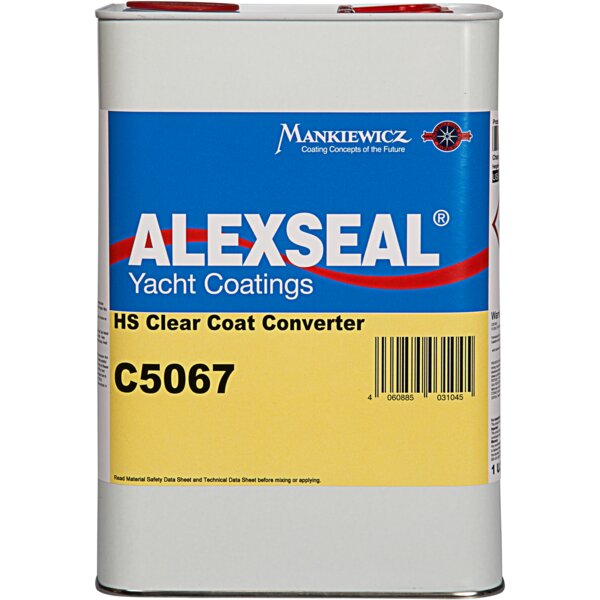
- C5067 ALEXSEAL HS Clear Coat Converter – 1 gal.
- R5561 ALEXSEAL HS Clear Coat Activator Medium – 1 gal.
- R5531 ALEXSEAL HS Clear Coat Activator Slow – 1 gal.
- Mixing ratio (by volume): 1 part H0150 : 1 part C5067 : 1 part R… Activator (Medium or Slow).
- Activated reducer: Amount of ALEXSEAL HS Clear Coat Activator is fixed and must not be changed.
- Filtration: Mixed material must be filtered through an appropriate paint filter before application.
Appearance and coverage
- Color: Clear.
- Volume solids (catalyzed, without reduction): 50%.
- Theoretical coverage (first technical sheet, 70 µm DFT / 2.8 mils):
- 7.5 m²/liter
- 28.5 m²/gal
- 313.5 sq.ft./gal
- Practical coverage at 70 µm DFT / 2.8 mils:
- Conventional air spray: 4.5 m²/l (17.1 m²/gal; 188 sq.ft./gal)
- HVLP air spray: 5.7 m²/l (21.4 m²/gal; 235 sq.ft./gal)
- Theoretical coverage (second Spanish sheet, 35 µm DFT / 1.4 mils):
- 15 m²/liter
- 57 m²/gal
- 627 sq.ft./gal
- Practical coverage at 35 µm DFT / 1.4 mils:
- Conventional air spray: 9 m²/l (34.2 m²/gal; 376 sq.ft./gal)
- HVLP air spray: 11.3 m²/l (42.8 m²/gal; 470 sq.ft./gal)
Viscosity and application parameters
- Application viscosity (clear coat):
- Zahn #2: approx. 19–21 s
- DIN 4 cup, 4 mm: approx. 15–17 s
- ISO 3: approx. 45 s
- Recommended spray equipment:
- Gravity gun nozzle: 1.0–1.3 mm (0.040–0.051 in) – Conventional & HVLP.
- Siphon cup nozzle: 1.0–1.3 mm (0.040–0.051 in) – Conventional & HVLP.
- Pressure pot fluid nozzle: 0.8–1.0 mm (0.032–0.040 in) – Conventional & HVLP.
- Atomizing pressure: 2.5–4.0 bar (40–60 psi) – Conventional & HVLP.
- Pot pressure: 0.5–1.2 bar (7–16 psi) – Conventional & HVLP.
Film thickness and spray process
- System design: Part of a base coat/clear coat system over ALEXSEAL HS Base Coat.
- Number of clear coats: 2 cross coats to seal the base coat.
- Wet film thickness (per cross coat): 80–100 µm (3–4 mils).
- Flash-off time between cross coats: 30 minutes to 4 hours.
- Resulting dry film thickness: 60–100 µm (2.4–4 mils) in two cross coats.
- Second application: Use freshly prepared material.
Pot life and drying times
Optimal application environment: 15–30 °C (60–85 °F), 40–80% RH; minimum during drying 15 °C (60 °F); ideal 25 °C (77 °F).
| Substrate temperature |
15 °C (60 °F) |
20 °C (68 °F) |
25 °C (77 °F) |
30 °C (85 °F) |
| Pot life (approx.) |
3 h |
2.5 h |
2 h |
1.5 h |
| Dust free |
3 h |
3 h |
2 h |
2 h |
| Tape dry / sandable (Spanish sheet) |
36 h |
30 h |
24 h |
16 h |
| Fully cured |
10 days |
7 days |
7 days |
7 days |
| Recoat with additional HS Clear Coat (after tack-free) |
90 min |
60 min |
60 min |
45 min |
Maximum recoat window (Spanish sheet): 3 days.
Note: Actual times are influenced by surface temperature, air flow, direct or indirect sunlight, solvent quantity/type and film thickness. Minimum application conditions should be at least 3 °C (5.4 °F) above dew point.
Physical properties (from Safety Data Sheet)
- Physical state: Liquid (20–25 °C, 1,013 hPa).
- Odour: Characteristic.
- Boiling range: approx. 120 °C.
- Flash point: 27 °C (ISO 13736).
- Upper explosion limit: 10% (v/v).
- Lower explosion limit: 1% (v/v).
- pH (10%): 3–4 (20 °C).
- Kinematic viscosity: > 21 mm²/s.
- Water solubility: Insoluble; immiscible with water.
- Density: approx. 1.05 g/cm³ (20 °C).
- VOC content: 41.73% (438 g/l) according to Directive 2010/75/EU.
Applications and use cases
- Yacht topsides and superstructures: High-gloss clear finish over ALEXSEAL HS Base Coat for a premium, wet-look appearance.
- Marine exterior areas above the waterline: Areas exposed to UV, salt, fuel and abrasion, but not in permanent immersion.
- Interior yacht surfaces: Clear, high-gloss protective coat over colored HS Base Coat where a durable, easy-to-clean finish is required.
- Refinishing and restoration: To restore gloss and protection on previously coated yacht surfaces prepared and base-coated with ALEXSEAL HS Base Coat.
FAQ
1. What type of product is HS Clear Coat Gloss?
It is a professional-use, high solids, two-component polyurethane clearcoat designed as the clear layer in a base coat/clear coat system over ALEXSEAL HS Base Coat.
2. Can it be used below the waterline or in permanent immersion?
No. It is suitable for interior and exterior areas that are not subject to permanent water immersion.
3. What is the recommended mixing ratio?
Mix 1:1:1 by volume – one part H0150 HS Clear Coat base, one part C5067 Converter and one part selected HS Clear Activator (Medium or Slow). The activator amount is fixed and cannot be changed.
4. How many coats should I apply and what film thickness is recommended?
Apply 2 cross coats over the dried ALEXSEAL HS Base Coat. Each cross coat should have a wet film thickness of 80–100 µm, resulting in a total dry film thickness of approximately 60–100 µm after two cross coats.
5. What is the pot life of the mixed product?
Depending on temperature, pot life is approximately 3 h at 15 °C, 2.5 h at 20 °C, 2 h at 25 °C and 1.5 h at 30 °C.
6. When can the coated surface be sanded or taped?
At 25 °C (77 °F), the coating is typically tape-dry and sandable after about 24 hours. Lower temperatures extend these times and higher temperatures shorten them.
7. What spray equipment and settings are recommended?
Use conventional or HVLP spray equipment with 1.0–1.3 mm nozzles (0.040–0.051 in) for gravity and siphon guns, or 0.8–1.0 mm (0.032–0.040 in) for pressure pots. Atomizing pressure should be 2.5–4.0 bar (40–60 psi) with pot pressure at 0.5–1.2 bar (7–16 psi).
8. What environmental conditions are required for application?
Apply between 15 °C and 30 °C (60–85 °F) with 40–80% relative humidity. Maintain at least 3 °C (5.4 °F) above the dew point and keep the temperature above 15 °C (60 °F) during drying.
9. How long should I wait between cross coats?
Allow a flash-off time of 30 minutes to 4 hours between cross coats. Recoat after tack-up with additional HS Clear Coat after approximately 45–90 minutes depending on temperature.
10. Is HS Clear Coat Gloss flammable?
Yes. According to the Safety Data Sheet it is classified as a flammable liquid, Category 3 (H226), with a flash point of 27 °C. Keep away from heat, sparks, open flames and other ignition sources and follow all safety recommendations.
Section 14 – Transport information
- UN number / ID number: UN 1263.
- UN proper shipping name: PAINT.
- Transport hazard class: Class 3 (flammable liquids) for ADR, IMDG and IATA.
- Packing group: III.
- ADR specific data:
- Classification code: F1.
- Hazard identification number: 30.
- Labels: 3.
- Tunnel restriction code: (D/E).
- Remark: When transported within the user’s premises, keep containers closed, upright and secure; personnel must know the emergency and spill procedures.
- IMDG specific data:
- Labels: 3.
- EmS code: F-E, S-E.
- Marine pollutant: No.
- IATA specific data:
- Cargo aircraft: Packing instruction 366, Packing group III, label “Flammable Liquids”.
- Passenger aircraft: Packing instruction 355, Limited Quantities Y344, Packing group III, label “Flammable Liquids”.
- Environmental hazards: Not classified as environmentally hazardous for transport under ADR or as a marine pollutant under IMDG.
- Bulk transport (IMO instruments): Not applicable for product as supplied.
Section 8 – Personal protective measures
The following information is taken from the Safety Data Sheet (Section 8 – Exposure controls/personal protection) and must be observed during handling and application.
Engineering controls
- Provide adequate ventilation through local exhaust and general extraction to keep solvent vapour and aerosol concentrations below occupational exposure limits.
- If ventilation is insufficient, suitable respiratory protection must be used.
Eye and face protection
- Wear safety goggles providing protection against solvent splashes.
Hand protection
- Use chemical-resistant protective gloves tested according to EN 374.
- Recommended materials for short-term contact (splash protection):
- Nitrile rubber.
- Neoprene.
- Minimum glove thickness: > 0.4 mm.
- Breakthrough time: > 480 minutes.
- Before use, verify glove suitability for the specific workstation (mechanical resistance, product compatibility, antistatic properties).
- Follow manufacturer instructions for use, storage, care and replacement of gloves; replace immediately when damaged or worn.
- Use preventive skin protection (protective cream) and wash contaminated skin immediately.
Skin and body protection
- Wear suitable protective clothing adapted to the likelihood of explosive atmospheres and solvent exposure.
Respiratory protection
- If solvent vapour concentrations exceed limit values, wear an approved breathing apparatus.
- Use a half-mask with appropriate cartridge or an air-fed respirator.
- During spraying in booths where ventilation cannot reliably keep concentrations below limits, operators should use compressed air-fed respirators until particulate and vapour levels are below exposure limits.
- Dry grinding, torch cutting and welding of coated surfaces can generate hazardous dusts and vapours; where possible, use wet methods and effective local exhaust ventilation or appropriate respiratory protection.
General protective measures
- Do not eat, drink or smoke while using the product.
- Avoid contact with skin, eyes and clothing.
- Avoid inhalation of sanding dust, particulates and spray mist during application.
*Contenido generado por IA