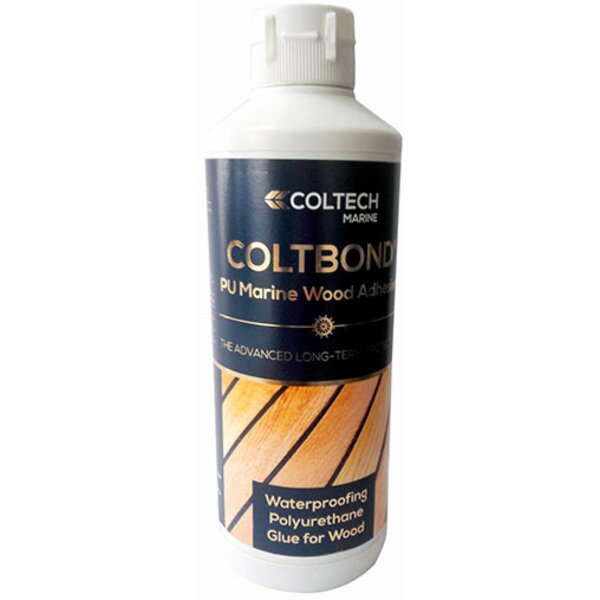
What is COLTECH COLTBOND Polyurethane Marine Glue and why choose it?
COLTECH COLTBOND Polyurethane Marine Glue is a single-component, solvent-free, marine-grade polyurethane adhesive designed primarily for wood-to-wood bonding in marine and exterior applications. It is hard-elastic and foaming, offering excellent elasticity, impact and vibration resistance, long-term durability and strong chemical resistance with minimum shrinkage. The adhesive cures by reaction (cross-linking) with surface and air moisture and can be applied manually or with airless spray equipment.
Thanks to its fast cold-curing behavior, resistance to fresh and salt water, and reliability proven for over 20 years, COLTBOND is a professional solution for demanding boatbuilding, outdoor woodwork and sandwich panel production.
Main features
- Single-component system: Ready to use, no mixing required.
- Solvent-free formulation: Polyurethane resin prepolymer without solvents.
- Foaming adhesive: Expands in the joint, helping to fill gaps.
- Cold and quick curing: Cures at ambient temperature; open time 30–45 minutes, press removal after 1–2 hours (20 °C, 50 % RH).
- High impact strength and vibration resistance: Suitable for dynamic loads in marine and exterior environments.
- Moisture and water resistant: Stable in water and domestic moisture exposure.
- Salt water resistant: Designed for marine environments and coastal applications.
- Chemical resistant: Stable in contact with domestic detergents, diesel oil and selected dilute chemicals.
- Elastic but hard bond line: Combines hardness (>80 Shore A) with elasticity for long-term performance.
- Minimal shrinkage: Dimensional stability after curing.
- Easy application: Can be applied by trowel, roller, brush or airless spray; supplied in practical packaging.
- Proven performance: More than 20 years of positive feedback worldwide.
- Professional-use adhesive: Intended for industrial and professional applications.
Technical specifications
General data
- Chemical base: Polyurethane resin prepolymer, solvent free.
- Physical state: Dense liquid.
- Color: Transparent–yellowish / yellowish.
- Odor: Odourless.
- Relative density at 20 °C: 1.14.
Mechanical and curing properties
- Hardness (Shore A): > 80 (ASTM D 2240).
- Solids content: 100 % (calculated).
- Temperature strength (fully cured): 120 °C (in-house lab).
- Low temperature brittleness (fully cured): -40 °C (in-house lab).
- Open time*: 30–45 minutes (20 °C, 50 % RH).
- Removal time from press*: 1–2 hours (20 °C, 50 % RH).
- Final curing time: 7 days.
*Values depend on conditions such as temperature, humidity, substrate and adhesive quantity.
Chemical resistance
According to the technical data sheet, COLTECH COLTBOND is classified as stable (+) in contact with:
- Water
- Salt water 20 %
- Potassium hydroxide 5 %
- Hydrochloric acid 5 %
- Domestic detergents
- Diesel oil
Legend: + stable, - unstable, ± stable for a short period.
Consumption
- Typical coverage: 0.050–0.200 kg/m² depending on the materials being bonded and the application method.
Storage
- Storage temperature: 5–35 °C.
- Maximum storage time: Up to 9 months in original, unopened containers.
- Conditions: Store in dry, cool rooms; protect from moisture and direct sunlight.
Applications and use cases
Marine and exterior wood bonding
- Wooden elements on boats and ships.
- Wooden garden furniture.
- Wooden pergolas.
The product is specifically developed for wood-to-wood adhesion in marine and outdoor environments where high humidity, water and vibration resistance are required.
Sandwich panels and insulation elements
COLTECH COLTBOND is used as a fast-setting adhesive for the production of sandwich elements and panels using:
- Aluminum
- Steel
- Wood
- Expanded and extruded polystyrene (EPS and XPS)
- Polyisocyanurate (PIR)
- Mineral wool
- Honeycomb cores
It is suitable for refrigerator panels and panels for exterior applications, including seaside locations and other areas with high humidity.
Application guidelines (summary)
- Ensure all substrates are clean, free of dust, oils, grease, release agents and other contaminants.
- Maximum surface moisture content should not exceed 4 %.
- Stir COLTBOND well before use; product temperature during application should be above 18 °C.
- Apply the adhesive to one surface using a trowel, brush, roller or spray equipment.
- Spray clean water onto the opposite surface, then bring both surfaces together and press.
- Place the assembly in a hydraulic or heated press to cure. Using a heated press at approximately 40–45 °C can accelerate curing and reduce removal time.
- Curing is based on reaction with surface and air moisture.
For any missing application detail: Consultar ficha técnica del fabricante.
FAQ – Frequently Asked Questions
1. Is COLTECH COLTBOND a one- or two-component adhesive?
It is a single-component polyurethane adhesive; no mixing of components is required.
2. Is the product solvent free?
Yes. The composition is a solvent-free polyurethane resin prepolymer.
3. What is the typical open time and press time?
At 20 °C and 50 % relative humidity, the open time is approximately 30–45 minutes, and the removal time from the press is 1–2 hours.
4. When does the adhesive reach full strength?
Final curing is achieved after about 7 days under standard conditions.
5. Which materials can be bonded with COLTBOND?
It is specialized for wood-to-wood bonding in marine and exterior applications and is also used to bond aluminum, steel, wood, EPS, XPS, PIR, mineral wool and honeycomb in sandwich panels.
6. Is it suitable for marine and coastal environments?
Yes. It is marine-grade, moisture- and water-resistant, and resistant to 20 % salt water, making it suitable for boats, coastal structures and high-humidity locations.
7. What is the appearance of the cured adhesive line?
The product is supplied transparent–yellowish and forms a hard-elastic, foaming bond line.
8. How should the product be stored?
Store in original, unopened containers in dry, cool rooms at 5–35 °C, protected from moisture and direct sunlight. Maximum recommended storage time is 9 months.
9. Is COLTBOND regulated as a dangerous good for transport?
No. According to the safety data sheet, this product is not regulated for transport (ADR/RID, IMDG, IATA).
10. Is COLTBOND intended for professional or DIY use?
It is specified for professional use only.
Section 14 – Transport information
According to the safety data sheet, COLTECH COLTBOND is not regulated for transport under the main international regulations:
- ADR/RID (road and rail)
- IMDG (sea)
- IATA (air)
No special transport classification is assigned under these systems.
Section 8 – Individual protection measures
The safety data sheet specifies the following personal protective equipment (PPE) and measures for professional users. Selection of PPE should follow local regulations and risk assessment.
General hygiene measures
- Use only outdoors or in well-ventilated areas.
- Do not eat or drink during handling; wash hands afterwards with suitable cleaning products.
- Keep containers tightly closed and maintain order and cleanliness in the work area.
Respiratory protection
- Use a filter mask for gases and vapours (in accordance with EN 405:2001+A1:2009) when needed.
- Replace the mask when taste or smell of the contaminant is detected inside the mask.
- Where additional warnings or high exposure are possible, isolation equipment is recommended.
Hand protection
- Wear non-disposable chemical protective gloves compliant with EN 374-1:2003, EN 374-3:2003/AC:2006 and EN 420:2003+A1:2009.
- The breakthrough time specified by the glove manufacturer must exceed the expected contact time.
- Do not apply protective creams after the product has come into contact with the skin.
Eye and face protection
- Use a face mask / eye protection according to EN 166:2001 and related standards where splashing risk exists.
- Clean daily and disinfect periodically following the manufacturer’s instructions.
Body and foot protection
- Wear disposable clothing for protection against chemical risks in line with EN 13034:2005+A1:2009 and related standards.
- Use safety footwear for protection against chemical risk according to EN ISO 20345:2011 and EN 13832-1:2006; replace at any sign of deterioration.
Emergency equipment
- Provide emergency showers (ANSI Z358-1, ISO 3864-1:2002) and eyewash stations (DIN 12 899, ISO 3864-1:2002) in areas where the product is handled.
For any missing safety detail: Consultar ficha técnica del fabricante.
Contenido generado por IA