What it is and why choose it
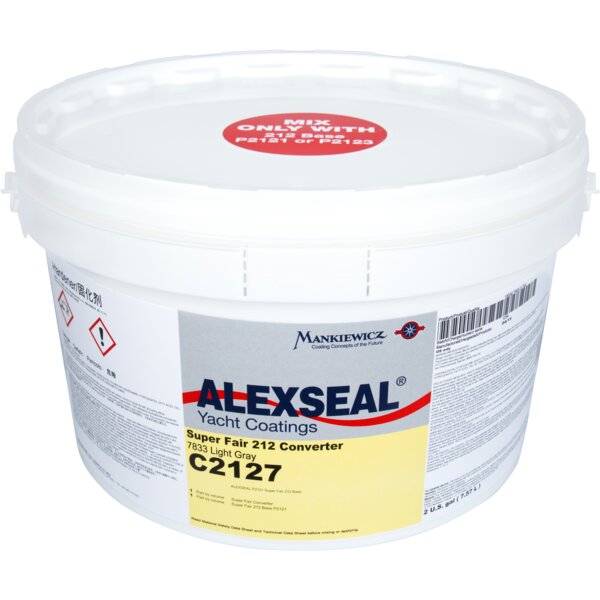
ALEXSEAL Fairing Compound 242 is a solvent-free, epoxy-based, light-weight filler designed for professional yacht fairing and filling work. When mixed at the specified ratio of base (P2420) and converter (C2427 or C2425), it offers excellent application, sanding and anti-sagging properties. The cured film creates an ideal surface for overcoating with other ALEXSEAL Yacht Coating products, both above and below the waterline (when correctly sealed).
Its 100% volume solids formulation, easy trowel application and very good sanding behavior make it suitable for high-quality, large-area fairing as well as localized repairs on properly prepared metal and GRP substrates.
Main features
- Epoxy-based, solvent-free filler: Designed as a light-weight fairing compound with 100% volume solids once catalyzed.
- Professional yacht applications: Intended for industrial serial painting and professional use only.
- Above and below waterline use: Can be applied on surfaces above and below the waterline; below the waterline it must be sealed with ALEXSEAL Finish Primer 442.
- Excellent workability: Easy to mix and apply by spatula or trowel; designed to minimize sagging on vertical surfaces.
- Good sanding properties: Block sandable with 36–120 grit; finishing with 80 grit or finer helps prevent sand-scratch print-through in the final coating system.
- Controlled mixing: Base and converters are supplied in different colors; a homogeneous green-gray mix visually confirms thorough mixing.
- Versatile substrate compatibility: For correctly prepared metal substrates primed with ALEXSEAL Protective Primer 161, and GRP substrates primed with ALEXSEAL Super Build 302, Finish Primer 442, or Protective Primer 161.
- Pot life and drying tuned to temperature: Defined pot life and dry-to-sand times depending on ambient temperature when using the standard converter.
- Hazard classification: Causes skin irritation and serious eye irritation, may cause an allergic skin reaction, and is toxic to aquatic life with long-lasting effects.
Technical specifications
Product identity and components
- Commercial product name: ALEXSEAL Fairing Compound 242
- Base: P2420 ALEXSEAL Fairing Compound 242 Base (Light Ivory)
- Standard converter: C2427 ALEXSEAL Fairing Compound 242 Converter (Green)
- Fast converter: C2425 ALEXSEAL Fairing Compound 242 Converter Fast (Red)
- Packaging (typical): ½ Gal, 2 Gal for base and converters
- Use: Industrial serial painting; professional use only
Colors
- Color of mixture (base + converter): Green-gray
- Standard base: Light ivory
- Standard converter: Green
- Fast converter: Red
Mixing and formulation
- Mixing ratio by volume: 1 : 1 (Base : Converter)
- Mixing ratio by weight: 10 : 6 (Base : Converter)
- Reduction: Must not be reduced; solvent-free system.
- Volume solids (catalyzed, without reduction): 100 %
Coverage (mixed product)
Coverage depends on the depth of filling and size of the surface to be faired.
- Theoretical coverage: 1 m²/l (3.8 m²/gal; 41 sq. ft./gal) at 1 mm dry film thickness.
- Practical coverage at average thickness:
- Approx. 0.15 m²/l (0.6 m²/gal; 6.4 sq. ft./gal) at 6 mm.
- Approx. 0.11 m²/l (0.44 m²/gal; 4.8 sq. ft./gal) at 8 mm.
- Approx. 0.07 m²/l (0.29 m²/gal; 3.2 sq. ft./gal) at 10 mm.
- Coverage values are calculated for the mixed base and converter.
Application parameters
- Recommended application tools: Trowels, spatulas, straight-edge materials.
- Optimal ambient conditions: 15–30 °C (60–85 °F) and 40–80 % relative humidity.
Pot life and drying (with C2427 standard converter)
- Pot life:
- 15 °C (60 °F): 1 hour
- 20 °C (68 °F): 50 minutes
- 25 °C (77 °F): 40 minutes
- 30 °C (85 °F): 30 minutes
- Dry to sand:
- 15 °C (60 °F): 36 hours
- 20 °C (68 °F): 24 hours
- 25 °C (77 °F): 18 hours
- 30 °C (85 °F): 12 hours
- Use Fast Converter below 15 °C. Do not use below 10 °C (50 °F) or above 40 °C (104 °F).
Substrate preparation
- General: Substrate must be clean, dry and free from dust, grease, oil and other contamination.
- Mechanical profiling: Grind and/or blast with 36–60 grit before priming to ensure system adhesion.
- Full fairing systems: heavily abraded substrate required.
- Thin fairing systems (< 3 mm): less aggressive profile sufficient.
- Metal substrates: Prime with ALEXSEAL Protective Primer 161. Fairing Compound 242 may be applied directly over this primer without sanding for up to 6 months.
- GRP substrates: Use ALEXSEAL Super Build 302, Finish Primer 442 or Protective Primer 161 over a properly prepared surface. All ALEXSEAL Primers (except 161) should be sanded with 60–80 grit after overnight dry before applying Fairing Compound 242.
Surface finishing and overcoating
- Sanding of Fairing Compound 242: Block sand with 36–120 grit. Finishing with 80 grit or finer helps prevent sand-scratch print-through in the final coating system.
- Recoating Fairing Compound 242 over itself: Follow minimum dry-to-sand times and scratch sand with 36–60 grit to ensure adhesion between layers.
- Overcoating with other products: Products including ALEXSEAL 302, 303, 328 and 442 may be applied after the minimum time and after block sanding the surface with 36–120 grit.
Selected physical and chemical properties (base)
- Physical state: Solid at 20–25 °C, 1,013 hPa.
- Odor: Characteristic.
- Boiling range: Approx. 120 °C.
- Flash point: 101 °C (ISO 13736).
- pH (10 % dispersion at 20 °C): 6–8.
- Water solubility: Insoluble; immiscible with water.
- Density: Approx. 1.1 g/cm³ at 20 °C.
- VOC content: < 0.01 %, < 0.1 g/l.
Applications and use cases
- Yacht hull fairing: Large-area fairing on metal or GRP hulls where a light-weight, easily sandable epoxy filler is required.
- Above-waterline repairs: Localized filling and surface correction before applying ALEXSEAL primers and topcoats.
- Below-waterline fairing: Fairing areas below the waterline, followed by sealing with ALEXSEAL Finish Primer 442.
- Superstructure and deck smoothing: Creating fair, smooth surfaces on superstructures and decks that will receive high-gloss yacht coatings.
- Multi-layer fairing systems: Building up thickness in several passes, with sanding between coats, to correct larger irregularities.
FAQ
-
Can ALEXSEAL Fairing Compound 242 be used below the waterline?
Yes. It can be used above and below the waterline. When used below the waterline, the fairing compound must be sealed with ALEXSEAL Finish Primer 442.
-
What is the correct mixing ratio for base and converter?
The mixing ratio is 1:1 by volume (base:converter) or 10:6 by weight. The product must not be reduced with solvent.
-
How do I know the base and converter are thoroughly mixed?
The base and converter are supplied in different colors. After proper mixing, the resulting filler should have a homogeneous color with no visible streaks.
-
What tools are recommended for application?
Apply with trowels, spatulas or straight-edge materials. The product should be applied in thin layers and built up to the desired thickness, avoiding air pockets.
-
What sanding grits should be used?
For Fairing Compound 242 itself, block sand with 36–120 grit. Finishing with 80 grit or finer helps prevent sand-scratch print-through in the final finish.
-
How long is the pot life?
Pot life with the standard converter C2427 is about 1 hour at 15 °C, 50 minutes at 20 °C, 40 minutes at 25 °C and 30 minutes at 30 °C.
-
When can I sand the fairing compound?
Dry-to-sand times with C2427 are approximately 36 hours at 15 °C, 24 hours at 20 °C, 18 hours at 25 °C and 12 hours at 30 °C.
-
On which primers can I apply Fairing Compound 242?
On metal substrates, apply over ALEXSEAL Protective Primer 161 (without sanding for up to 6 months). On GRP substrates, apply over ALEXSEAL Super Build 302, Finish Primer 442 or Protective Primer 161 after proper surface preparation and sanding where specified.
-
Is this product suitable for DIY use?
No. The documentation specifies “Professional Use Only” and the product is intended for industrial serial painting and professional applicators.
-
How should I clean application tools?
Clean equipment with R4042 ALEXSEAL Epoxy Primer Reducer after use.
Section 14 – Transport information
The following transport data refer to ALEXSEAL P2420 Fairing Compound 242 Base as supplied.
- UN number / ID number: UN 3077
- UN proper shipping name (ADR/IMDG/IATA): Environmentally hazardous substance, solid, n.o.s. (Paint)
- Transport hazard class: Class 9 (miscellaneous dangerous substances and articles)
- Packing group: III
- ADR classification code: M7
- ADR hazard identification number: 90
- Labels: 9 (Miscellaneous dangerous goods)
- IMDG EmS code: F-A, S-F
- Environmental hazards:
- ADR: Environmentally hazardous – yes
- IMDG: Marine pollutant – yes
- IATA (passenger and cargo): Environmentally hazardous – yes
- Maritime transport in bulk according to IMO instruments: Not applicable for the product as supplied.
- The transport classifications above are based on the properties of the unpackaged material described in the safety data sheet. Classifications may vary depending on mode of transport, packaging and regional regulations.
Section 8 – Personal protective measures
The following personal protection guidance is based on the safety data for ALEXSEAL P2420 Fairing Compound 242 Base.
Engineering controls
- Provide adequate ventilation using local exhaust and good general extraction.
Eye and face protection
- Wear safety goggles to protect against splashes.
Hand protection
- Use chemical-resistant protective gloves tested in compliance with EN 374.
- Recommended materials for short-term contact (splash protection): nitrile rubber or neoprene.
- Minimum material thickness: > 0.4 mm.
- Minimum breakthrough time: > 480 minutes.
- Check gloves for suitability at the workplace and replace immediately if damaged or worn.
- Wash contaminated skin immediately; use preventive skin protection cream as appropriate.
Skin and body protection
- Wear work clothing as usual in the chemical industry.
- Wash skin thoroughly after contact.
Respiratory protection
- Normally not required, but avoid breathing vapors where possible.
- Avoid inhalation of dust from sanding, particulates and spray mist arising from application.
General protective measures
- Do not eat, drink or smoke while working with the product.
- Avoid contact with skin, eyes and clothing.
Contenido generado por IA