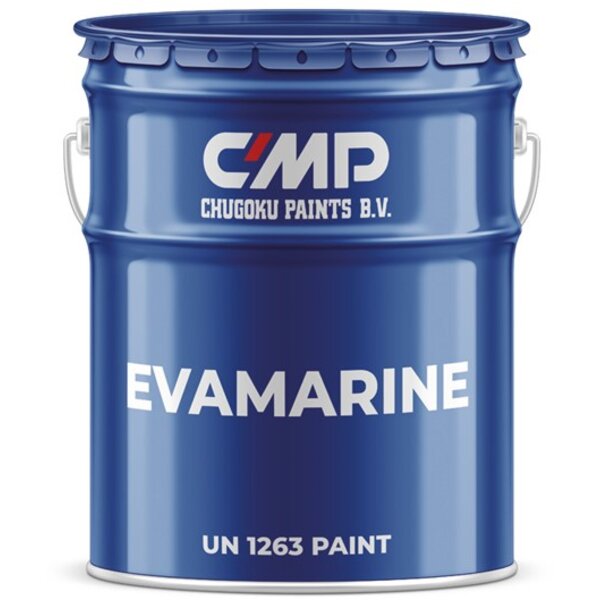
What is EVAMARINE and why choose it
EVAMARINE by Chugoku is a one-pack alkyd resin finish paint designed as a durable topcoat for exterior wood and steel surfaces. It offers excellent adhesion, good weathering resistance and colour retention, making it suitable for professional maintenance and new-build projects where long-term outdoor protection and easy application are required.
Main features
- Alkyd resin finish for robust exterior protection on wood and steel.
- Good weathering resistance, suitable for outdoor exposure.
- Excellent adhesion on recommended primed substrates.
- Good colour retention over time (may yellow in white and light colours).
- Single-component product for easier handling and application.
- Application versatility: airless spray, brush or roller.
- Usable in low temperatures down to -5 °C with controlled humidity.
- Compatible primers: typically applied over ROSWAN QD HB, BANNOH 200 and similar systems as specified by the manufacturer.
Technical specifications
- Type: Alkyd resin finish paint.
- Recommended use: Finishing coat on exterior wood and steel surfaces.
- Colour: White and other colours as specified.
- Flash point: 43 °C.
- Density: approx. 1.23 g/mL (ISO 2811).
- Volume solids (VS): 50 ± 2% (ISO 3233).
- VOC (theoretical): approx. 405–407 g/L (Method 24).
- Theoretical coverage: 0.05–0.07 L/m² (depending on film thickness).
- Recommended film thickness:
- Wet: 50–70 microns.
- Dry: 25–35 microns.
- Application methods: Airless spray, brush, roller.
- Thinner: MARINE THINNER.
- Thinning ratio: 0–7% by volume (according to application method and temperature).
- Application conditions:
- Minimum steel/wood surface temperature: -5 °C.
- Maximum relative humidity: 85% RH.
- Surface temperature at least 3 °C above dew point.
- Airless spray parameters (typical):
- Tip size: GRACO 615 or 715 (other tips such as 615–819 may also be specified).
- Paint output pressure: approx. 10.7–13.8 MPa.
- Viscosity for airless (Ford cup #4): approx. 110 s.
- Spray speed: 80–100 cm/s.
- Compatible preceding coats: ROSWAN QD HB, BANNOH 200 and other specified primers.
- Subsequent coats: Not specified.
- Packaging: One-pack product.
Drying and overcoating times (typical for 25–35 µm dry film)
Approximate values at the recommended film thickness:
- -5 °C: Set-to-touch 8 h; hard dry 70 h; minimum overcoating interval 120 h; no maximum interval specified.
- 0 °C: Set-to-touch 5 h; hard dry 48 h; minimum overcoating interval 72 h; no maximum interval specified.
- 5 °C: Set-to-touch 4 h; hard dry 30 h; minimum overcoating interval 48 h; no maximum interval specified.
- 10 °C: Set-to-touch 3 h; hard dry 16 h; minimum overcoating interval 24 h; no maximum interval specified.
- 20 °C: Set-to-touch 2 h; hard dry 8 h; minimum overcoating interval 16 h; no maximum interval specified.
- 30 °C: Set-to-touch 1.5 h; hard dry 6 h; minimum overcoating interval 12 h; no maximum interval specified.
Note: When applying by brush or roller, more coats may be required to achieve the specified dry film thickness.
Applications and use cases
- Exterior wood structures: Topcoat for doors, trims, rails and other wooden elements exposed to the weather.
- Exterior steel surfaces: Finish coat over compatible primer systems on structural steel, fabricated items and general steelwork.
- Maintenance painting: Can be applied over sound existing coatings after proper cleaning and surface preparation.
- Marine and industrial environments: For professional coating work where a durable, sprayable alkyd finish is required on external areas.
FAQ
-
On which substrates can EVAMARINE be used?
It is recommended as a finishing coat on exterior wood and steel surfaces, applied over suitable primers such as ROSWAN QD HB or BANNOH 200.
-
Can it be applied over an existing coating?
Yes. The technical information indicates that EVAMARINE can be applied over existing paint layers, provided the surface is clean, sound and properly prepared.
-
Which application methods are recommended?
Airless spray is the primary method, but brush and roller application are also allowed. When using brush or roller, additional coats may be necessary to reach the specified dry film thickness.
-
What thinner should be used?
Use MARINE THINNER, with typical thinning between 0% and 7% by volume depending on air temperature and application method.
-
What are the minimum application conditions?
The surface temperature should be at least -5 °C or higher, maximum relative humidity 85%, and at least 3 °C above the dew point.
-
How long should I wait before overcoating?
At 20 °C the minimum overcoating interval is about 16 hours; at lower temperatures, the interval is longer (up to 120 hours at -5 °C). No maximum interval is specified.
-
Is EVAMARINE a single-component or two-component paint?
It is a one-pack (single-component) alkyd finish paint.
-
Does the product have any important safety hazards?
It is classified as a flammable liquid (Category 3). Vapours may cause drowsiness or dizziness, and repeated exposure may cause skin dryness or cracking.
-
Who should apply this product?
The English technical sheet states that it should be used only by professional applicators, following the Safety Data Sheet and local regulations.
Section 14 – Transport information
- UN number / ID number: UN 1263.
- UN proper shipping name: PAINT.
- Transport hazard class: Class 3 (flammable liquid).
- Packing group: III.
- Regulations: ADR/RID/ADN, IMDG Code, IATA.
- Environmental hazards: Not classified as a marine pollutant.
- Special provisions:
- Viscosity exemption for carriage by road/rail/inland waterways up to 450 L packages (ADR/RID/ADN 2.2.3.1.5).
- Viscous substances exemption for sea transport up to 30 L packages (IMDG 2.3.2.5).
- Viscosity exemption does not apply to air transport.
- EmS (sea transport): F-E, S-E.
- Transport within user’s premises: Always move in closed, upright and secure containers. Personnel should know the emergency procedures in case of accident or spillage.
Section 8 – Individual protection measures
Exposure controls and personal protection
- Engineering controls: Ensure adequate ventilation using local exhaust and general extraction. If solvent vapour and particulates cannot be kept below occupational exposure limits, suitable respiratory protection must be worn.
- Respiratory protection: When required, use a respirator to EN 140 fitted with a combined particulate and vapour filter in accordance with EN 14387, with an assigned protection factor of at least 10 (for example A2P3). In spray booths where ventilation is insufficient, a compressed air-fed respirator may be necessary.
- Hand protection:
- Use chemical-resistant gloves tested to EN 374.
- For repeated or prolonged contact, recommended materials include polyethylene (PE), PVA and butyl/Viton gloves, with specified minimum thicknesses (e.g. PE 0.062 mm, PVA 0.2–0.3 mm, butyl/Viton 0.70 mm).
- Nitrile gloves provide good protection during spray application.
- Gloves should be inspected regularly and replaced at the first sign of damage.
- Eye/face protection: Use safety eyewear to EN 16321 / EN 166 designed to protect against liquid splashes.
- Skin and body protection: Wear antistatic protective clothing made from natural fibres or high-temperature-resistant synthetic fibres (EN ISO 13688). Avoid contaminated rags or clothing; these may self-ignite and must be stored and disposed of safely.
- Hygiene measures: Avoid skin and eye contact and inhalation of vapours, mists or sanding dust. Do not eat, drink or smoke in the application area. Wash hands and exposed skin with soap and water after use; do not use solvents or thinners for skin cleaning.
- Environmental protection: Prevent product and cleaning residues from entering drains or watercourses.
Contenido generado por IA