What is Epifanes PU Speedcoat and why choose it?
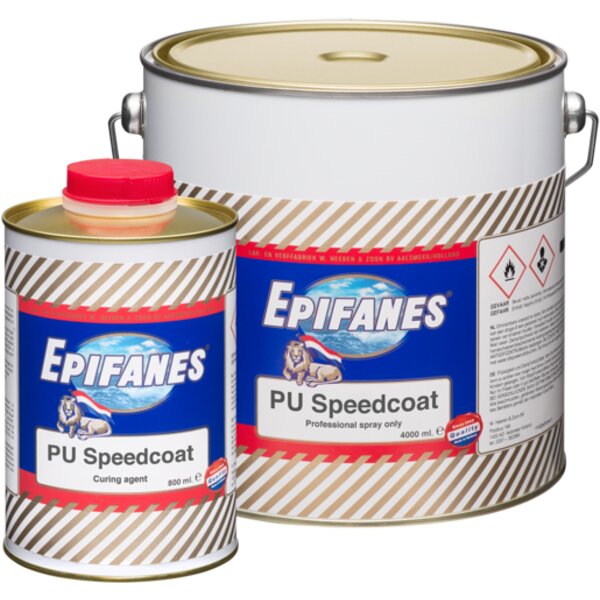
Epifanes PU Speedcoat is a professional two-component, chemically drying polyurethane topcoat designed exclusively for spray application. Based on an acrylic poly-ol resin, it delivers an extremely high-gloss finish with outstanding flow, very short overcoating times and long-lasting gloss retention. Once fully cured, the surface is scratch resistant, weather resistant and polishable, making it suitable as a durable protecting finish for both interior and exterior areas on properly primed substrates.
The system is intended for professional sprayers who require a fast-drying, high-build topcoat with excellent appearance on FRP, steel, aluminum and plywood constructions.
Main features
- Two-component polyurethane topcoat (Component A + Component B).
- Dedicated to spray application only (conventional air, HVLP and RP spray guns).
- Extremely high gloss with very good flow and leveling.
- Fast overcoating: short recoating and dust-dry times at standard temperatures.
- Long-term gloss retention with scratch and weather resistance.
- Polishable after full cure (approx. 7 days at 68°F / 20°C).
- Usable on FRP, steel, aluminum and plywood in combination with suitable Epifanes epoxy and polyurethane primers.
- Available in Epifanes colours, maritime-related colours and RAL colours on request.
Technical characteristics
Product type and composition
- Type: Chemical drying.
- Base: Acrylic poly-ol.
- System: Two-component (Component A base + Component B curing component).
- Gloss: Extreme high gloss.
Physical data (mixed product)
- Density at 68°F (20°C): 1.10 – 1.30 g/cm³ (depending on colour).
- Viscosity: 40 seconds ISO-cup 4 mm.
- Solids content: 40 ± 2 % by volume; 50 ± 2 % by weight.
- VOC level after mix: 569 g/l.
Packaging and shelf life
- Packing: 2 kg Component A (base) + 1 kg Component B (curing component) = 3 kg set.
- Shelf life (unopened, dry storage 41–86°F / 5–30°C):
- Component A: 3 years after production date.
- Component B: 1 year after production date.
Mixing and thinning
- Mixing ratio by weight: 2 parts Component A : 1 part Component B.
- Mixing instructions: Stir Component A well before adding Component B. Mix both components together for at least 5 minutes (or 2 minutes with mechanical stirring) until homogeneous.
- Induction time at 68°F (20°C): 10 minutes.
- Recommended thinners after mixing:
- Slow: Epifanes PU Speedcoat Spray Thinner.
- Fast: Epifanes Poly-urethane Spray Thinner.
- Thinning guideline for spray: 15–20 % by volume, adjusted to product temperature and working conditions. Avoid over-thinning.
Application parameters
- Application method: Spray only (not suitable for brush or roller).
- Recommended technologies: Conventional air spray, HVLP or RP spray guns (RP gives finest results).
- Air / HVLP spray: 15–20 % thinner, nozzle 1.2–1.6 mm, pressure 37–50 psi, 17–20 s DIN-cup 4 mm.
- RP spray: 15–20 % thinner, nozzle 1.1–1.3 mm, pressure 30–37 psi, 17–20 s DIN-cup 4 mm.
- Airless spray: Not advised.
Recommended film thickness and coverage
- Recommended film thickness per coat: 2–2.5 mil wet ≈ 1 mil dry.
- System build up: 3 coats or more.
- Film thickness per coat: 2–3 mil wet; 1–1.5 mil dry.
- Total dry film thickness: 3.5–4.5 mil.
- Theoretical coverage: 130 ft² per kg @ 1 mil dry film thickness.
Substrate and conditions
- Substrate types: FRP, steel, aluminum, plywood.
- Substrate condition: Well cured, cleaned, degreased, sanded, intact two-component paint systems.
- New systems: Build up with Epifanes Epoxy Primers and Epifanes Poly-urethane Primer.
- Application temperature: Minimum 59°F (15°C) – maximum 86°F (30°C).
- Relative air humidity: Minimum 50 % – maximum 75 %.
- Avoid large temperature differences between product, substrate and working area.
Drying and pot life (1 mil dry film, 65 % R.H.)
| Temperature | Dust dry | Recoatable | Sandable | Pot life after mixing |
|---|
| 59°F (15°C) | 1.5 hours | 2 hours | 30 hours | 4 hours |
| 68°F (20°C) | 1 hour | 1 hour | 24 hours | 3 hours |
| 77°F (25°C) | 1 hour | 1 hour | 20 hours | 1.5 hours |
Note: Higher wet film thicknesses and/or limited ventilation will extend drying times, especially on horizontal surfaces.
Applications and use cases
- Yacht and boat topsides and superstructures on FRP, steel or aluminum using appropriate Epifanes primers.
- Metal structures (steel and aluminum) requiring a high-gloss, durable spray finish in professional environments.
- Plywood and wooden components that have been correctly primed with compatible Epifanes epoxy and polyurethane primers.
- Interior and exterior protection where high gloss, fast throughput and polishability are required.
For additional gloss and depth, one or more coats of Epifanes PU Speedcoat Clear Gloss may be sprayed over Epifanes PU Speedcoat Colour. This is also recommended if the surface will be polished.
Wet-on-wet application is possible when the solvents of the previous coat have evaporated (typically 60–90 minutes at 68°F / 20°C). If the subsequent coat is applied after more than 48 hours at 68°F, sanding is required.
FAQ – Epifanes PU Speedcoat
1. Can PU Speedcoat be applied by brush or roller?
No. This product is formulated solely for spray application and is not suitable for brush or roller use.
2. On which substrates can I use PU Speedcoat?
It can be used on FRP, steel, aluminum and plywood, always in combination with the correct Epifanes epoxy and polyurethane priming system or intact compatible two-component coatings.
3. How many coats are recommended?
A minimum of three spray coats is recommended to achieve a total dry film thickness of approximately 3.5–4.5 mil.
4. When can I polish the finish?
The coating can be polished after approximately one week at 68°F (20°C).
5. What are the ideal application conditions?
Apply between 59–86°F (15–30°C) with 50–75 % relative humidity in a well-ventilated area, avoiding major temperature differences between product, substrate and environment.
6. How long is the pot life after mixing?
Pot life depends on temperature: about 4 hours at 59°F, 3 hours at 68°F and 1.5 hours at 77°F.
7. What is the theoretical coverage?
Approximately 130 ft² per kg at 1 mil dry film thickness, depending on application technique and substrate shape.
8. Do I need to sand between coats?
Intercoat sanding is not required for wet-on-wet application. If the overcoating interval exceeds 48 hours at 68°F, sanding is necessary before applying the next coat.
Section 14 – Transport information
- UN number / ID number: UN1263.
- UN proper shipping name: PAINT.
- Transport hazard class: Class 3 (flammable liquids).
- Label: 3.
- Packing group: III.
- Environmental hazards: Not applicable.
- ADR transport category: 3.
- Tunnel restriction code: D/E.
- Limited quantities (ADR/IMDG): 5 L.
- Excepted quantities: Code E1 (max. 30 ml per inner packaging, 1000 ml per outer packaging).
- Hazard identification number (Kemler code): 30.
- EMS code (sea transport): F-E, S-E.
- Stowage category: A.
Section 8 – Personal protective measures
The following information is based on the safety data sheets for Epifanes PU Speedcoat Component A and Component B.
General safety recommendations
- For professional use. Keep out of reach of children.
- Keep away from heat, hot surfaces, sparks, open flames and other ignition sources. No smoking.
- Prevent formation of aerosols and ensure good ventilation or local exhaust at the workplace.
- Prevent electrostatic charges during handling and mixing.
Personal protective equipment (PPE)
Respiratory protection
- Do not breathe vapours or spray mist.
- For short or low exposure: use a suitable filter respirator with AX filter or a half-face mask for organic vapours and solvents (EN140 type A1 or A2).
- For intensive or prolonged exposure, or in confined spaces: use self-contained breathing apparatus independent of ambient air.
Hand protection
- Wear chemical-resistant protective gloves, impermeable to the product.
- For permanent contact (Component A):
- PE gloves, recommended film thickness > 0.7 mm.
- For 30–120 minutes contact: PVA gloves, recommended thickness 0.7 mm.
- Alternative for up to 15 minutes contact: butyl rubber gloves.
- For splash protection: nitrile rubber gloves (> 0.3 mm), neoprene or butyl rubber (> 0.4 mm).
- Glove breakthrough time must be confirmed with the glove manufacturer and observed during use.
Eye and face protection
- Wear tightly sealed safety goggles.
Skin and body protection
- Wear suitable protective clothing resistant to solvents and liquid coatings.
- Remove soiled or contaminated clothing immediately.
Hygiene measures
- Wash hands and exposed skin before breaks and after work.
- Avoid contact with skin and eyes.
- Do not eat, drink or smoke while handling the product.
*Contenido generado por IA