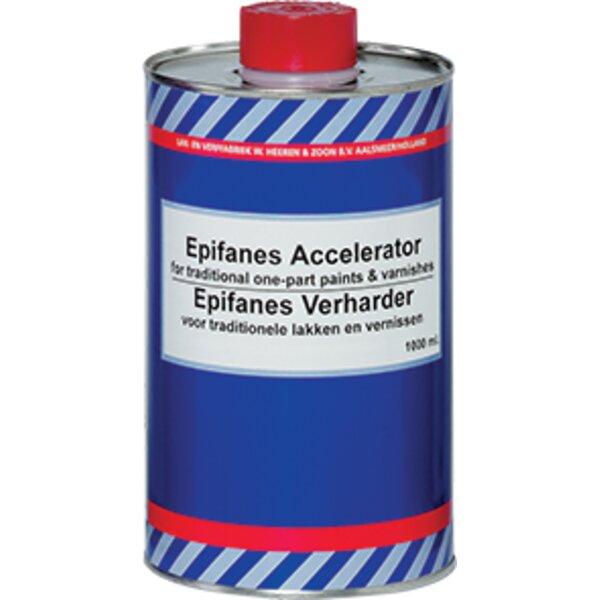
What is Epifanes Accelerating Additive and why choose it
Epifanes Accelerating Additive (Epifanes Accelerator for Paint & Varnish) is a liquid additive designed for use with one-component paints and varnishes within the coatings and paints category (PC9a). It is intended for roller or brush application (PROC10) and for use in the formulation of coating preparations (ERC2). Based on a resin and solvent mixture with specific additives, it integrates easily into compatible paint and varnish systems where an accelerator for these products is required.
Main characteristics
- Additive for one-component paints and varnishes.
- Supplied as a fluid, solvent-containing resin mixture with additives.
- Classified as a flammable liquid, Category 3 (H226: Flammable liquid and vapour).
- Contains components classified as suspected carcinogens and reproductive toxicants (H351, H361).
- May cause allergic skin reactions due to sensitising components (H317).
- Organic solvent content: 41.1 % (VOC content 372.7 g/l; 3.11 lb/gal).
- Solids content: 58.0 % (VB% 1h 150 °C).
- Designed for professional use with appropriate ventilation and protective equipment.
Technical specifications
Chemical nature
- Type: Resin mixture in solvent with additives.
- Dangerous components (non-exhaustive):
- Naphtha (petroleum), hydrotreated heavy (CAS 64742-48-9): 25–50 %; Flam. Liq. 3, H226; Asp. Tox. 1, H304.
- 2-butanone oxime (CAS 96-29-7): ≤1 %; Carc. 2, H351; Eye Dam. 1, H318; Acute Tox. 4, H312; Skin Sens. 1, H317; Flam. Liq. 4, H227.
- 4-(1,1,3,3-tetramethylbutyl)phenol (CAS 140-66-9): ≤0.5 %; Eye Dam. 1, H318; Skin Irrit. 2, H315.
- 4-tert-butylphenol (CAS 98-54-4): ≤0.5 %; Repr. 2, H361; Skin Corr. 1C, H314; Eye Dam. 1, H318.
- cobalt bis(2-ethylhexanoate) (CAS 136-52-7): ≤0.5 %; Carc. 2, H351; Repr. 2, H361; Skin Sens. 1, H317.
Physical and chemical properties
- Form: Fluid.
- Colour: According to product specification.
- Odour: Characteristic.
- Boiling range: approx. 150 °C (302 °F).
- Flash point: > 36 °C (> 97 °F).
- Ignition temperature: 240 °C (464 °F).
- Explosion limits in air: 0.6–7.0 Vol %.
- Vapour pressure at 20 °C (68 °F): 1.0 hPa (1 mm Hg).
- Density at 20 °C (68 °F): 0.90701 g/cm³ (7.569 lbs/gal) (ISO 2811).
- Water solubility: Not miscible or difficult to mix.
- Kinematic viscosity at 20 °C (68 °F): 37 s (ISO 6 mm).
- VOC content: 41.1 %; 372.7 g/l (3.11 lb/gal).
- Solids content: 58.0 % (VB% 1h 150 °C).
Stability and reactivity
- Chemically stable when used according to specifications.
- No dangerous reactions known under recommended conditions.
- No hazardous decomposition products known under normal use.
Applications and use cases
- Additive for one-component paints and varnishes used on suitable substrates.
- For professional coating and paint applications within product category PC9a (coatings and paints, thinners, paint removers).
- Designed for roller application or brushing (process category PROC10).
- Use in the formulation of coating preparations (environmental release category ERC2).
- Application should follow the dedicated technical datasheet of the product. Consultar ficha técnica del fabricante.
FAQ
1. What type of products is Epifanes Accelerating Additive designed for?
It is specified as an additive for one-component paints and varnishes within the coatings and paints category (PC9a).
2. How is this additive typically applied?
The relevant process category is PROC10, which refers to roller application or brushing. Application details should follow the technical datasheet. Consultar ficha técnica del fabricante.
3. Is the product flammable?
Yes. It is classified as a flammable liquid, Category 3 (H226: Flammable liquid and vapour). Keep away from heat, sparks, open flames and hot surfaces and do not smoke during use.
4. Does the product contain solvents and VOCs?
Yes. The organic solvent content is 41.1 %, with a VOC content of 372.7 g/l (3.11 lb/gal).
5. Are there any health hazard classifications?
Yes. It is classified with H317 (may cause an allergic skin reaction), H351 (suspected of causing cancer) and H361 (suspected of damaging fertility or the unborn child).
6. How should spills or accidental releases be handled?
Ensure adequate ventilation, keep unprotected persons away and avoid release to surface or ground water. Absorb with liquid-binding materials such as sand, diatomite, acid binders, universal binders or sawdust, then dispose of according to official regulations.
7. How should the product be stored?
Store only in the original, tightly sealed receptacle, in dry conditions. Keep away from ignition sources, do not smoke and protect against electrostatic charges.
8. Can the product be disposed of with household waste?
No. It must not be disposed of together with household garbage, and the product should not be allowed to reach the sewage system. Disposal must follow official regulations.
9. Is the product hazardous to water?
It is classified as slightly hazardous for water (water hazard class 1). Undiluted product or large quantities should not be allowed to reach ground water, water courses or sewage systems.
10. Is there a chemical safety assessment available?
No chemical safety assessment has been carried out for this mixture.
Section 14 – Transport information
- UN number: UN1263.
- UN proper shipping name:
- DOT: Consumer commodity, ORM-D; Paint related material.
- ADR: 1263 Paint related material.
- IMDG: Consumer commodity, ORM-D; Paint related material.
- IATA: Paint related material.
- Transport hazard class:
- DOT: Class 3, Flammable liquids (Label 3).
- ADR, IMDG, IATA: Class 3, Flammable liquids (Label 3).
- Packing group: III (DOT, ADR, IMDG, IATA).
- Marine pollutant: No.
- Special precautions for user: Warning – flammable liquids.
- Danger code (Kemler): 30.
- EMS number (IMDG): F-E, S-E.
- Transport in bulk according to Annex II of MARPOL 73/78 and the IBC Code: Not applicable.
- DOT quantity limitations:
- Passenger aircraft/rail: 60 L.
- Cargo aircraft only: 220 L.
- ADR excepted quantities (EQ):
- Code: E1.
- Maximum net quantity per inner packaging: 30 ml.
- Maximum net quantity per outer packaging: 1000 ml.
- IMDG:
- Limited quantities (LQ): 5 L.
- Excepted quantities (EQ): Code E1; maximum net quantity per inner packaging: 30 ml; maximum net quantity per outer packaging: 1000 ml.
- UN model regulation: UN1263, Paint related material, 3, III.
Section 8 – Personal protective measures
- General hygiene measures:
- Wash hands before breaks and at the end of work.
- Do not inhale gases, fumes or aerosols.
- Ensure good ventilation or exhaust at the workplace; work only in a fume cabinet where specified.
- Hand protection:
- Use protective gloves impermeable and resistant to the product.
- For permanent contact, suitable materials include nitrile rubber with recommended thickness > 0.45 mm and permeation time > 480 min (EN 374).
- For splash protection, suitable gloves include:
- Chloroprene, glove thickness > 0.7 mm, breakthrough time > 60 min (EN 374).
- Nitrile rubber, glove thickness > 0.3 mm, breakthrough time > 60 min (EN 374).
- The exact breakthrough time must be confirmed with the glove manufacturer.
- Eye protection:
- Use tightly sealed safety goggles.
*Contenido generado por IA