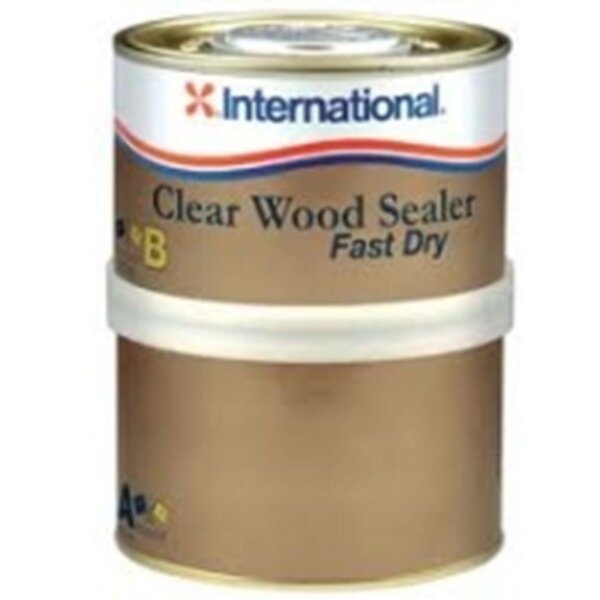
What is Clear Wood Sealer Part A and why choose it?
Clear Wood Sealer Part A from International Náutica is the base component of a premium, fast-drying, two-pack polyurethane clear primer for wood. When mixed 1:1 by volume with its dedicated curing agent (YVA328), it creates a high-gloss, transparent sealer that can accept up to four coats in a single working day (at 25°C/73°F, unthinned). Designed for use above the waterline on both interior and exterior areas, it delivers a hard, impact-, scratch- and wear-resistant surface ready for overcoating with compatible International finishes.
Main features
- Two-pack polyurethane clear primer specifically formulated for marine wood surfaces.
- Fast drying: touch dry from 15 minutes at 15–25°C, allowing up to 4 coats in 1 day (at 25°C/73°F, unthinned).
- High-gloss finish that enhances the natural look of the wood while sealing it.
- Excellent resistance to impact, scratching, transit and wear when overcoated with suitable finishes.
- For interior and exterior use above the waterline, on marine plywood and tropical hardwoods.
- No sanding required between coats (optional fine sanding improves appearance).
- Good coverage: theoretical 11 m²/L per coat; practical 10 m²/L by brush/roller.
- Clear, colour YVA327 with high-gloss appearance and specific gravity of 1.03.
- Professional-grade system with defined overcoating windows for International topcoats and varnishes.
Technical specifications
- Product type: Clear Wood Sealer Part A (base component of Clear Wood Sealer Fast Dry two-pack polyurethane primer)
- Colour: YVA327 (clear)
- Finish: High gloss
- Specific gravity: 1.03
- Volume solids: 38%
- Mix ratio (with Part B / YVA328): 1:1 by volume (as supplied); 1:1 by weight
- Curing agent: YVA328 (Clear Wood Sealer Part B)
- Typical shelf life: 2 years
- VOC (as supplied): 582 g/L
- VOC (EU Solvent Emissions Directive): 565.05 g/kg (Directive 1999/13/EC)
- Recommended number of coats: Minimum 4 coats (including first thinned coat). More coats may be required depending on wood porosity and to fully fill the grain.
- Recommended dry film thickness (DFT) per coat: 35 microns (by brush)
- Recommended wet film thickness (WFT) per coat: 91 microns (by brush)
- Theoretical coverage: 11 m²/L per coat
- Practical coverage (brush/roller): 10 m²/L per coat
- Application methods: Brush, roller, conventional spray (spray for professional applicators only)
- Touch dry times:
- 5°C (41°F): 30 minutes
- 15°C (59°F): 15 minutes
- 25°C (77°F): 15 minutes
- 35°C (95°F): 10 minutes
- Pot life (mixed product):
- 5–25°C (41–77°F): 3 hours
- 35°C (95°F): 2 hours
- Overcoating intervals with Clear Wood Sealer Fast Dry and compatible International finishes (minimum / maximum):
- 5°C (41°F): 24 h min / extended max
- 15°C (59°F): 6 h min / extended max
- 25°C (77°F): 3 h min / extended max
- 35°C (95°F): 2 h min / extended max
- Compatible overcoats: Clear Wood Sealer Fast Dry, Compass, Goldspar Satin, Perfection, Perfection Plus Varnish/Glazecoat (Professional), Perfection Pro Varnish, Schooner Gold, Toplac (within the stated overcoating windows).
- Recommended substrates: Marine plywood and tropical hardwood, well prepared, clean and sanded.
- Unit sizes: 750 ml; 10 L; 2.5 L (5 L kit) AP. Not all sizes are available in all countries.
- Use area: Above the waterline, interior and exterior.
Applications and use cases
Suitable substrates and environments
- Marine plywood structures above the waterline.
- Tropical hardwoods and oily woods (e.g. teak) once correctly degreased and prepared.
- Previously varnished wood in good condition (two-pack systems) or bare wood inside and outside the vessel, above the waterline.
- Areas requiring a tough, clear, high-gloss primed surface before finishing with International varnishes or topcoats.
Surface preparation
- Previously varnished wood (in good condition, two-pack only):
- Clean the surface with suitable thinners.
- Sand smooth with 280–320 grade abrasive paper.
- Remove sanding dust with thinners.
- Previously coated wood (one-pack or in poor condition): Remove all previous coatings.
- Bare wood:
- Sand with 180 grit, then lightly with 240 grit abrasive paper.
- Remove all sanding debris before proceeding.
- If the surface is wiped with solvent, allow it to dry completely before applying the first coat.
- For priming bare wood, thin the first coat by 25% with Thinner No. 9 (YTA006) and apply by brush to improve penetration. This will increase the drying time of the first coat.
- Oily woods (e.g. teak):
- Thoroughly degrease with Thinners No. 4, 9 or 10 and ensure the surface is completely dry.
- Sand any loose or flaking areas with 320 grit paper before coating.
Application method
- Mixing:
- Mix the quantity required in a separate container.
- Add Part B (curing agent YVA328) to Clear Wood Sealer Part A at 1:1 by volume (or 1:1 by weight).
- Stir thoroughly and leave for 10 minutes to allow bubbles to disperse.
- Coating system:
- Apply a minimum of 4 coats, including the first thinned coat.
- Sanding between coats is not required, but light sanding with 320 grit paper between coats can improve appearance.
- Thinning and equipment:
- Brush: Thin the first coat by 25% with YTA006 Thinner No. 9. Use a long-haired, wide, flat brush.
- Roller: Thin each coat by 10% with YTA006 Thinner No. 9.
- Conventional spray (professional applicators only): Thin 10–15% by volume with YTA910 Fast Spray Solvent, YTA064 (AP) or Thinners No. 10.
- Spray pressure: 3.5–4.0 bar (50–60 psi).
- Tip size: 1.0–1.4 mm.
- Cleaning of tools: YTA910/YTA006, YTA064 Thinners No. 10, Thinner No. 9.
- Environmental conditions during application:
- Ambient temperature: 5–35°C (41–95°F).
- Substrate temperature: 5–35°C (41–95°F) and at least 3°C (5°F) above the dew point to prevent condensation.
- Product temperature: 5–35°C (41–95°F).
- Relative humidity: greater than 30% and not exceeding 80%.
- Avoid painting in direct sunlight.
- Ventilation and humidity control: During application and drying in confined spaces, continuous ventilation is required to extract solvent vapours for health and safety reasons and to assist curing. Maximum relative air humidity should not exceed 80%.
Finishing and compatibility
- Clear Wood Sealer Part A (mixed with Part B) must only be used as a primer/sealer and must always be overcoated with a suitable International finish.
- Not recommended for use on light-coloured woods such as ash or light-coloured oak because the product may darken on exposure to light.
- Do not apply over conventional paints or flexible constructions.
FAQ
-
Is Clear Wood Sealer Part A suitable for below-waterline use?
No. It is specified for use above the waterline only, on interior and exterior surfaces.
-
How many coats are recommended?
A minimum of four coats is recommended, including the first thinned coat. Additional coats may be required depending on the porosity of the wood and to fully fill the grain.
-
Do I need to sand between coats?
Sanding between coats is not required, but optional sanding with 320 grade abrasive between coats will enhance the final appearance.
-
Can it be used on previously varnished wood?
Yes. On two-pack systems in good condition, clean with thinners, sand with 280–320 grit paper and remove dust before application. On one-pack or poor-condition coatings, all previous coatings must be removed.
-
Is this product suitable for light-coloured woods?
It is not recommended for use on light-coloured woods such as ash or light-coloured oak, as the product may darken on exposure.
-
What is the mixing ratio with the curing agent?
The mix ratio with curing agent YVA328 is 1:1 by volume (as supplied) and 1:1 by weight.
-
What thinners should I use?
For brushing and rolling use YTA006 Thinner No. 9. For conventional spray use YTA910 Fast Spray Solvent, YTA064 (AP) or Thinners No. 10. The same products are recommended for cleaning equipment.
-
What are the drying times before overcoating?
At 25°C (77°F) the minimum overcoating interval is 3 hours; at 35°C (95°F) it is 2 hours; at 15°C (59°F) 6 hours; and at 5°C (41°F) 24 hours, for Clear Wood Sealer Fast Dry and the listed International finishes.
-
Can Clear Wood Sealer Part A be left as a final finish?
No. The mixed product (Clear Wood Sealer Fast Dry) is a primer/sealer only and must always be overcoated with a suitable finish.
-
What storage conditions are required?
Store in a firmly closed container between 5°C/41°F and 35°C/95°F, away from extremes of temperature and out of direct sunlight.
Section 14 – Transport information
- UN number / ID number: UN1263
- UN proper shipping name: PAINT
- Transport hazard class: 3 (flammable liquid)
- Packing group: III
- Environmental hazards: Not classified as hazardous to the environment for transport.
- ADR/RID additional information: Tunnel code (D/E).
- IMDG additional information: Emergency schedules F-E, S-E.
- Special precautions for users: Transport within the user’s premises only in closed, upright and secure containers. Ensure personnel transporting the product know what to do in case of accident or spillage.
Section 8 – Individual protection measures
Exposure controls and personal protection
- General hygiene measures:
- Wash hands, forearms and face thoroughly after handling, before eating, drinking or smoking, and at the end of work.
- Remove contaminated clothing and protective equipment before entering eating areas. Wash contaminated clothing before reuse.
- Ensure eyewash stations and safety showers are close to work areas.
- Eye/face protection: Chemical splash goggles complying with an approved standard should be used when there is a risk of splashes, mists, gases or dusts.
- Hand protection:
- Wear chemical-resistant, impervious gloves complying with EN374 or equivalent.
- For prolonged or frequently repeated contact, use gloves with protection class 6 (breakthrough time > 480 minutes). Recommended materials: Viton or nitrile, thickness ≥ 0.38 mm.
- For expected brief contact, use gloves with protection class 2 or higher (breakthrough time > 30 minutes). Recommended material: nitrile, thickness ≥ 0.12 mm.
- Replace gloves regularly and if any signs of damage or degradation appear.
- Skin and body protection:
- Wear appropriate protective clothing selected according to task and risks.
- When there is a risk of ignition from static electricity, use anti-static protective clothing including overalls, boots and gloves, in line with EN 1149 requirements.
- Respiratory protection:
- Use only with adequate ventilation. If ventilation is insufficient, wear a respirator conforming to EN140 with type A/P2 filter or better.
- During dry sanding, flame cutting and/or welding of dry paint film, hazardous dust or fumes can be generated. Prefer wet sanding/flatting where possible and use suitable respiratory protection if exposure cannot be avoided by local exhaust ventilation.
- Environmental exposure controls: Emissions from ventilation or work equipment should comply with environmental legislation. Where necessary, use fume scrubbers, filters or engineering modifications to reduce emissions.
- Health warnings: Contains isocyanates which may be harmful to the respiratory system. Use only in controlled, well-ventilated conditions. Overspray and vapours can cause skin irritation or respiratory problems.
*Contenido generado por IA