What is ALEXSEAL WATERBORNE TOPCOAT and why choose it?
ALEXSEAL WATERBORNE TOPCOAT is a professional, two-component, water-reducible polyurethane topcoat designed for industrial and marine environments. Once cured, it offers high gloss retention and excellent colour stability even under extreme climatic conditions. The dry film shows strong resistance to abrasion, scratching, solvents, chemicals, synthetic cooling agents and hydraulic oils.
The product is approved according to IMO Resolution MSC.307(88) (FTP-Code 2010) as a marine paint with low flame-spread characteristics, making it particularly suitable for demanding onboard applications where safety and durability are essential.
Main features
- Water-reducible, two-component polyurethane system for professional use.
- High gloss retention and colour resistance under extreme climatic conditions.
- Excellent chemical and mechanical resistance to abrasion, scratching, solvents, chemicals, synthetic cooling agents and hydraulic oils.
- IMO MSC.307(88) approval as a low flame-spread marine coating (FTP-Code 2010).
- Direct adhesion to fibreglass thanks to very good adhesion properties.
- Optimised for enclosed areas such as engine rooms and lockers where a water-based product is desirable.
- Professional application by spray, brush or roller with defined mixing ratios and film thickness ranges.
Key technical characteristics
Coverage and solids
- Volume solids (catalysed, without reduction): 46 %
- Recommended dry film thickness (DFT): 30–40 µm (approx. 1.2–1.6 mils) for a 2-coat system
Indicative coverage for 2-coat application
- Theoretical (brush and roller): 12 m²/l · 45 m²/gal · 484 sq.ft./gal at 40–50 µm DFT
- Practical – conventional air spray: 7.2 m²/l · 27.2 m²/gal · 293 sq.ft./gal at 40–50 µm DFT
- Practical – HVLP air spray: 8.4 m²/l · 31.7 m²/gal · 342 sq.ft./gal at 40–50 µm DFT
Colour and packaging
- Colour: white, standard factory-packaged (WATERBORNE TOPCOAT base)
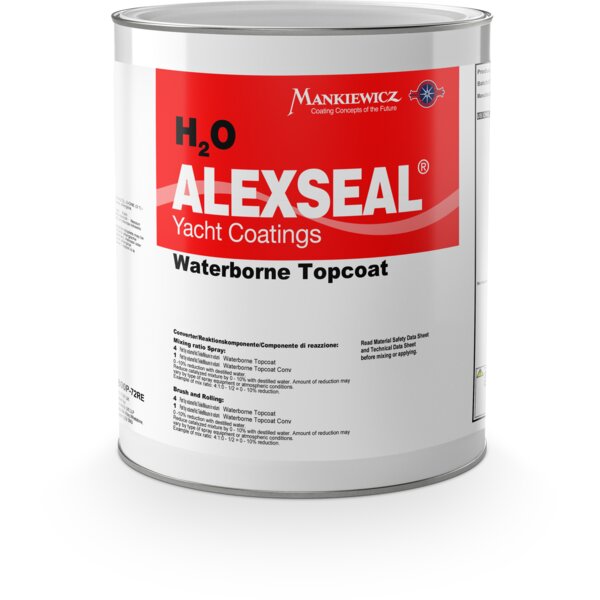
- Base (colour): W…. ALEXSEAL Waterborne Topcoat Base Color, 1 gal
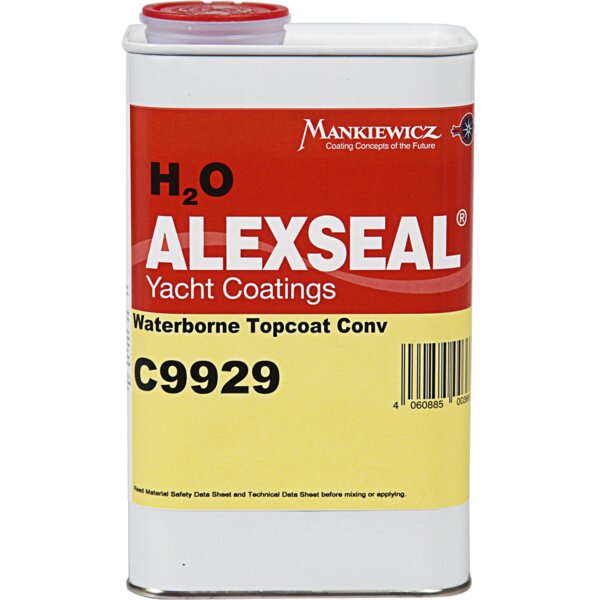
- Converter: C9929 ALEXSEAL Waterborne Topcoat Converter, 1 qt
- Reducer: distilled water
Mixing ratio
- Spray application:
- 4 parts by volume W…. Waterborne Topcoat Base Color
- 1 part by volume C9929 Converter
- 10–15 % by volume distilled water (e.g. 4:1:1/2 to 3/4 ≈ 20 % reduction)
- Brush/Roller application:
- 4 parts by volume W…. Waterborne Topcoat Base Color
- 1 part by volume C9929 Converter
- 5–10 % by volume distilled water (e.g. 4:1:1/4 to 1/2 = 5–10 % reduction)
- Mixing procedure: Mix base and converter with a high-speed mixer for approx. 2 minutes, then adjust application viscosity by adding distilled water. Mixed material must be filtered before application.
Application parameters
- Viscosity: Zahn #2: approx. 37–50 s; DIN 4 (4 mm): approx. 30–40 s
- Gravity gun nozzle size: 1.0–1.4 mm (0.040–0.050) – conventional and HVLP
- Siphon cup nozzle size: 1.2–1.6 mm (0.046–0.060) – conventional and HVLP
- Pressure pot fluid nozzle size: 1.0–1.2 mm (0.040–0.042) – conventional and HVLP
- Atomising pressure: 3.0–3.5 bar (42–50 psi) – conventional and HVLP
- Pot pressure: 0.7–1.5 bar (10–20 psi) – conventional and HVLP
Recommended film build and curing
- Spray application:
- Apply 2 coats at 30–40 µm (1.1–1.6 mils) wet film thickness (WFT) per coat.
- Flash-off between coats: 60 minutes.
- Resulting DFT: 30–40 µm (1.2–1.6 mils) for 2 coats.
- Maximum recommended total film build (spray): 60–80 µm (2.5–3 mils) WFT or 30–40 µm (1.2–1.6 mils) DFT.
- Brush/Roller application:
- Apply 2 coats at 30–40 µm (1.1–1.6 mils) WFT per coat.
- Each coat should dry to a tape-dry stage within 12–24 hours.
- Sand with grit 320–400 between coats.
- Maximum recommended total film build (brush/roller): 60–80 µm (2.5–3 mils) WFT or 30–40 µm (1.2–1.6 mils) DFT.
- Optimal application environment: 15–30 °C (60–85 °F) and 40–80 % relative humidity; minimum 3 °C (5.4 °F) above dew point.
Pot life and drying times (approximate)
Ambient range: 15–30 °C (60–85 °F), 40–80 % RH
- Pot life:
- 15–20 °C (60–68 °F): 2–3 h
- 25 °C (77 °F): 2 h
- 30 °C (85 °F): 1.5 h
- Dust free (60 % RH):
- 15 °C: 4 h
- 20 °C: 3 h
- 25 °C: 2 h
- 30 °C: 1 h
- Tape dry:
- 15 °C: 26 h
- 20 °C: 24 h
- 25 °C: 18 h
- 30 °C: 12 h
- Fully cured:
- 15 °C: 21 days
- 20 °C: 18 days
- 25 °C: 14 days
- 30 °C: 12 days
- Recoat with ALEXSEAL Waterborne Topcoat (after tack-up): 60–90 min depending on temperature (see table in data sheet).
- Overcoat with other products (after sanding): typically 12–24 h depending on temperature.
Applications and use cases
- Engine rooms: Interior areas near, but not directly on, engines. The coating should not be applied directly on engine surfaces, as heat may cause gloss and colour changes (without affecting protective properties).
- Lockers and storage spaces: Particularly where a water-based, low flame-spread system is requested.
- Other interior marine surfaces: Any areas where a durable, waterborne topcoat with IMO low flame-spread approval is required.
- Fibreglass structures: Can be applied directly to fibreglass substrates after proper cleaning, thanks to very good adhesion.
FAQ
-
Is ALEXSEAL WATERBORNE TOPCOAT water-based?
Yes. It is a water-reducible, two-component polyurethane topcoat. Distilled water is used as the reducer.
-
Where can this product be used on a vessel?
It is specified for engine rooms, lockers and other interior surfaces where a water-based coating is desirable. It should not be used directly on engines because heat may change gloss and colour.
-
Can it be applied directly to fibreglass?
Yes. Due to its good adhesion properties, the product may be applied directly to clean, dry fibreglass.
-
What is the recommended number of coats?
The system is designed for 2 coats, either by spray or by brush/roller, to reach 30–40 µm DFT.
-
How much coverage can I expect?
The theoretical coverage with brush/roller at 40–50 µm DFT is 12 m²/l (484 sq.ft./gal). Practical rates are lower and depend on the application method.
-
How is the product mixed for spraying?
Mix 4 parts base with 1 part converter and reduce with 10–15 % distilled water by volume, then filter before application.
-
What conditions are recommended for application and drying?
Apply between 15–30 °C (60–85 °F) and 40–80 % RH, ensuring the surface temperature is at least 3 °C above the dew point. Ideal drying temperature is around 25 °C (77 °F).
-
Is the coating flame-retardant?
The topcoat has been approved under IMO Resolution MSC.307(88) (FTP-Code 2010) as a marine paint with low flame-spread characteristics.
-
How long does it take to fully cure?
Depending on temperature, full cure is reached between 12 and 21 days.
-
Can it be recoated with other products?
Yes. Overcoating with other products is possible after 12–24 hours (temperature-dependent) and requires sanding of the surface.
Section 14 – Transport information
- UN number: UN 1263
- UN proper shipping name: PAINT RELATED MATERIAL
- Transport hazard class: Class 3 (flammable liquids)
- Packing group: III
- ADR classification code: F1
- ADR hazard identification number: 30
- Tunnel restriction code: (D/E)
- IMDG EmS code: F-E, S-E
- Marine pollutant: no
- Environmental hazard (ADR): not classified as environmentally hazardous.
- On-site transport advice: Within the user’s premises, transport only in closed, upright and secure containers. Personnel handling the product should be trained on what to do in case of incident or spillage.
- Small receptacles: Receptacles with capacity less than 450 litres may be exempt from some ADR/IMDG provisions (see detailed transport regulations).
Section 8 – Personal protective measures
The converter C9929 used with WATERBORNE TOPCOAT is a flammable, hazardous hardener based on polyisocyanates. Follow the safety data sheet and local regulations when handling and applying the mixed product.
Engineering controls
- Provide good general and/or local exhaust ventilation to keep vapour and particulate concentrations below occupational exposure limits.
- In case ventilation is insufficient, use suitable respiratory protection.
Eye and face protection
- Wear safety goggles designed to protect against solvent splashes.
Hand protection
- Use chemical-resistant protective gloves compliant with EN 374.
- Recommended materials for splash contact: nitrile rubber or neoprene.
- Minimum material thickness: > 0.4 mm.
- Breakthrough time: > 480 min.
- Inspect gloves before use and replace immediately if damaged or worn.
- Wash any contaminated skin immediately and use preventive skin protection creams where appropriate.
Skin and body protection
- Wear anti-static clothing made from natural fibres (e.g. cotton) or heat-resistant synthetic fibres where explosive atmospheres may occur.
- Avoid product contact with skin and clothing; clean contaminated skin thoroughly after contact.
Respiratory protection
- During spraying: use an air-fed respirator.
- Other operations in well-ventilated areas: air-fed respirators may be replaced by a half mask with a combination charcoal and particulate filter, depending on risk assessment.
Additional protective measures and precautions
- Persons with a history of asthma, allergies or chronic/recurrent respiratory disease should not work with this preparation.
- Do not eat, drink or smoke while working with the product.
- Avoid inhalation of vapours, spray mist and sanding dust arising from the product.
- Keep away from heat, hot surfaces, sparks, open flames and other ignition sources. No smoking.
*Contenido generado por IA