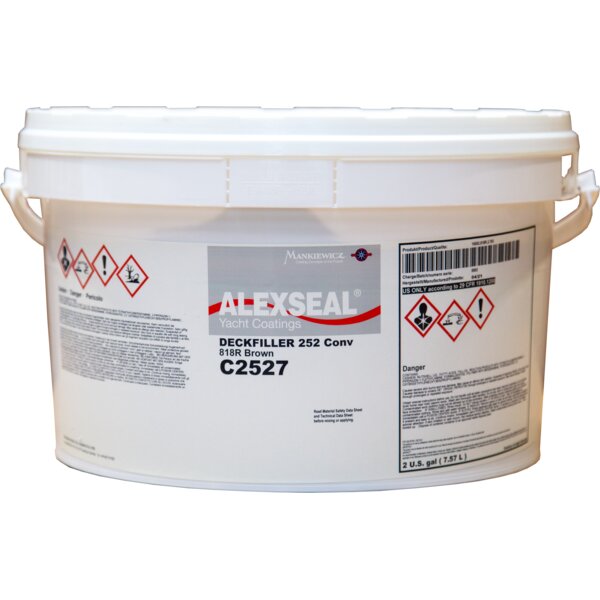
What is ALEXSEAL Deckfiller 252 Converter and why choose it
ALEXSEAL Deckfiller 252 Converter (ALEXSEAL C2527-Deckfiller 252 Conv) is a polyamine-based hardener specifically formulated for use with ALEXSEAL Deckfiller 252, a solvent-free, epoxy-based lightweight deck fairing filler. Used as part of the Deckfiller 252 system, this brown converter ensures correct curing, reliable mechanical properties and a stable base for subsequent teak deck systems on steel or aluminium yacht decks. It is designed for professional industrial use and provides consistent processing and sanding characteristics when mixed 1:1 with the Deckfiller 252 base.
Main features
- Dedicated hardener for Deckfiller 252: Converter component for the ALEXSEAL Deckfiller 252 epoxy deck fairing system.
- Polyamine/amino adduct technology: Chemical nature defined as a hardener based on polyamine/amino adduct, optimised for epoxy crosslinking.
- Solvent-free deck fairing system: Used within a catalysed system that offers 100 % volume solids when combined with the Deckfiller 252 base.
- Professional application: Intended for industrial serial painting and yacht deck construction where high reliability and controlled curing are required.
- Consistent colour control: Brown converter, designed to give a homogeneous light brown mixture when properly blended with the light blue base.
- Optimised pot life and sanding times: When mixed 1:1 with the base, the Deckfiller 252 system offers defined pot life and dry-to-sand times depending on temperature.
Technical specifications
- Product type: Hardener / converter for ALEXSEAL Deckfiller 252 (hardener based on polyamine / amino adduct).
- Trade name: ALEXSEAL C2527-Deckfiller 252 Conv 818R Brown.
- Physical state: Solid (20 – 25 °C, 1,013 hPa).
- Colour: According to product name (brown).
- Odour: Amine-like.
- Density: Approx. 0.55 g/cm³ (20 °C).
- Boiling range: Approx. 120 °C.
- Flash point: 130 °C (ISO 13736).
- pH: 13 – 14 at 20 °C (10 %).
- Water solubility: Insoluble; immiscible with water.
- VOC content: 0.47 %, 3 g/l (Directive 2010/75/EU).
- Viscosity (kinematic): > 21 mm²/s.
- Vapour pressure: Approx. 100 hPa at 50 °C.
- Mixing ratio with Deckfiller 252 Base: 1 : 1 by volume and 1 : 1 by weight (Base : Converter).
- Reduction: ALEXSEAL Deckfiller 252 must not be reduced.
- Recommended storage temperature: 5 – 35 °C.
Applications and use cases
Intended use within the Deckfiller 252 system
- Designed for industrial serial painting and professional yacht construction.
- Used as the converter component in the ALEXSEAL Deckfiller 252 deck fairing system, applied on primed steel or aluminium decks before bonding teak deck systems.
Typical application workflow (system level)
- Substrate (steel or aluminium) is cleaned, ground and/or blasted with 36–60 grit and primed with ALEXSEAL Protective Primer 161.
- Deckfiller 252 Base and Deckfiller 252 Converter are mixed 1:1 by volume or weight until a homogeneous light brown colour is obtained.
- The mixed filler is applied by spatula or trowel in layers up to 10 mm, worked to thickness and pulled off with a straight edge to avoid air pockets.
- After drying, the surface is sanded to a smooth, even finish and resealed with Protective Primer 161 before gluing the final decking.
FAQ
1. What is the correct mixing ratio for ALEXSEAL Deckfiller 252 Converter?
The Deckfiller 252 system must be mixed 1 : 1 by volume or 1 : 1 by weight (Base : Converter). The mixture must not be reduced.
2. How can I verify that the base and converter are properly mixed?
The components have different colours to help control mixing. After thorough mixing, the filler should have a homogeneous colour; otherwise improper curing may occur.
3. What tools should be used to apply the mixed Deckfiller 252?
Application should be carried out with trowels, spatulas or straight edge materials.
4. What is the recommended layer thickness when applying the system?
The mixed material should be applied in layers up to 10 mm and worked to the desired total thickness before being pulled out with a straight edge.
5. At what temperatures can I apply Deckfiller 252 with this converter?
The optimal application environment is between 15 °C (60 °F) and 30 °C (85 °F) with 40–80 % relative humidity. During drying, the minimum temperature is 15 °C (60 °F); the ideal temperature is 25 °C (77 °F).
6. What are the pot life and dry-to-sand times of the mixed product?
Using C2527 Converter, approximate pot life is 1 h at 15 °C, 40 min at 20 °C, 30 min at 25 °C and 20 min at 30 °C. Dry-to-sand times are about 36 h at 15 °C, 20 h at 20 °C, 18 h at 25 °C and 12 h at 30 °C.
7. How should the substrate be prepared before applying the Deckfiller 252 system?
The substrate must be clean, dry and free from dust, grease, oil and other contamination. It should be ground and/or blasted with 36–60 grit and primed with ALEXSEAL Protective Primer 161.
8. Can I recoat Deckfiller 252 over itself?
Yes. Recoating over itself should follow the minimum dry-to-sand times. Scratch sanding with 36–60 grit is recommended to ensure adhesion between layers.
9. How do I clean equipment after using Deckfiller 252 with this converter?
For equipment cleaning, use R4042 ALEXSEAL Epoxy Primer Reducer.
Section 14 – Transport information
- UN number: UN 3066.
- UN proper shipping name: PAINT RELATED MATERIAL.
- Transport hazard class: Class 8 (corrosive).
- Packing group: III.
- ADR classification code: C9.
- ADR hazard identification number: 80.
- ADR tunnel restriction code: (E).
- IMDG EmS code: F-A, S-B.
- Environmental hazards: Classified as environmentally hazardous for ADR; marine pollutant for IMDG.
- Special transport advice: If transported within the user’s premises, it should always be moved in closed, upright and safe containers. Persons handling the containers should be aware of the rules of conduct in case of incident or spillage.
Section 8 – Personal protection measures
- Engineering controls: Provide adequate ventilation with local exhaust and general extraction. If this is not sufficient to keep particulate concentrations below the occupational exposure limit, suitable respiratory protection must be worn.
- Eye/face protection: Wear safety goggles to protect against splashes.
- Hand protection:
- Use chemical-resistant protective gloves tested according to EN 374.
- Recommended materials for short-term contact: nitrile rubber or neoprene.
- Minimum material thickness: > 0.4 mm.
- Minimum breakthrough time: > 480 min.
- Gloves should be checked for workplace suitability and replaced immediately when damaged or worn.
- Skin and body protection: Wear clothing as usual in the chemical industry.
- Respiratory protection: None is generally required, but vapours should be avoided whenever possible. If adequate ventilation cannot be ensured, appropriate respiratory protection should be used.
- General protective measures:
- Do not eat, drink or smoke during work.
- Avoid contact with skin, eyes and clothing.
- Avoid inhalation of dust from sanding, particulates and spray mist arising from application.
- Preventive hand protection (skin protection cream) and immediate washing of contaminated skin are recommended.
*Contenido generado por IA