What Awlwood MA Primer Clear is and why choose it
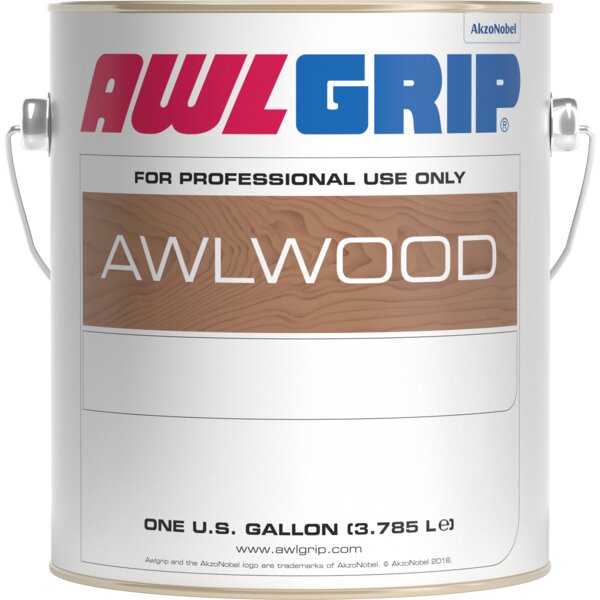
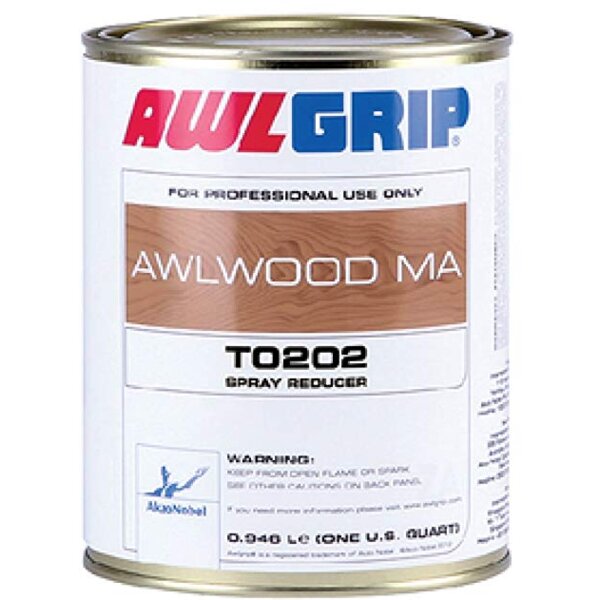
Awlwood MA Primer Clear is a high-performance clear primer designed for exterior timber above the waterline. As part of the Awlwood Primer & Clear Gloss system, it adheres directly to wood, deeply penetrating the grain to establish a permanent, rich base colour. This clear version is ideal when you want to maintain the natural tone of the timber while improving flexibility, adhesion and long-term durability of the full coating system.
Main features
- Deep wood penetration – saturates the grain rather than forming a surface film, giving long‑lasting colour stability.
- Enhanced system performance – improves flexibility, adhesion and durability of subsequent Awlwood Clear Gloss coats.
- Wide application window – can be applied between 4ºC and 30ºC, with relative humidity from 30% to 95%.
- Single‑coat priming – only one coat is required, applied to full timber saturation.
- High theoretical coverage – up to 10 m²/L per coat at the recommended dry film thickness.
- Clear, natural appearance – designed to keep the natural colour of the wood, ideal on timbers where a transparent look is desired.
- Compatible with coloured Awlwood primers – can be intermixed with yellow or red primers to adjust tint strength when required.
Key specifications
- Product type: Awlwood MA Primer Clear (Awlwood primer clear)
- Use: Part of a two-component coating system for exterior use above the waterline on wood substrates
- Volume solids: 45%
- Specific gravity: 1.013
- Available pack size: 1 US quart
- Colour: Clear
- Application methods: Brush or roller
- Recommended coats: 1 coat, applied until the timber is fully saturated (do not build a film)
- Recommended wet film thickness (WFT): 100 µm (3.9 mil)
- Recommended dry film thickness (DFT): 45 µm (1.8 mil)
- Theoretical coverage: 10 m²/L (407.4 ft²/gal) at 45 µm DFT
- VOC (product as supplied): 500 g/L (4.17 lb/gal)
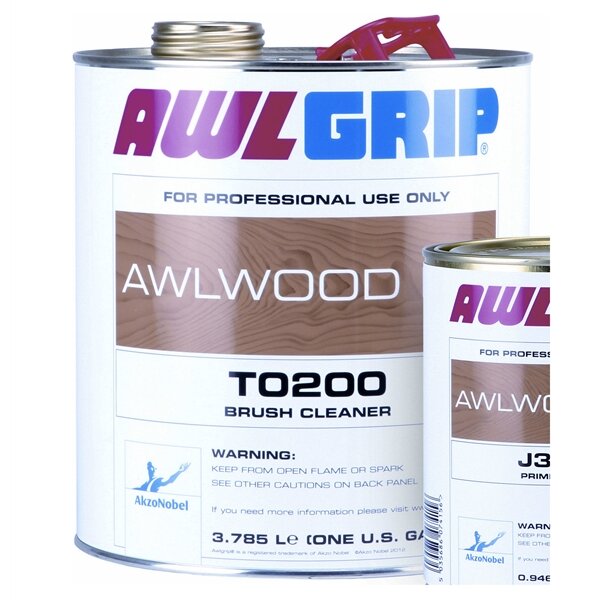
- Cleaning of equipment: Awlwood OT0200 Brush Cleaner
- Mixing and reduction: Do not thin.
- Flash point (clear component): 29°C (84.2°F) closed cup
- Density (clear component): 0.952 g/cm³
Surface preparation and application
Timber preparation
- Remove all previous coatings and contaminants.
- If timber is badly weathered, hard sand in line with the grain using 60 or 80 grit, removing all grey, UV‑damaged fibres. Clean deep grain pits thoroughly; a stiff wire brush may assist.
- Mechanically sand until colour is even and the original timber tone is exposed.
- Sand all substrates using no finer than P120 grit, sanding with the grain for the final sand.
- Radius all edges so no sharp corners remain.
- If timber has been saturated with salt water, scrub with fresh water to remove salt deposits before sanding.
- If timber becomes wet after final sanding and water spots appear, re‑sand affected areas with P120 before priming.
- Any cracks should be epoxy filled or splined with timber before sanding.
Resinous timbers
- Remove sanding dust using clean compressed air or vacuum.
- Working in sections, scrub the surface with acetone using a brush, then immediately remove with paper towels or rags, changing them frequently.
- Ensure the surface is completely dry, then apply Awlwood MA Primer Clear within one hour of degreasing.
- Some timber extracts may retard curing; test on a small, non‑critical area if unsure.
Filling defects and fixing holes
- Where possible, fill defects and screw holes with wooden plugs of the same wood, aligned with the grain and fixed using an epoxy resin‑based glue.
- Sand away any excess cured epoxy before priming to avoid irregular spots in the varnished finish.
- If plugs are not feasible, fill with epoxy resin mixed with wood dust/shavings (preferably from the same timber), then sand smooth after curing.
- This method can leave these areas slightly darker than surrounding wood; using coloured primer or adding coloured primer to topcoats can help minimise colour differences.
Application conditions
- Temperature: 4ºC to 30ºC (39°F to 86°F)
- Relative humidity: 30% to 95%
- Awlwood Primer cures by moisture in the air; very low humidity will extend cure times.
- Do not use in air‑conditioned environments where humidity is very low. If low humidity is suspected, test on a small area first.
Practical application steps (clear primer)
- Decant only enough product for approximately 30 minutes of use into a roller tray or deep working pot. Reseal the original container immediately to minimise moisture exposure. Do not return unused product to the can.
- Apply Awlwood MA Primer Clear by brush or roller until the timber is fully saturated. Do not attempt to build a surface film.
- On very deep‑grained timbers such as Iroko and Wenge, do not flood‑coat the grain. Remaining grain depth should be filled later using successive coats of Awlwood Clear Gloss.
Use with coloured Awlwood primers and topcoats
- All Awlwood primers (clear, yellow, red) are intermixable.
- On very absorbent softwoods such as Cedar and Oregon, coloured primers are often mixed 50:50 by volume with clear primer to reduce tint strength.
- For more even colour on highly absorbent timbers (e.g. Spruce), use the clear primer and add no more than 10% coloured primer to the Awlwood Gloss topcoat.
- A darker timber tone can be achieved by applying multiple coats of Awlwood Gloss with up to 10% coloured primer added.
Recoatability and drying
- Touch dry:
- 5°C (41°F): 12 hours
- 15°C (59°F): 4 hours
- 25°C (77°F): 3 hours
- Hard dry:
- 5°C (41°F): 24 hours
- 15°C (59°F): 18 hours
- 25°C (77°F): 12 hours
- Overcoating with Awlwood Clear Gloss:
- At 5°C (41°F): minimum 9 hours, maximum 14 hours
- At 15°C (59°F): minimum 4 hours, maximum 8 hours
- At 25°C (77°F): minimum 3 hours, maximum 6 hours
- Always aim to apply the first coat of Awlwood Gloss on the same day as the primer application.
- Sanding Awlwood Primer is not a substitute for respecting the overcoat window. If the window is exceeded, hard‑block sand with P120, clean the timber and re‑apply primer.
Applications and typical uses
- Exterior timber surfaces above the waterline where a clear, durable base for Awlwood Clear Gloss is required.
- Situations where long‑term colour stability of the wood and high system durability are needed.
- Projects requiring application in a broad range of temperatures and humidities within the given limits.
FAQ
-
Is Awlwood MA Primer Clear suitable for interior use?
The product data sheet specifies it is designed for exterior application above the waterline. Consultar ficha técnica del fabricante.
-
How many coats of Awlwood MA Primer Clear are required?
Only one coat is recommended. Apply by brush or roller until the timber is saturated, without attempting to build a film.
-
Can I sand the primer before applying Awlwood Gloss?
Sanding is not required if the gloss is applied within the specified overcoating window. If the window is exceeded, hard‑block sand with P120, clean the timber and re‑apply the primer.
-
Can I thin Awlwood MA Primer Clear?
No. The product should not be thinned.
-
What should I use to clean brushes and equipment?
Use Awlwood OT0200 Brush Cleaner. Brushes cleaned with this product must then be thoroughly rinsed with acetone, Awlwood Brushing Reducer or Awlwood Spray Reducer before being used with Awlwood Primer.
-
Is this product suitable for very low temperatures or very dry conditions?
No. It is not suitable for use below 4ºC (39°F) or in very low humidity atmospheres, as curing relies on moisture in the air.
-
Can I use alcohol‑based cleaners or teak cleaners before priming?
No. Alcohol‑based cleaners and teak cleaners containing oxalic acid residues should not be used, as they impede curing of primers and topcoats.
-
Is Awlwood MA Primer Clear intended for consumer use?
The safety data sheet identifies industrial use and advises against consumer use.
-
What are the main hazards associated with this primer?
The clear component is a flammable liquid and vapour, may cause respiratory irritation, may cause drowsiness or dizziness and may cause cancer.
-
How should leftover product and containers be disposed of?
Disposal of product, solutions and containers must comply with local, regional and national regulations. Waste should be handled via authorised waste contractors and must not be released to drains or waterways.
Section 14 – Transport information
The following transport data are taken from the product safety documentation for Awlwood primers and Awlwood primer clear.
- UN number: UN1263
- Proper shipping name: PAINT / PINTURAS
- Transport hazard class: Class 3 (Flammable liquid)
- Packing group: III
- Environmental hazards: Not classified as environmentally hazardous for transport under the cited regulations.
- ADR/RID: Class 3, Packing group III
- Additional note (viscous liquid exemption): class 3 viscous liquid not subject to regulation in packages up to 450 L according to 2.2.3.1.5.1.
- Tunnel restriction code: (D/E).
- IMDG: Class 3, Packing group III
- Emergency schedules: F-E, S-E.
- IATA: Class 3, Packing group III.
- Special precautions for users: Transport within user premises only in closed, upright and secure containers. Ensure personnel know what to do in case of accident or spillage.
Section 8 – Individual protection measures
The following personal protective equipment (PPE) guidance is summarised from the safety data sheets for Awlwood primers and Awlwood primer clear. A specific risk assessment must always be carried out to determine the appropriate level of protection.
General hygiene measures
- Eating, drinking and smoking are prohibited in areas where the product is handled, stored or processed.
- Wash hands, forearms and face thoroughly after handling and before eating, drinking or smoking, and at the end of the work period.
- Remove contaminated clothing and protective equipment before entering eating areas. Wash contaminated clothing before reuse.
- Ensure eyewash stations and safety showers are close to the workstation.
Eye and face protection
- Wear safety eyewear that complies with an approved standard when there is a risk of exposure to liquid splashes, mists, gases or dusts.
- Where contact is possible, use safety glasses with side shields as a minimum.
Hand protection
- Use chemical‑resistant, impervious gloves that comply with relevant standards whenever handling this product, if indicated by the risk assessment.
- For prolonged or frequently repeated contact, the European SDS recommends protective gloves of class 6 (breakthrough time > 480 minutes according to EN374). Recommended materials include Viton or nitrile with a thickness ≥ 0.38 mm.
- For brief contact, at least class 2 gloves (breakthrough time > 30 minutes) are recommended, for example nitrile gloves with thickness ≥ 0.12 mm.
- Replace gloves regularly and immediately if damaged. Actual breakthrough times depend on glove manufacturer and conditions of use.
Skin and body protection
- Select protective clothing based on the task and associated risks, approved by a specialist before use.
- When there is a risk of ignition from static electricity, wear anti‑static protective clothing including overalls, boots and gloves, complying with EN 1149.
- Choose appropriate protective footwear and additional skin protection as indicated by the risk assessment.
Respiratory protection
- Use only with adequate ventilation. Where ventilation is insufficient to maintain exposures below recommended limits, wear suitable respiratory protective equipment.
- Based on the SDS, a respirator conforming to EN140 with type A/P2 filter or better is recommended.
- Dry sanding, flame cutting and welding of dry paint films generate hazardous dust and fumes; wet sanding/flatting is preferred. If exposure cannot be avoided, use appropriate respiratory protection.
Environmental exposure controls
- Emissions from ventilation or process equipment should comply with environmental legislation. Fume scrubbers, filters or engineering modifications may be required to reduce emissions.
*Contenido generado por IA