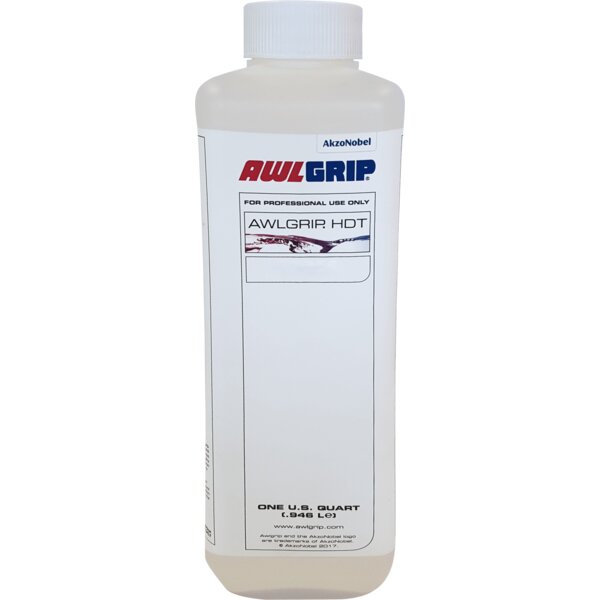
What is Awlgrip HDT Fast Activator and why choose it?
Awlgrip HDT Fast Activator is a professional-grade curing component designed to be used in accordance with the directions on the can within Awlgrip coating systems. Classified as a flammable liquid, it is formulated to accelerate curing while maintaining the performance of high-end Awlgrip finishes. It is intended for industrial and professional applications where controlled, fast activation of Awlgrip HDT systems is required.
Main features
- Professional and industrial use: Identified for professional and industrial applications, as well as other uses when handled according to the instructions on the can.
- Fast-acting activator: Designed to promote rapid curing of compatible Awlgrip HDT coating systems.
- Flammable liquid (Category 3): Flash point of 39°C (Pensky-Martens closed cup); produces flammable vapors and must be kept away from ignition sources.
- Harmful if swallowed or inhaled: Classified Acute Tox. 4 (oral and inhalation) and STOT SE 3 (may cause drowsiness or dizziness).
- Solvent-based liquid: Colorless, solvent odor, not soluble in cold water.
- VOC-regulated product: Subject to Directive 2004/42/EC on VOC; ready-for-use VOC value not specified.
- Controlled under Seveso Directive: Classified under danger category P5c (flammable liquids).
- For professional use only: Use is restricted to trained users who can comply with all safety and handling requirements.
Technical specifications
- Product type: Mixture (activator).
- Physical state: Liquid.
- Color: Colorless.
- Odor: Solvent.
- Density: 0.841 g/cm³ (DIN EN ISO 2811-1).
- Flash point: 39°C (102.2°F), closed cup, Pensky-Martens.
- Viscosity:
- Kinematic at room temperature: 21 mm²/s (DIN EN ISO 3219).
- Kinematic at 40°C: 18 mm²/s (DIN EN ISO 3219).
- Water solubility: Not soluble in cold water (OECD TG 105).
- Explosion limits: Greatest known range based on pentane-2,4-dione – lower 2.4%, upper 11.6%.
- Classification (Regulation (EC) No. 1272/2008):
- Flam. Liq. 3, H226 – Flammable liquid and vapor.
- Acute Tox. 4, H302 – Harmful if swallowed.
- Acute Tox. 4, H332 – Harmful if inhaled.
- STOT SE 3, H336 – May cause drowsiness or dizziness.
- Key hazardous components:
- Heptan-2-one (≥50 – ≤78%).
- Pentane-2,4-dione (≤14%).
- Dibutyltin dilaurate (<0.25%; may cause allergic reaction; very toxic to aquatic life at high concentrations).
- Intended users: Professional use, industrial use, and other uses following the directions on the can.
Applications and use cases
Awlgrip HDT Fast Activator is intended to be used as a curing/activating component within Awlgrip HDT coating systems. It is designed for professional and industrial environments where controlled, fast curing of Awlgrip HDT coatings is required. Typical scenarios include:
- Use by professional applicators in workshops or shipyards.
- Industrial finishing lines that apply Awlgrip HDT systems and require fast through-dry and handling times.
- Any application where the activator is used strictly according to the instructions on the product can and associated Awlgrip technical documentation.
Detailed mixing ratios, compatible basecoats and clearcoats, and process parameters are not specified here. Consultar ficha técnica del fabricante.
FAQ – Awlgrip HDT Fast Activator
-
Is Awlgrip HDT Fast Activator ready to use on its own?
No. It is an activator to be used within compatible Awlgrip HDT coating systems, in accordance with the directions on the can. It is not a stand-alone coating.
-
Who is allowed to use this product?
The product is intended for professional and industrial use, and is labeled for professional use only. Users must be trained and follow all safety, handling and legal requirements.
-
What are the main hazards associated with this activator?
It is a flammable liquid and vapor (Flam. Liq. 3) and is harmful if swallowed or inhaled (Acute Tox. 4). It may cause drowsiness or dizziness (STOT SE 3). It contains dibutyltin dilaurate, which may cause an allergic reaction.
-
Can I dilute or mix it freely with other products?
No. It must only be mixed and used as specified for Awlgrip HDT systems and as instructed on the can and official Awlgrip documentation. For detailed mixing information: Consultar ficha técnica del fabricante.
-
How should I store Awlgrip HDT Fast Activator?
Store in the original, tightly closed container in a dry, cool and well-ventilated area, protected from direct sunlight and away from heat, sparks, open flames and oxidizing materials. Store locked up and avoid unlabeled containers.
-
Is the product water-soluble?
No. It is not soluble in cold water.
-
Can this product enter drains or watercourses?
No. Do not allow the product to enter drains or watercourses. Spills must be contained and disposed of via licensed waste contractors.
-
How should empty containers be handled?
Empty containers may contain flammable and harmful residues. They must be disposed of safely, not cut, welded or ground unless thoroughly cleaned internally. Dispose of according to local and national regulations.
-
What should I do in case of fire involving this product?
Use dry chemical, CO₂, water spray (fog) or foam to extinguish. Never use a direct jet of water for extinction. Fire-fighters should wear suitable protective equipment and self-contained breathing apparatus (SCBA).
-
Where can I find detailed application conditions or mixing ratios?
These are not specified in this description. Consultar ficha técnica del fabricante.
Section 14 – Transport information
- UN number (ADR/RID, IMDG, IATA): UN1263.
- UN proper shipping name: PAINT.
- Transport hazard class: Class 3 (flammable liquid).
- Packing group: III.
- Environmental hazards: Not classified as environmentally hazardous for transport (ADR/RID, IMDG, IATA: No).
- ADR/RID tunnel code: (D/E).
- IMDG emergency schedules: F-E, S-E.
- Transport within user’s premises: Always transport in closed containers that are upright and secure. Ensure that persons transporting the product know what to do in case of an accident or spillage.
- Transport in bulk according to IMO instruments: Not applicable.
Section 8 – Individual protection measures
The following personal protective equipment (PPE) and control measures are recommended based on the safety data sheet and are intended for professional users who have carried out a suitable risk assessment.
Engineering controls
- Use only with adequate ventilation.
- Use process enclosures, local exhaust ventilation or other engineering controls to keep airborne concentrations below recommended or statutory limits and below lower explosive limits.
- Use explosion-proof ventilation equipment.
Hygiene measures
- Wash hands, forearms and face thoroughly after handling, before eating, drinking, smoking and at the end of the working period.
- Use appropriate techniques to remove contaminated clothing; wash before reuse.
- Ensure eyewash stations and safety showers are close to workstations.
Eye and face protection
- Use safety eyewear complying with an approved standard when there is a risk of liquid splashes, mists, gases or dusts.
- Where contact is possible, safety glasses with side shields are recommended unless a higher degree of protection is indicated by the risk assessment.
Hand protection
- Wear chemical-resistant, impervious gloves complying with an approved standard whenever handling the product, if indicated by the risk assessment.
- For prolonged or frequent contact: gloves with protection class 6 (breakthrough time >480 minutes according to EN374) are recommended – e.g. Viton or nitrile, thickness ≥ 0.38 mm.
- For brief contact: gloves with protection class ≥2 (breakthrough time >30 minutes according to EN374) are recommended – e.g. nitrile, thickness ≥ 0.12 mm.
- Replace gloves regularly and immediately if damaged. The user must ensure the glove type is suitable for the specific conditions of use.
Skin and body protection
- Wear personal protective clothing suitable for the task and risks, approved by a specialist.
- When there is a risk of ignition from static electricity, wear anti-static protective clothing. For maximum protection, include anti-static overalls, boots and gloves (refer to EN 1149).
- Use appropriate footwear and any additional skin protection based on the risk assessment.
Respiratory protection
- Select a respirator that meets the appropriate standard or certification, based on hazard and exposure potential.
- Wear a respirator conforming to EN140 with type A/P2 filter or better.
- Respirators must be used under a respiratory protection program ensuring correct fit, training and maintenance.
- Dry sanding, flame cutting or welding of the dry paint film can generate hazardous dust or fumes; use wet methods where possible. If local exhaust ventilation is insufficient, use suitable respiratory protection.
Environmental exposure controls
- Check emissions from ventilation or process equipment to ensure compliance with environmental legislation.
- Where necessary, use fume scrubbers, filters or engineering modifications to reduce emissions.
*Contenido generado por IA