What is Awlfair Surfacing Filler Converter and why choose it?
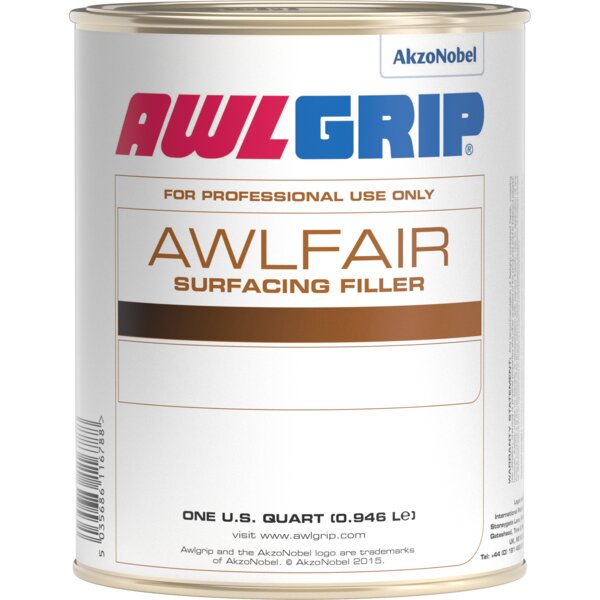
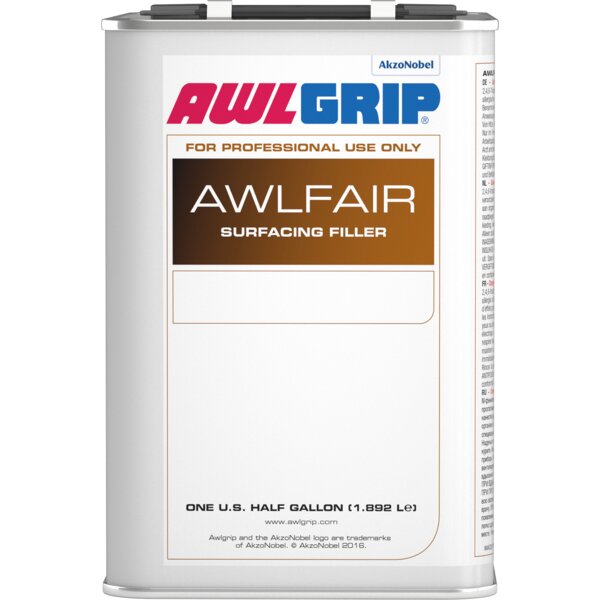
Awlfair Surfacing Filler Converter (D3200 / OD3200) is the curing component of the Awlfair Surfacing Filler high-end, two-component epoxy finishing system from Awlgrip. Used in combination with the D6200 base, it creates a non-shrinking, solvent-resistant finishing filler designed to eliminate sand scratches, pinholes and minor surface imperfections over Awlfair LW Fairing Compound before sealing, high-build priming or topcoat systems.
This converter is formulated to deliver a very smooth, high-quality surface with excellent solvent resistance and an optimized health and safety profile when used as directed.
Main features
- Two-component epoxy converter specifically designed for Awlfair Surfacing Filler base D6200.
- Creates a smooth, solvent-resistant surface when mixed with the base and applied over Awlfair LW Fairing Compound.
- Non-shrinking finishing filler system suitable for filling sanding scratches, pinholes and other small imperfections.
- High solids system – mixed Awlfair Surfacing Filler has approximately 88–88.36% volume solids and a specific gravity of about 1.64–1.642.
- Low VOC when mixed – theoretical VOC of the mixed system is approximately 119 g/L (0.99 lb/gal).
- Compatible with Awlgrip epoxy primers such as 545 Epoxy Primer, High Build, Hullgard Extra Epoxy Primer, Awlquik and others when correct sanding and overcoating intervals are followed.
- Professional-grade performance for demanding finishing work prior to high-build primers and topcoats.
Technical specifications
- Product type: Two-component epoxy converter (curing agent) for Awlfair Surfacing Filler.
- Product code: D3200 / OD3200 (Awlfair Surfacing Filler Standard Converter).
- System mix ratio:
- 2:1 by volume (base D6200 : converter D3200).
- Approximately 2.37:1 by weight (base : converter).
- Mixed volume solids: approx. 88–88.36%.
- Mixed specific gravity: approx. 1.64–1.642.
- VOC (theoretical, as supplied):
- D3200 converter: 337 g/L (2.81 lb/gal); 230 g/kg (0.23 lb/lb).
- Mixed Awlfair Surfacing Filler (2:1 by volume): approx. 119 g/L (0.99 lb/gal); 80 g/kg (0.080 lb/lb).
- Appearance (converter): Paste, yellow, amine-like odour.
- Flash point (converter): approx. 101 °C (closed cup).
- Density (converter): approx. 1.46 (relative density).
- Recommended application tools (mixed system): trowel, spatula, batten, putty knife / mason’s trowel.
- Recommended coats (mixed system): typically 2 coats.
- Recommended wet film thickness per coat: 100 µm (3.9 mil).
- Dry film thickness per coat: 100 µm (3.9 mil).
- Maximum DFT per coat: 100 µm (3.9 mil).
- Maximum total system thickness: 500 µm (20 mil) in several tight screeded layers.
- Theoretical coverage (mixed system): approx. 8.8 m²/L per 100 µm DFT (358.5 ft²/gal).
- Pot life (mixed system):
- 40 minutes at 15 °C (59 °F).
- 25 minutes at 25 °C (77 °F).
- 18 minutes at 35 °C (95 °F).
- Hard dry times of mixed system:
- 24 hours at 15 °C (59 °F).
- 12 hours at 25 °C (77 °F).
- 8 hours at 35 °C (95 °F).
- Hardness development (mixed system): Shore D 60 (±10%) after 8 hours (measurement may be difficult due to thin layers).
- Cleaning of equipment: T0002 or T0006, or MEK for equipment as specified.
- Recommended temperature range for use (mixed system): 13–40 °C (55–104 °F). Outside this range, proper application and cure may be more difficult.
Applications and use cases
- Professional marine finishing: Designed primarily for professional application of inks and coatings and for yacht and boat finishing over Awlfair LW Fairing Compound.
- Surface refinement prior to priming: Used to remove sanding scratches, pinholes and small surface defects to achieve an ultra-smooth surface before applying sealing primers, high-build epoxies or finishing primers.
- Compatibility with Awlgrip systems: Once mixed, applied and sanded, Awlfair Surfacing Filler can be overcoated with:
- Awlfair Surfacing Filler (self-recoat).
- High Build epoxy primers.
- Hullgard Epoxy Primer and Hullgard Extra Epoxy Primer.
- Epoxy Sprayable Fairing Compound / Ultra Build Awlfair Surfacing & Fairing Compound.
- 545 Epoxy Primer.
- Awlquik.
- Overcoating intervals for mixed system:
- At 15 °C (59 °F): minimum 24 hours; no maximum limit, provided the surface is sanded and then overcoated within 24 hours after sanding.
- At 25 °C (77 °F): minimum 6 hours; same unlimited time condition with sanding.
- At 35 °C (95 °F): minimum 2 hours; same unlimited time condition with sanding.
- Substrate restriction: Must only be applied over properly prepared Awlfair LW Fairing Compound. Do not apply directly to GRP.
FAQ
-
What is the role of AWLFAIR SURFACING FILLER CONVERTER in the system?
It is the curing agent (converter) that reacts with the Awlfair Surfacing Filler base D6200 to form a hard, solvent-resistant epoxy finishing filler.
-
What is the correct mix ratio between base and converter?
The recommended mix ratio is 2:1 by volume (base D6200 : converter D3200), or approximately 2.37:1 by weight.
-
Can I thin or reduce the mixed filler?
No. Do not add reducers, solvents or thinners of any kind to Awlfair Surfacing Filler. The product must be used without dilution.
-
How thick can I apply the mixed filler?
The recommended dry film thickness per coat is 100 µm (3.9 mil), with a maximum of 100 µm per coat and a maximum total thickness of 500 µm (20 mils) in several tight screeded layers.
-
When can I sand Awlfair Surfacing Filler?
Awlfair Surfacing Filler can typically be sanded after 24 hours at 15 °C, 6 hours at 25 °C, or 2 hours at 35 °C. Use P100–P120 grit paper.
-
Which primers can I apply over the sanded filler?
Once sanded, it can be recoated with Awlfair Surfacing Filler itself, High Build epoxy primers, Hullgard and Hullgard Extra Epoxy Primers, Epoxy Sprayable Fairing Compound / Ultra Build, 545 Epoxy Primer and Awlquik, following the specified overcoating intervals.
-
Are there temperature limitations for use?
Yes. The system should not be used below 13 °C (55 °F) or above 40 °C (104 °F), as correct application and cure may be difficult outside this range.
-
Can I wipe cured filler with solvent before overcoating?
No. Do not wipe down cured Awlfair Surfacing Filler with thinners or solvents. Surface preparation should be by sanding and, if required, detergent and fresh water wash.
-
What should I do if a surface by-product appears during cure?
Low temperature combined with high humidity can produce a surface by-product (amine exudate) that must be removed either by detergent washing followed by fresh water rinse, or by sanding.
-
Where can I find more detailed performance data?
Consultar ficha técnica del fabricante.
Section 14 – Transport information for the converter
The following information refers to the Awlfair Surfacing Filler Standard Converter (OD3200) as classified in the safety data sheet.
- UN number: UN1759.
- Proper shipping name: Corrosive solid, n.o.s. (m-phenylenebis(methylamine), Formaldehyde, polymer with benzenamine, hydrogenated).
- Transport hazard class: Class 8 (corrosive).
- Packing group: II.
- Environmental hazards:
- ADR/RID: Dangerous for the environment.
- IMDG: Marine pollutant (Formaldehyde, oligomeric reaction products with phenol and m-phenylenebis(methylamine)).
- IATA: Not classified as environmentally hazardous for air transport.
- Special notes:
- For ADR/RID and IMDG, environmental hazard / marine pollutant marking is not required when transported in packages ≤ 5 L or ≤ 5 kg.
- Tunnel restriction code (ADR): (E).
- User transport precautions: Within user premises, always transport in closed, upright and secure containers. Ensure personnel know what to do in case of accident or spill.
- Bulk transport (MARPOL/IBC): Consultar ficha técnica del fabricante.
Section 8 – Individual protection measures
The converter contains corrosive and sensitising components. Appropriate personal protective equipment (PPE) and exposure controls are essential.
Exposure controls
- Engineering controls: If operations generate dust, fumes, gas, vapour or mist, use process enclosures, local exhaust ventilation or other engineering controls to keep airborne exposures below applicable limits.
- Workplace hygiene: Wash hands, forearms and face thoroughly after handling chemicals, before eating, smoking and at the end of the work period. Contaminated work clothing should not be taken off-site and must be washed before reuse. Ensure eyewash stations and safety showers are close to workstations.
Personal protective equipment
- Hand protection:
- Use chemical-resistant gloves compliant with EN 374.
- Recommended materials: Viton or nitrile gloves.
- For prolonged or frequently repeated contact: gloves with protection class 6 (breakthrough time > 480 minutes according to EN 374).
- For short contact: gloves with protection class 2 or higher (breakthrough time > 30 minutes according to EN 374).
- Final glove choice must consider all workplace factors (other chemicals handled, cut/puncture risk, dexterity, thermal protection, etc.).
- Eye and face protection:
- Use safety eyewear that meets approved standards when risk assessment indicates exposure to splashes, mists, gases or dust.
- Recommended: chemical splash goggles and/or face shield. Where there is inhalation risk, a full-face respirator may be used instead.
- Skin and body protection:
- Wear appropriate protective clothing selected based on the specific task and risks, and approved by a specialist before handling the product.
- Select suitable footwear and any additional skin protection as required by the application.
- Barrier creams may help protect exposed skin areas but must not be applied after exposure has occurred.
- Respiratory protection:
- Use a properly fitted respirator with particle filter meeting approved standards when risk assessment indicates it is necessary.
- Respirator selection must be based on actual or expected exposure levels, product hazards and the reliability of the chosen respirator.
Environmental exposure controls
- Check emissions from ventilation or process equipment to ensure compliance with environmental protection legislation.
- Where necessary, use scrubbers, filters or modify process equipment to reduce emissions.
*Contenido generado por IA