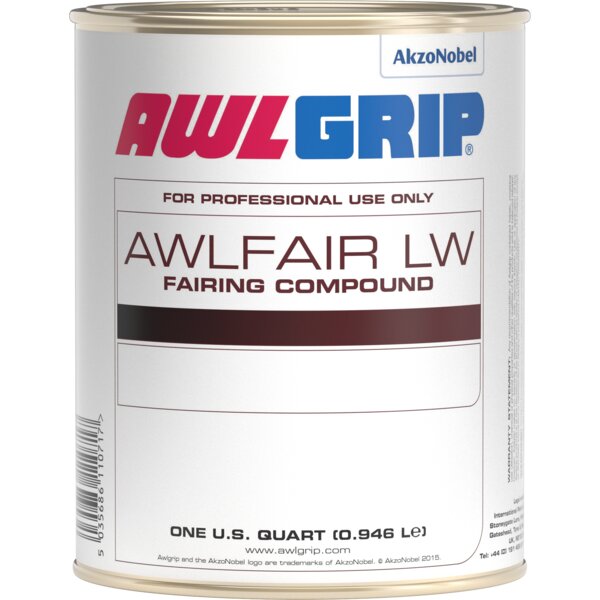
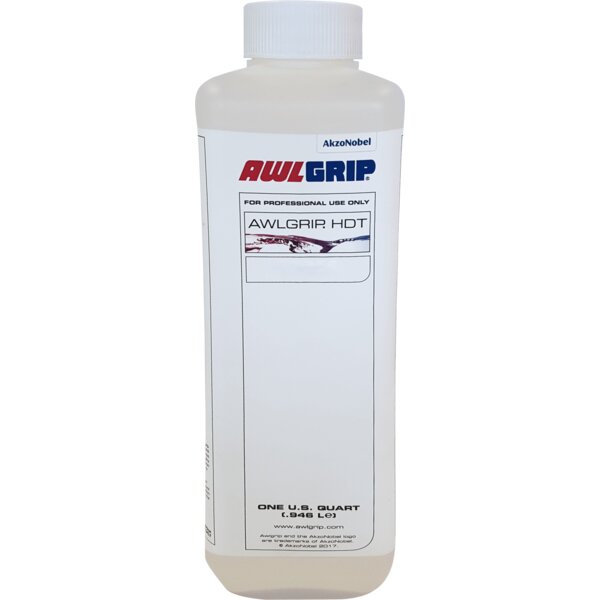
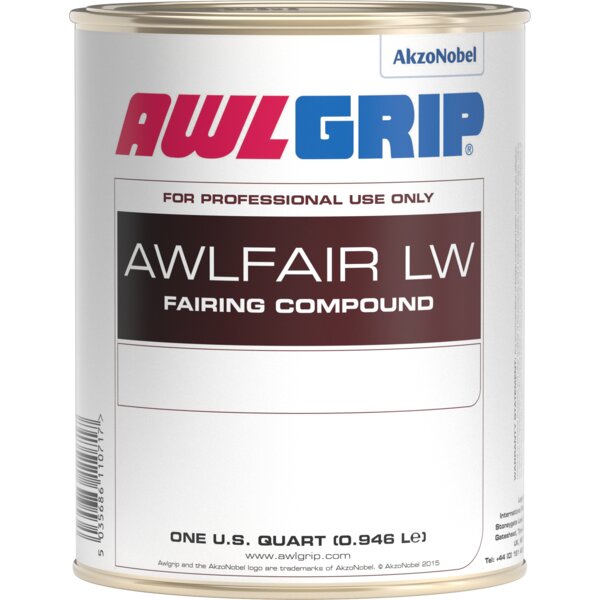
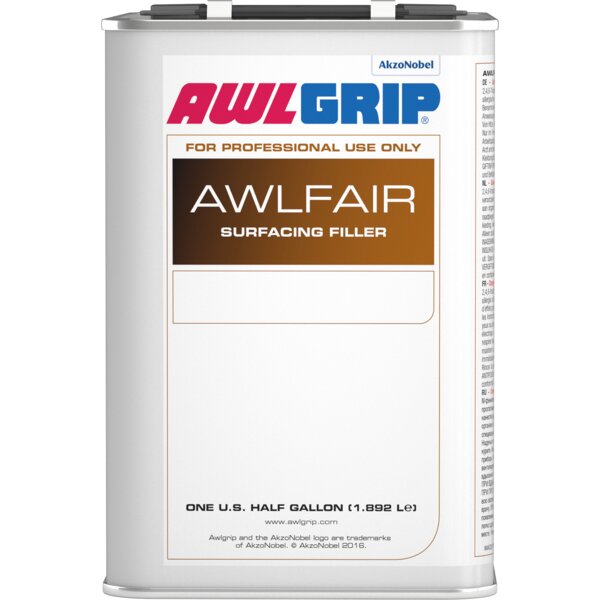
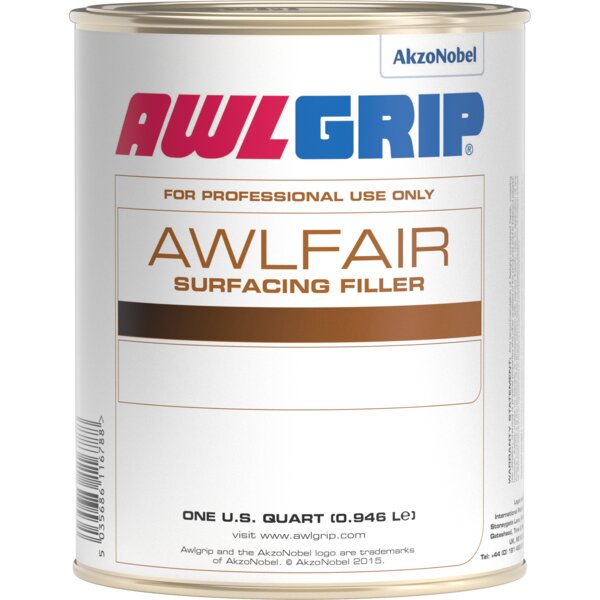
What is Awlfair L.W. Fast Converter and why choose it?
Awlfair L.W. Fast Converter (OD7222) is the fast-curing converter component of the Awlfair LW / Fast trowelable epoxy fairing system from Awlgrip. When mixed in the specified ratio with the Awlfair LW Fast base, it creates a premium epoxy filler designed to smooth irregular surfaces, fair hulls and structures, and produce a level, even finish that reduces drag and improves the boat’s appearance. The system is suitable for professional fairing work above and below the waterline on aluminium and other appropriately primed substrates and is sandable after approximately 6 hours at 25°C.
Main features
- Fast-curing converter for Awlfair LW Fast fairing compound.
- Designed to produce super-smooth, easily sanded surfaces.
- Suitable for both manual and automatic mixing systems.
- For use above and below the waterline on aluminium when applied over approved Awlgrip primers.
- Part of a 100% volume solids epoxy system for high build per coat.
- Industrial-grade product intended for use by professional, trained applicators.
Key technical characteristics
Awlfair LW / Fast system data
- Intended use: Trowelable epoxy filler / fairing compound for smoothing irregular surfaces and levelling hulls and structures.
- Suitable substrates: Aluminium (above and below waterline) over approved Awlgrip epoxy primers; GRP and other substrates where specified and correctly primed.
- Finish: Super-smooth, easy to sand.
- Sandable time (mixed system): approx. 6 hours at 25°C (77°F).
Composition and mixing
- Product type: Two-component epoxy filler (base + Fast converter).
- Mix ratio (Base : Converter) for Awlfair LW / Fast:
- 1 : 1 by volume.
- 1.56 : 1 by weight.
- Recommended reducers/thinners: Do not thin. No reducer or solvent should be added.
Physical and performance data (mixed Awlfair LW / Fast)
- Volume solids: 100%.
- Specific gravity: approx. 0.92.
- Available pack sizes: 1 US Quart, 2 US Gallon, 5 US Gallon.
- Base colour: OD8200 White.
- Fast Converter colour: OD7222 Red.
- Equipment cleaning: Awlgrip T0002, T0006.
Theoretical coverage (Awlfair LW Fast system)
- Application methods: Trowel, spatula, putty knife, longboard battens.
- Recommended wet film thickness per coat: 6000 µm (236.2 mil).
- Recommended dry film thickness per coat: 6000 µm (236.2 mil).
- Maximum dry film thickness per coat: 10000 µm (393.7 mil).
- Theoretical coverage at recommended DFT: 0.15 m²/L (6.1 ft²/gal) for Awlfair LW / Fast; 0.2 m²/L (6.9 ft²/gal) for Awlfair LW Standard.
- Note: Coverage values are theoretical and based on 100% transfer efficiency. Actual coverage will vary with equipment, technique, part geometry and conditions.
Mechanical properties (cured system, reference values)
Values below are typical for Awlfair LW / Fast mixed, hand-applied and cured under controlled conditions:
- Compressive strain (%): 6 at -20°C; 6 at 0°C; 5 at 20°C.
- Compressive strength (MPa): 66 at -20°C; 60 at 0°C; 47 at 20°C.
- Flexural modulus (MPa): 2874 at -20°C; 2596 at 0°C; 2272 at 20°C.
- Flexural strain (%): 1.6 at -20°C; 1.5 at 0°C; 1.6 at 20°C.
- Flexural strength (MPa): 42 at -20°C; 39 at 0°C; 36 at 20°C.
- Tensile modulus (MPa): 3541 at -20°C; 3041 at 0°C; 2527 at 20°C.
- Tensile strain (%): 0.5 at -20°C; 0.8 at 0°C; 0.8 at 20°C.
- Tensile strength (MPa): 19 at -20°C; 23 at 0°C; 20 at 20°C.
- Thermal expansion coefficient: 8 × 10⁻⁵ /°C (all temperatures listed).
VOC information
All VOC values are theoretical and may vary between batches and colours.
- OD8200 Base: 0 g/L; 0 lb/gal.
- OD7222 Fast Converter: 185 g/L; 1.54 lb/gal.
- Awlfair LW / Fast mixed: 93 g/L; 0.78 lb/gal.
Drying and recoat times for Awlfair LW / Fast
- Temperature 15°C (59°F):
- Sandable: 17 hours.
- Pot life: 80 minutes.
- Temperature 25°C (77°F):
- Sandable: 6 hours.
- Pot life: 30 minutes.
- Temperature 35°C (95°F):
- Sandable: 90 minutes.
- Pot life: 20 minutes.
- Overcoating (Awlfair LW / Fast, Epoxy Surfacing Primer, High Build, Ultra Build): minimum 24 hours at 15°C, 25°C or 35°C; maximum interval extended (no fixed maximum stated).
- Requirement before recoating: Awlfair LW / Fast must be sanded before recoating with itself or other Awlgrip products.
Applications and use cases
Typical uses
- Fairing and levelling hulls and superstructures on yachts and other vessels.
- Smoothing weld seams, pits from corrosion, dents and other surface defects prior to priming and topcoating.
- Creating fair, hydrodynamically efficient underwater surfaces to help reduce drag.
- Fairing topsides and superstructures to deliver a visually smooth surface that maximises gloss and colour holdout in Awlgrip topcoat systems.
Application guidance (mixed Awlfair LW / Fast)
- Apply only over properly applied and prepared Awlgrip-approved epoxy primers such as Hullgard Extra Epoxy Primer and High Build (GRP only).
- Awlfair LW / Fast may be applied directly to Hullgard Epoxy Primer without sanding; High Build must be sanded before application.
- Apply by trowel, spatula, putty knife or longboard battens to an area you can work in approximately 5–10 minutes.
- Begin with thin coats in low areas and build out towards high areas. Several applications may be needed for large areas.
- Block and/or machine sand with 36–60 grit (Awlfair LW / Fast) or P36–80 grit (Awlfair LW Standard), removing sanding dust between coats.
- Stop when the faired surface is uniform and meets the required fairing quality.
- Operating temperature range for application: not below 13°C (55°F) and not above 40°C (104°F).
- Avoid low temperature combined with high humidity, as this can create a surface by-product that must be removed by detergent wash and freshwater rinse, or by sanding.
Sealing and overcoating
- When used below the waterline, Awlfair LW / Fast must be sealed with Hullgard Epoxy Primer (D6070/D3707).
- When used above the waterline, it must be sealed with an Awlgrip epoxy primer such as High Build or Ultra Build.
- For additional filling of porosity and sanding marks prior to priming, Awlgrip Surfacing Filler may be used over Awlfair LW where specified.
FAQ
1. What is Awlfair L.W. Fast Converter used for?
Awlfair L.W. Fast Converter is the curing component of the Awlfair LW / Fast epoxy fairing system. Mixed with the base, it produces a trowelable filler used to fair and smooth irregular surfaces on boats and other structures, both above and below the waterline (on aluminium when properly primed).
2. What is the correct mixing ratio?
For Awlfair LW / Fast, mix base and Fast converter at 1:1 by volume (1.56:1 by weight) until a uniform, homogeneous colour is obtained. Do not use the converter alone.
3. Can I thin Awlfair LW / Fast with solvent?
No. You must not add reducer, solvent or thinner of any kind. Thinning is not recommended and may alter the product’s properties and performance.
4. How long do I have to wait before sanding?
At 25°C (77°F) the Awlfair LW / Fast system is typically sandable after about 6 hours. At 15°C (59°F) sanding is possible after around 17 hours, and at 35°C (95°F) after about 90 minutes.
5. On which substrates can I use this system?
Awlfair LW / Fast is intended for use over correctly prepared and approved Awlgrip epoxy primers, and is suitable above and below the waterline on aluminium. Use on other substrates only where the appropriate Awlgrip primer system has been applied and prepared as specified.
6. Do I need to sand before recoating?
Yes. Awlfair LW / Fast must always be sanded before recoating with itself, with other Awlgrip fairing products, or with epoxy primers.
7. What primers should I use over and under the waterline?
Below the waterline, seal Awlfair LW / Fast with Hullgard Epoxy Primer (D6070/D3707). Above the waterline, seal with an Awlgrip epoxy primer such as High Build or Ultra Build.
8. Is this product suitable for DIY users?
No. Awlfair LW / Fast is specified “for industrial use only” and is intended for professional, trained personnel using proper equipment.
9. What happens if I apply outside the recommended temperature range?
Application below 13°C (55°F) or above 40°C (104°F) can make proper application and curing difficult and may lead to defects, including surface by-products that require washing or sanding to remove.
10. How should I clean tools and equipment?
Use Awlgrip cleaners T0002 or T0006 to clean equipment after applying the Awlfair LW / Fast system.
Section 14 – Transport information
The information below refers to the classified transport properties of Awlfair LW Fast Converter (OD7222) as supplied.
- UN number: UN1759.
- Proper shipping name (ADR/RID): SÓLIDO CORROSIVO, N.E.P. (m-fenilenbis(metilamina), Formaldehyde, polymer with benzenamine, hydrogenated).
- Proper shipping name (IMDG): CORROSIVE SOLID, N.O.S. (m-phenylenebis(methylamine), Formaldehyde, polymer with benzenamine, hydrogenated). Marine pollutant (Formaldehyde, oligomeric reaction products with phenol and m-phenylenebis(methylamine)).
- Proper shipping name (IATA): CORROSIVE SOLID, N.O.S. (m-phenylenebis(methylamine), Formaldehyde, polymer with benzenamine, hydrogenated).
- Transport hazard class: Class 8 (corrosive).
- Packing group: II.
- Environmentally hazardous / Marine pollutant:
- ADR/RID: Yes (environmentally hazardous).
- IMDG: Yes, marine pollutant. The marine pollutant mark is not required when transported in pack sizes ≤5 L or ≤5 kg.
- IATA: No.
- Tunnel restriction code (ADR): (E).
Transport precautions for users
- Transport within site only in tightly closed, upright containers, secured to prevent movement or damage.
- Ensure personnel involved in transport know what to do in case of accident or spillage.
- Avoid release to drains, waterways or soil; spilled material and contaminated firefighting water may be harmful to the aquatic environment.
Section 8 – Personal protective measures
The following measures are based on the safety data for Awlfair LW Fast Converter (OD7222). They apply particularly when handling the converter, mixing, and sanding cured material.
Exposure controls and general hygiene
- Use local exhaust ventilation, process enclosures or other engineering controls to keep airborne concentrations below any applicable limits.
- Avoid contact with skin, eyes and clothing and avoid ingestion.
- Do not eat, drink or smoke in areas where the product is handled or stored.
- Wash hands, forearms and face thoroughly after handling chemicals and before eating, smoking or using the restroom.
- Remove contaminated clothing and protective equipment before entering eating areas, and wash contaminated garments before reuse.
Hand protection
- Wear chemical-resistant gloves compliant with EN 374 (protective gloves against chemicals and micro-organisms).
- Recommended materials: Viton or nitrile gloves.
- For prolonged or frequently repeated contact, gloves with protection class 6 (breakthrough time greater than 480 minutes according to EN 374) are recommended.
- For short-term contact, gloves with protection class 2 or higher (breakthrough time greater than 30 minutes according to EN 374) may be suitable.
Eye and face protection
- Use chemical splash goggles and/or a face shield meeting approved standards whenever there is a risk of splashes, mists or dust.
- If there is a risk of inhalation exposure, a full-face respirator may provide combined eye and respiratory protection.
Skin and body protection
- Wear suitable protective clothing selected according to the task and risks involved.
- Use appropriate safety footwear and any additional skin protection required; selection should be approved by a safety specialist.
Respiratory protection
- When ventilation is inadequate, or risk assessment indicates it is necessary, use a properly fitted respirator with a suitable particulate filter that complies with applicable standards.
- Select the respirator based on expected exposure levels, product hazards and the performance characteristics of the chosen equipment.
Environmental exposure controls
- Check emissions from ventilation and process equipment to ensure compliance with environmental legislation.
- If necessary, use scrubbers, filters or process modifications to reduce emissions to acceptable levels.
*Contenido generado por IA