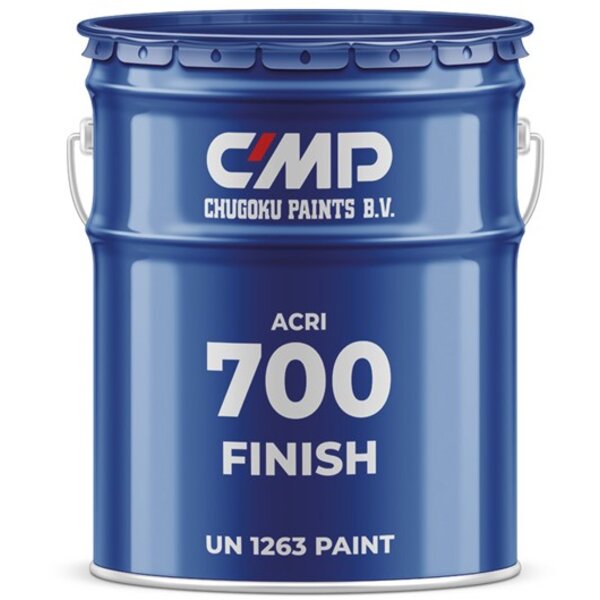
What is ACRI 700 FINISH and why choose it
ACRI 700 FINISH by Chugoku is a one-pack acrylic finish coat based on acrylic resin and physical drying by solvent evaporation. It is designed as a high-performance topcoat for ships and steel structures, offering excellent adhesion, weathering resistance and long-lasting gloss and colour retention. The coating does not yellow and can be applied by airless spray, brush or roller, making it suitable for professional marine and industrial maintenance work.
Main features
- Acrylic finish paint based on acrylic resin with solvent-evaporation drying.
- Excellent adhesion to properly prepared substrates and suitable existing coatings.
- High weathering resistance with very good gloss and colour retention.
- Non-yellowing topcoat appearance.
- Versatile application: suitable for airless spray, brush and roller.
- Marine and industrial use: finishing coat for ship topsides and superstructures and other steel structures.
- One-pack product for easier handling and application.
- Compatible systems: can be applied over ACRI 700 PRIMER, BANNOH series and UMEGUARD series primers and over suitable existing coatings.
Technical characteristics
Physical data
- Type: Acrylic finish paint.
- Colour: As specified.
- Flash point: 30 °C.
- Volume solids: 40 ±2 %.
- VOC (theoretical): 548 g/l.
Application data
- Application methods: Airless spray, brush, roller.
- Thinner: CR/ACRI THINNER A.
- Minimum application temperature: 5 °C.
- Maximum relative humidity: 85 % R.H.
Recommended airless spray settings
- Tip No.: Graco 719.
- Paint output pressure at tip: 12.0 – 15.0 MPa.
- Thinning: 0 – 10 % by volume (with CR/ACRI THINNER A).
Film thickness and spreading rate
- Wet film thickness: 75 – 100 µm.
- Dry film thickness: 30 – 40 µm.
- Theoretical spreading rate: 13.3 – 10.0 m²/l (at the above DFT range).
Drying and overcoating times at 35 µm DFT
- 5 °C: Surface dry 90 min; hard dry 10 h; minimum overcoating interval 16 h; no maximum.
- 10 °C: Surface dry 60 min; hard dry 8 h; minimum overcoating interval 12 h; no maximum.
- 20 °C: Surface dry 30 min; hard dry 6 h; minimum overcoating interval 8 h; no maximum.
- 30 °C: Surface dry 30 min; hard dry 4 h; minimum overcoating interval 6 h; no maximum.
Surface preparation
- All surface contamination such as dirt, grease, oil, etc. must be removed.
- Wash with fresh water (and detergents if necessary) and allow to dry.
- Can also be used over suitable existing coatings.
Compatible coatings
- Preferable preceding coatings: ACRI 700 PRIMER, BANNOH series, UMEGUARD series.
- Preferable subsequent coatings: Consultar ficha técnica del fabricante.
Applications and use cases
- Ship topsides and superstructures: Designed as a finishing coat on ship topside areas and superstructure where high weather resistance and colour retention are required.
- Steel decks and external steelwork: Suitable as final coat on steel structures when applied over specified primers from ACRI 700 PRIMER, BANNOH or UMEGUARD ranges.
- Maintenance over existing coatings: Can be applied over suitable existing paint systems after proper cleaning and surface preparation.
- Professional spray and brush/roller work: Formulated for both airless spray application and conventional brush/roller application in indoor or outdoor professional environments, following the safety recommendations of the Safety Data Sheet.
FAQ
-
What type of paint is ACRI 700 FINISH?
ACRI 700 FINISH is a one-pack acrylic finish paint based on acrylic resin, drying by solvent evaporation.
-
Where is ACRI 700 FINISH typically used?
It is recommended as a finishing coat on ship topsides and superstructures and as a final coat on steel structures when used over compatible primers.
-
Which application methods are supported?
The coating can be applied by airless spray, brush or roller.
-
What thinner should be used?
Use CR/ACRI THINNER A, with a thinning ratio of 0–10 % by volume for airless spray, according to the Technical Data Sheet.
-
Can it be applied over existing coatings?
Yes, ACRI 700 FINISH can be used over suitable existing coatings, provided that all contamination is removed and the surface is clean and dry.
-
What are the recommended primers?
The preferable preceding coatings are ACRI 700 PRIMER, BANNOH series and UMEGUARD series.
-
What is the minimum application temperature?
The minimum recommended substrate and ambient temperature for application is 5 °C, with a maximum relative humidity of 85 %.
-
Is ACRI 700 FINISH classified as hazardous?
Yes. It is classified as a flammable liquid (Flam. Liq. 3) and is very toxic to aquatic life with long lasting effects. It can cause skin and serious eye irritation, may cause respiratory irritation, drowsiness or dizziness, may cause harm to breast-fed children and may cause damage to organs through prolonged or repeated exposure.
-
Is it suitable for immersion service?
Consultar ficha técnica del fabricante.
-
What is the theoretical coverage of the product?
At a dry film thickness of 30–40 µm, the theoretical spreading rate is approximately 13.3–10.0 m² per litre.
Section 14 – Transport information
According to the Safety Data Sheet, ACRI 700 FINISH is classified as a dangerous good for transport.
- UN number: UN 1263.
- UN proper shipping name: PAINT.
- Transport hazard class: Class 3 (flammable liquid).
- Packing group: III.
- ADR/RID/ADN: Class 3, packing group III; environmentally hazardous substance for the aquatic environment; hazard identification number 30.
- IMDG: Class 3, packing group III; marine pollutant (Chlorinated paraffins, C14–17 (52%)); EmS code F-E, S-E.
- IATA: Class 3, packing group III.
- General transport advice: Always transport in closed, upright and secure containers and ensure personnel know the actions to take in case of accident or spillage.
Section 8 – Individual protection measures
Engineering controls
- Provide adequate ventilation using local exhaust and good general extraction. If these are not sufficient to keep solvent vapour and particulates below occupational exposure limits, suitable respiratory protection must be worn.
- During spray application in spray booths, operators may need compressed air-fed respiratory protection until vapour and particulate concentrations fall below exposure limits.
Respiratory protection
- If workers may be exposed above the exposure limits, use a respirator conforming to EN 140 fitted with a combined particulate and vapour filter to EN14387 (for example, type A2P3) with an assigned protection factor of at least 10.
- When dry sanding, flame cutting or welding on the dry paint film, use suitable respiratory protection if local exhaust ventilation is not sufficient.
Hand protection
- Use chemical-resistant gloves tested according to EN 374 for repeated or prolonged contact.
- Nitrile gloves provide good protection during spray application.
- Viton gloves offer good protection for intense solvent contact (e.g. complete immersion).
- Polyethylene (PE) gloves can be used as under-gloves in difficult situations such as high exposure or unknown chemical properties.
- Follow glove manufacturer instructions for use, storage, maintenance and replacement; replace gloves regularly and immediately when damaged.
Eye and face protection
- Use safety eyewear tested according to EN 16321 or EN 166, designed to protect against liquid splashes.
Skin and body protection
- Wear anti-static clothing made of natural fibre or high temperature resistant synthetic fibre (EN ISO 13688).
Environmental exposure control
- Do not allow the product to enter drains or watercourses.
Contenido generado por IA