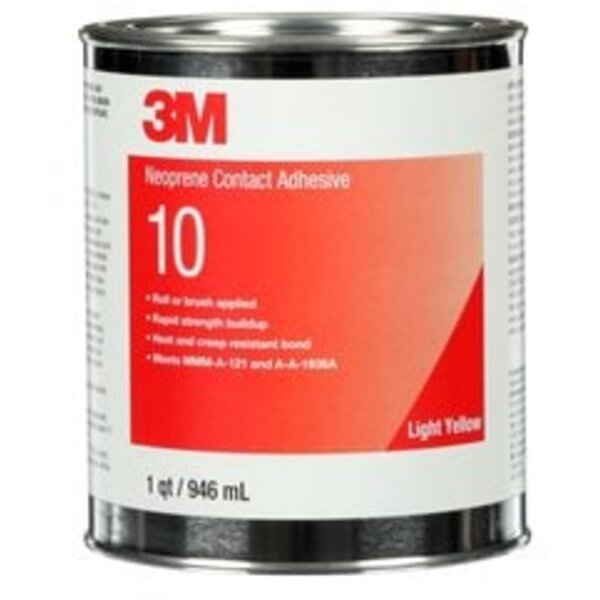
What FASTBOND 10 Contact Adhesive is and why choose it
FASTBOND 10 Contact Adhesive by 3M is a yellow, solvent-based industrial contact adhesive supplied as a liquid. It is designed exclusively for professional and industrial applications where a fast-acting, high-performance adhesive is required. The product combines a high content of volatile solvents with synthetic polymers such as polychloroprene and a range of hydrocarbons to deliver strong contact bonding, while complying with current REACH and CLP regulations.
Its formulation is classified as a highly flammable liquid (Flam. Liq. 2) and as toxic to aquatic life with long lasting effects (Aquatic Chronic 2), so it is particularly suited to controlled industrial environments where adequate ventilation, personal protective equipment and safe waste management are in place.
Main features
- Industrial contact adhesive: Formulated for professional and industrial use only; not intended for consumer applications.
- Liquid, solvent-based system: Yellow liquid with characteristic solvent odour, enabling brush, roller or spray application according to local procedures.
- Fast-evaporating solvent blend: Contains acetone, C6 and C7 isoalkane hydrocarbons and propyl acetate, providing rapid solvent evaporation and high percent of volatiles (77–79%).
- High flammability: Flash point of -26 °C and classified as Flammable Liquid Category 2; requires strict ignition control and explosion-proof ventilation.
- Irritant formulation: Causes skin irritation and serious eye irritation; may cause drowsiness or dizziness due to central nervous system depression.
- Allergy potential: Contains rosin (colophony), which may produce allergic skin reactions in sensitised individuals (EUH208).
- Environmental hazard: Classified as toxic to aquatic life with long lasting effects (Aquatic Chronic 2; presence of zinc oxide and hydrocarbon fractions).
- Stable under normal conditions: Chemically stable, non-reactive under normal use; no hazardous polymerisation expected.
- REACH-compliant Safety Data Sheet: Prepared according to Regulation (EC) 1907/2006 as amended by Regulation (EU) 2020/878.
Technical specifications
- Physical state: Liquid
- Colour: Yellow
- Odour: Solvent
- Boiling range: 48 – 105 °C (tested per ASTM protocol)
- Flash point: -26 °C (closed cup)
- Flammability classification: Flammable Liquid, Category 2 (Flam. Liq. 2; H225)
- Kinematic viscosity: 588 – 1,121 mm²/s
- Density: 0.803 – 0.851 g/ml (relative density 0.803 – 0.851 vs. water = 1)
- Percent volatile: 77 – 79 %
- Water solubility: Substance/mixture is non-soluble in water
- pH: Not applicable (non-soluble in water)
- Main classified components (approximate ranges by weight):
- Acetone: 10 – 30 % (Flam. Liq. 2; Eye Irrit. 2; STOT SE 3)
- Hydrocarbons, C7, n-alkanes, isoalkanes, cyclics: 15 – 30 % (Flam. Liq. 2; Skin Irrit. 2; STOT SE 3; Asp. Tox. 1; Aquatic Chronic 2)
- Hydrocarbons, C6, isoalkanes, < 5% n-hexane: < 20 % (Flam. Liq. 2; Skin Irrit. 2; STOT SE 3; Asp. Tox. 1; Aquatic Chronic 2)
- Propyl acetate: < 20 % (Flam. Liq. 2; Eye Irrit. 2; STOT SE 3)
- Polychloroprene: 5 – 15 % (not classified as hazardous)
- Formaldehyde, polymer with 4-(1,1-dimethylethyl)phenol, magnesium oxide complex: 5 – 15 % (not classified as hazardous)
- Zinc oxide: < 1 % (Aquatic Acute 1; Aquatic Chronic 1)
- Rosin: < 1 % (Skin Sens. 1B)
- Use restrictions: Restricted to industrial/occupational use. Not for consumer sale or use.
Applications and use cases
This product is identified as an adhesive/contact adhesive formulated for use at industrial sites and by professional workers. Typical operational scenarios described in the Safety Data Sheet include:
- Industrial use of adhesives: Application by brush, roller or industrial spraying in manufacturing or processing plants.
- Professional use of adhesives: Widespread use by trained professional workers, including non‑industrial spraying and roller/brush application in indoor and outdoor environments.
- Formulation and repacking: Transfer and filling into small containers in dedicated or non-dedicated facilities under controlled conditions.
All uses must follow the exposure scenarios and risk management measures described in the Safety Data Sheet, including proper ventilation, PPE, and waste management practices.
FAQ
1. Is FASTBOND 10 Contact Adhesive flammable?
Yes. It is classified as a Flammable Liquid Category 2 (Flam. Liq. 2; H225) with a flash point of -26 °C. Keep away from heat, hot surfaces, sparks, open flames and other ignition sources. No smoking, and use only non-sparking tools and explosion-proof ventilation.
2. What are the main health hazards during use?
The adhesive causes skin irritation (H315) and serious eye irritation (H319). Vapours may cause drowsiness or dizziness (STOT SE 3; H336) and can irritate the respiratory tract. It also contains rosin, which may produce allergic skin reactions in sensitised individuals.
3. Is this product suitable for consumer or household use?
No. The SDS explicitly restricts the product to industrial/occupational use only. It is not intended for consumer sale or household applications.
4. What ventilation is required during application?
Use general dilution and/or local exhaust ventilation to keep airborne concentrations below applicable occupational exposure limits and to control vapours, mist or spray. Where flammable vapours may accumulate, only explosion-proof ventilation equipment should be used.
5. How should I respond to accidental eye or skin contact?
For eye contact, immediately flush with plenty of water, remove contact lenses if easy to do, and continue rinsing; seek medical attention. For skin contact, wash immediately with soap and water, remove contaminated clothing and wash before reuse; if irritation develops, obtain medical attention.
6. What should be done in case of inhalation of vapours?
Remove the affected person to fresh air. If any symptoms such as headache, dizziness or nausea occur, seek medical attention.
7. How is waste adhesive or contaminated absorbent disposed of?
Dispose of contents and container according to local, regional, national and international regulations. The SDS recommends incineration in a permitted hazardous waste incineration facility. The EU waste code for the product as sold is 08 04 09* (waste adhesives and sealants containing organic solvents or other dangerous substances).
8. Is the product hazardous for the environment?
Yes. It is classified as hazardous to the aquatic environment, Chronic Category 2 (H411), and contains zinc oxide and hydrocarbon fractions that are toxic to aquatic organisms with long lasting effects. Avoid release to waterways, sewers or soil.
9. Does the product contain substances of very high concern (PBT/vPvB)?
According to the SDS, the mixture does not contain substances that are assessed to be persistent, bioaccumulative and toxic (PBT) or very persistent and very bioaccumulative (vPvB).
Section 14 – Transport information
FASTBOND 10 Contact Adhesive is classified as a dangerous good for transport by road, air and sea:
- UN number (ADR / IATA / IMDG): UN1133
- UN proper shipping name (ADR / IATA): ADHESIVES
- UN proper shipping name (IMDG): ADHESIVES (ZINC OXIDE)
- Transport hazard class: 3 (flammable liquids)
- Packing group: II
- Environmental hazards:
- ADR (ground): Environmentally hazardous
- IATA (air): Not applicable
- IMDG (marine): Marine pollutant
- ADR classification code: F1 (for ground transport)
- IMDG segregation code: NONE
- Special precautions for user: Refer to the Safety Data Sheet for additional information on hazards, safe handling, and emergency measures during transport and storage.
Section 8 – Personal protective measures
The following personal protective equipment (PPE) and exposure controls are specified in the Safety Data Sheet for FASTBOND 10 Contact Adhesive:
Engineering controls
- Use general dilution ventilation and/or local exhaust ventilation to control airborne exposure below relevant occupational exposure limits.
- Ventilation must control dust, fume, mist, vapours or spray generated during application.
- Where flammable vapours may be present, only explosion‑proof ventilation equipment should be used.
Eye and face protection
- Use eye/face protection based on the results of an exposure assessment.
- Recommended options:
- Safety glasses with side shields.
- Indirect vented safety goggles.
- Eye protection should conform to EN 16321.
Hand and skin protection
- Select gloves and/or protective clothing approved to relevant local standards to prevent skin contact.
- Selection must consider exposure level, concentration, frequency and duration of contact, temperature and other use conditions.
- Recommended glove material: polymer laminate (no specific thickness or breakthrough time data available).
- Nitrile gloves may be worn over polymer laminate gloves to improve dexterity.
- Gloves should be tested according to EN 374.
- Wear suitable protective clothing where there is a risk of splashes or extensive contact.
Respiratory protection
- An exposure assessment may be required to determine if respiratory protection is needed.
- If required, respirators must be used as part of a full respiratory protection program.
- Recommended types:
- Half-facepiece or full-facepiece air‑purifying respirator suitable for organic vapours and particulates.
- Organic vapour cartridges may have a short service life; change-out schedules should be defined according to conditions of use.
- Respirators must conform to EN 140 or EN 136 with filter types A and P.
Environmental exposure controls
- Avoid release to the environment; refer to the exposure scenarios in the SDS annex.
- Where applicable, waste water should be managed by incineration or treatment in authorised facilities, and releases to sewers or waterways must be prevented.
*Contenido generado por IA