What it is and why choose it
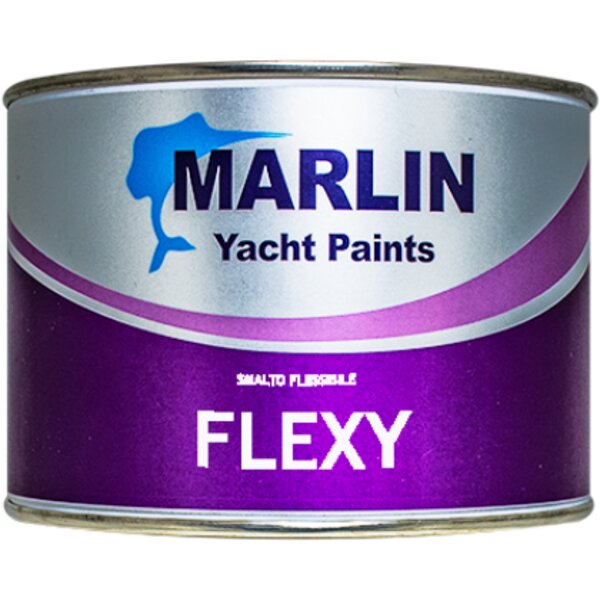
MARLIN FLEXY is a one-component satin enamel specially formulated for flexible inflatable boats and rubber or vinyl dinghies. Thanks to its excellent adhesion and flexibility, it is suitable for PVC, Hypalon, neoprene and other similar substrates, making it ideal for renewing and protecting worn inflatable tubes without cracking when the material bends or is inflated.
The product is designed for easy application by brush, roller or spray, with good coverage and a durable flexible film. It is recommended for users who need a specific coating for pneumatic boats rather than a rigid marine enamel.
Main features
- Flexible satin enamel specially developed for inflatable and rubber boats.
- One-component system for simple application and no mixing ratios.
- High adhesion on PVC, Hypalon, neoprene and similar tubular materials (after proper preparation).
- Good elasticity so the coating follows the deformations of the tubes without flaking.
- Suitable for refurbishment: formulated to renew and visually restore old rubber boats.
- Multiple application methods: brush, roller or spray.
- Available colours: white, grey, black and red oxide.
- Packaging size: 0.5 L.
- Theoretical coverage of 10–11 m²/L per coat (at 90–100 μm wet film thickness and 30–35 μm dry film thickness).
- Shelf life of 24 months when stored between 10 °C and 40 °C, protected from excessive humidity and direct sunlight.
Technical specifications
- Product type: one-component flexible satin enamel.
- Recommended substrates: inflatable boat tubes made of PVC, Hypalon, neoprene or similar materials.
- Colours: white, grey, black, red oxide.
- Solids by volume: 30–40 %.
- Specific weight: 1.20–1.30.
- VOC: 550–600 g/L.
- Pack size: 0.5 L.
- Theoretical yield: 10–11 m²/L per coat at 90–100 μm wet film thickness and 30–35 μm dry film thickness.
- Application methods: brush, roller, spray.
- Recommended thinner: Thinner No. 4.
- Shelf life: 24 months (storage between 10 °C and 40 °C, protected from excessive humidity and direct sunlight).
Application recommendations
Surface preparation
- Tubulars (PVC, Hypalon, neoprene or others):
- Wash the surface at least twice with a clean cloth soaked in SOLVENTE 102 antisilicone or another good quality paint remover.
- Use always clean cloths and replace them frequently on large surfaces to ensure complete removal of contaminants such as greases, waxes and silicones that can impair adhesion.
- Lightly sand with fine sandpaper (grit 320) or a scuffing felt pad to slightly roughen/matt the surface without damaging it.
Application by brush or roller
- Preferably apply by brush in two coats.
- Always brush in a single direction, without crossing or reworking areas that have already been painted, even if they are still fresh.
- This recommendation is especially important for the second coat.
- Apply two coats with an interval of approximately 6 hours at 20 °C.
Application by spray
- Dilute with Thinner No. 4 at approximately 10–20 %.
- Recommended nozzle: 1.8–2.0 mm.
- Recommended pressure: 50–60 PSI (3.5–4.0 bar).
Drying and curing times
Drying times depend on temperature, paint thickness, ventilation and humidity. The surface must be dry and free from contamination before applying the next coat. Launching must take place within 6 months after application.
| Temperature |
Dust dry |
Touch dry |
Overcoating interval |
Minimum time before immersion |
| 10 °C |
45 min |
5 h |
12 h |
48 h |
| 20 °C |
30 min |
3 h |
6 h |
24 h |
| 30 °C |
20 min |
2 h |
4 h |
16 h |
Use recommendations
- Mix very thoroughly before use; the product can show marked separation due to the pigments used in the formulation.
- Do not apply at temperatures below 5 °C or above 38 °C.
- At temperatures below 10 °C, wait at least 48 hours before launching after the final coat.
Applications and use cases
- Refurbishment of inflatable dinghies: restores the appearance of aged PVC, Hypalon or neoprene tubes.
- Protection of rubber and vinyl boats: provides a flexible, adherent coating adapted to pneumatic craft.
- Touch-up work on localised worn or discoloured areas of inflatable tubes, following the recommended surface preparation.
FAQ
How many coats are recommended?
The product should preferably be applied in two coats, especially when applied by brush.
Can it be applied directly on PVC and Hypalon tubes?
Yes, it is suitable for PVC, Hypalon, neoprene and similar tubular materials, provided that the surface is carefully cleaned with antisilicone solvent and lightly sanded as indicated.
Which application methods are allowed?
The enamel can be applied by brush, roller or spray, following the corresponding dilution and equipment recommendations.
What thinner should be used?
The recommended thinner is Thinner No. 4. For spray application, dilute approximately 10–20 % with this thinner.
How long do I need to wait before launching the boat?
Minimum immersion times are 48 hours at 10 °C, 24 hours at 20 °C and 16 hours at 30 °C. In any case, launching must take place within 6 months of application.
What is the approximate coverage?
The theoretical coverage is 10–11 m²/L per coat at 90–100 μm wet film thickness and 30–35 μm dry film thickness.
How should the product be stored?
Store the can between 10 °C and 40 °C, protected from excessive humidity and direct sunlight. Under these conditions the shelf life is 24 months.
At what temperatures can I apply the product?
Do not apply at temperatures below 5 °C or above 38 °C. If temperatures are below 10 °C, wait at least 48 hours before launching after the last coat.
Is the product flammable?
Yes. According to the safety data sheet it is classified as a flammable liquid, category 3 (H226: flammable liquid and vapour). Keep away from heat, hot surfaces, sparks and open flames.
How should I dispose of leftovers and empty packaging?
Use dedicated hazardous waste containers normally available in storage areas or consult the site manager. Disposal must be carried out in accordance with applicable regulations.
Section 14 – Transport information
- UN number: 1263.
- UN proper shipping name: PAINT or PAINT RELATED MATERIAL.
- Transport hazard class:
- ADR/RID: Class 3, label 3.
- IMDG: Class 3, label 3.
- IATA: Class 3, label 3.
- Packing group: I.
- Environmentally hazardous:
- ADR/RID: no.
- IMDG: no.
- IATA: no.
- Special precautions for users: information given in the safety data sheet indicates the need to follow the regulations applicable to class 3 flammable liquids during transport.
Section 8 – Personal protective measures
During handling and application, ensure good ventilation of the work area and, where necessary, use the following personal protective equipment as indicated in the safety data sheet:
- Hand protection: work gloves of category III compliant with EN 374, selected taking into account compatibility, degradation, breakthrough time and permeability.
- Skin protection: long-sleeved work clothing and professional protective footwear of category I (Regulation 2016/425 and EN ISO 20344). Wash with water and soap after removing protective clothing. Consider antistatic clothing if there is explosion risk.
- Eye protection: tight-fitting safety goggles compliant with EN 166.
- Respiratory protection: if exposure limits are exceeded, use a half mask with type A filter selected according to EN 14387, or combined filters where vapours and aerosols may be present. In emergencies or where oxygen levels are inadequate, use self-contained breathing apparatus in accordance with EN 137 or respirators with external air supply according to EN 138.
- Environmental exposure control: process emissions, including those from ventilation systems, must be controlled to meet environmental protection regulations.
Contenido generado por IA