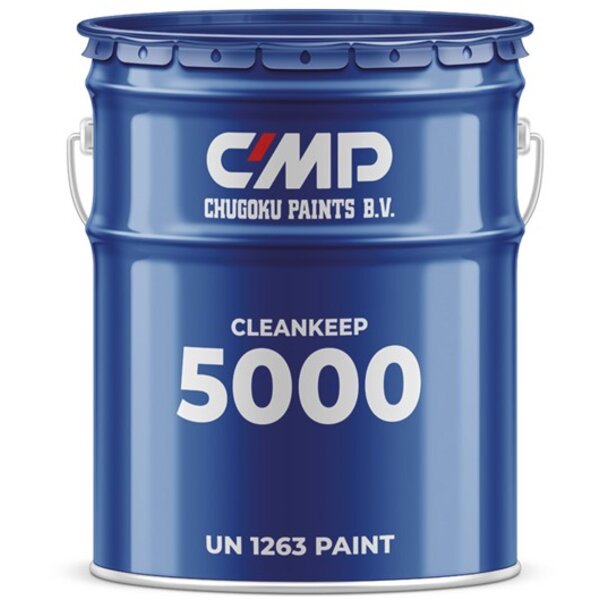
What is CLEAN KEPP 5000 CONVERTER and why choose it?
CLEAN KEPP 5000 CONVERTER is the hardener component of the CLEANKEEP 5000 solvent-free epoxy system from Chugoku. Together with the base component, it forms a high-build, 100% solids lining for drinking water and fresh water tanks. The system is free of solvents and heavy metals, eliminating the risk of solvent contamination, fire during application and organic solvent poisoning, while providing a tough, glossy and smooth internal tank coating.
When correctly mixed with the CLEANKEEP 5000 base, the converter allows a single high-build coat (up to 500 µm dry film) by airless spray and is certified for use in potable water tanks by authorities in Singapore, Italy and Japan.
Main features
- Two-pack, solvent-free epoxy system: 100% volume solids and 0 g/L VOC (theoretical).
- Designed for drinking water service: Recommended for fresh water, drinking water and potable water tanks; may also be used in other tanks and dry spaces.
- High-build application: One-coat application of 300–500 µm DFT by airless spray (300 µm specified in the English TDS; 500 µm noted as achievable).
- No added thinner in use: No thinning required for application; EPOXY THINNER A is used only for equipment cleaning.
- Excellent hygiene profile: No heavy metals; solvent-free formulation helps minimise contamination risk of stored water.
- Certified for potable water:
- SS375:1994 – Singapore
- Ministry of Health Circular no.102/78:2001 – Italy
- Hiroshima City Research Laboratory of Public Health – Japan
- Application versatility: Can be applied by airless spray; brush and roller are permitted for smaller areas or stripe-coating (additional coats may be required to reach specified thickness).
- Dedicated converter/hardener SDS: CLEANKEEP 5000 HARDENER (converter) includes full safety, handling and transport classification information.
Key technical characteristics
System and mixing
- Type: Solvent-free epoxy coating.
- Components: Two-pack product (Base + CLEAN KEPP 5000 CONVERTER).
- Mixing ratio (by volume): Base 81 : Converter (Hardener) 19.
- Mixing instructions: Add the converter to the base while mixing and stir well before use.
- Packing: Two-pack product. Consultar ficha técnica del fabricante.
Recommended use
- Fresh water tanks.
- Drinking water / potable water tanks.
- Other tanks and dry spaces where a solvent-free epoxy lining is required.
Physical data (mixed product)
- Colour: Off-white, red brown, cream.
- Flash point (mix): >100°C (ISO 13736).
- Volume solids: 100%.
- VOC (theoretical): 0 g/L.
- Relative density (converter only): approx. 0.97 at 20°C (ASTM D1475-98).
- Kinematic viscosity (converter only): 12 mm²/s at 40°C (ISO 3219), non-Newtonian, thixotropic.
Application data (mixed system)
- Application methods: Airless spray, brush, roller.
- Airless spray tip size: Graco 619, 721.
- Paint output pressure: 23.5 – 33.4 MPa.
- Thinning: No thinning required.
- Thinner for cleaning: EPOXY THINNER A (for cleaning only).
- Minimum substrate temperature: 10°C.
- Surface temperature: At least 3°C above dew point.
- Maximum relative humidity: 85% R.H.
Film thickness and spreading rate (mixed system)
- Wet film thickness (typical): 300 µm.
- Dry film thickness (typical): 300 µm.
- Theoretical spreading rate: 3.3 m²/L at 300 µm DFT.
Compatible primers and subsequent coats
- Preferable preceding coatings: CERABOND 2000, EPICON ZINC RICH PRIMER B-2, CLEANKEEP 5000 HOLDING PRIMER.
- Preferable subsequent coating: Not specified. Consultar ficha técnica del fabricante.
Surface preparation (for the full system)
- New building: Dependent on yard procedures. Consult CMP representative.
- Repair/Maintenance:
- Remove oil and grease.
- Remove salt and other contaminants with fresh water high-pressure cleaning and dry the surface completely.
- Damaged areas: abrasive blast to Sa2 (ISO 8501-1:2007) minimum or power-tool clean to St3 (ISO 8501-1:2007).
- For water jetting, consult CMP representative.
Drying and overcoating (at 300 µm DFT)
- 10°C:
- Surface dry: 45 hours.
- Hard dry: 4 days.
- Minimum overcoating interval: 4 days.
- Maximum overcoating interval: 14 days.
- Pot life: 1.5 hours.
- 20°C:
- Surface dry: 18 hours.
- Hard dry: 32 hours.
- Minimum overcoating interval: 32 hours.
- Maximum overcoating interval: 14 days.
- Pot life: 1 hour.
- 30°C:
- Surface dry: 11 hours.
- Hard dry: 24 hours.
- Minimum overcoating interval: 24 hours.
- Maximum overcoating interval: 14 days.
- Pot life: 45 minutes.
Note: Drying times and overcoating intervals increase with higher applied film thickness. Before overcoating, ensure the existing film is completely through-dry.
Applications and use cases
- Drinking water tanks: Internal lining of potable water storage where certifications for human consumption are required.
- Fresh water tanks: Protection of fresh water storage tanks in marine and industrial environments.
- Other liquid storage and dry spaces: May be used in other tanks and dry compartments requiring a solvent-free, high-build epoxy coating. Consultar ficha técnica del fabricante for chemical resistance specifics.
FAQ
1. What is CLEAN KEPP 5000 CONVERTER used for?
It is the converter/hardener component for the CLEANKEEP 5000 solvent-free epoxy system, enabling curing and film formation on fresh water and potable water tank linings.
2. What is the correct mixing ratio with the base component?
The recommended mixing ratio is 81 parts base to 19 parts converter by volume. Always add the converter to the base while mixing and stir thoroughly before use.
3. Can I add thinner to the mix?
No. Thinning is not required and should be avoided. EPOXY THINNER A is specified only for cleaning application equipment.
4. What application methods are allowed?
The mixed product can be applied by airless spray, brush or roller. When using brush or roller, additional coats may be needed to achieve the specified dry film thickness.
5. Which primers are compatible?
Preferred primers before applying the CLEANKEEP 5000 system include CERABOND 2000, EPICON ZINC RICH PRIMER B-2 and CLEANKEEP 5000 HOLDING PRIMER.
6. Is the system suitable for drinking water?
Yes. CLEANKEEP 5000 is certified for drinking water service in Singapore (SS375:1994), Italy (Ministry of Health Circular no.102/78:2001) and by the Hiroshima City Research Laboratory of Public Health in Japan.
7. What are the recommended environmental conditions during application?
Substrate temperature should be at least 10°C and at least 3°C above the dew point, with a maximum relative humidity of 85% R.H.
8. How long can I use the mixed paint (pot life)?
Pot life depends on temperature at 300 µm DFT: approximately 1.5 hours at 10°C, 1 hour at 20°C and 45 minutes at 30°C.
9. Does the converter contain solvents or heavy metals?
The overall CLEANKEEP 5000 system is formulated as a solvent-free epoxy with no heavy metals and a theoretical VOC of 0 g/L.
10. Where can I find more detailed performance or storage data?
Where information is not listed here, please refer to the manufacturer documentation: Consultar ficha técnica del fabricante.
Section 14 – Transport information (CLEANKEEP 5000 HARDENER / CONVERTER)
- UN number: UN 2735.
- UN proper shipping name (ADR/RID/ADN, IMDG, IATA): AMINES, LIQUID, CORROSIVE, N.O.S. (Reaction Products Of Di-, Tri- And Tetra-Propoxylated Propane-1,2-Diol With Ammonia., 3-Aminomethyl-3,5,5-Trimethylcyclohexylamine.).
- Transport hazard class: Class 8 (corrosive).
- Packing group: II.
- Hazard identification number (ADR/RID): 80.
- Marine pollutant: No.
- EmS (IMDG): F-A, S-B.
- Environmental hazards under transport rules: Not classified as environmentally hazardous for transport.
- Special precautions for user: Always transport in closed, upright and secure containers. Ensure transport personnel know what to do in case of accident or spillage.
- Bulk transport under IMO instruments: Not applicable.
Section 8 – Personal protection measures
The CLEANKEEP 5000 converter is classified as causing severe skin burns and eye damage, harmful if swallowed and potentially sensitising to skin. Appropriate personal protective equipment (PPE) and engineering controls are essential.
Engineering controls
- Provide adequate ventilation via local exhaust and general extraction.
- For spraying in booths or confined spaces, ventilation may be insufficient; use compressed air-fed or suitable respirators until vapour and particulate levels are below exposure limits.
- Avoid release to drains or watercourses.
Respiratory protection
- If exposure may exceed occupational limits, use a half-mask respirator to EN 140 fitted with combined particulate and vapour filters to EN 14387, with an assigned protection factor of at least 10 (e.g. A2P3).
- During dry sanding, flame cutting or welding of the cured film, use suitable respiratory protection if local exhaust ventilation cannot control dust and fumes.
Hand protection
- Use chemical-resistant gloves tested to EN 374.
- Suitable materials (examples, depending on exposure time) include:
- Polyethylene (PE) gloves (0.062 mm) – high chemical resistance.
- Butyl/Viton gloves (approx. 0.70 mm) – high protection for prolonged contact or immersion.
- Butyl gloves (approx. 0.3 mm) – high protection.
- Neoprene gloves (0.13–<0.4 mm) – medium to low protection depending on thickness.
- Nitrile gloves offer good protection during spray application.
- Use PE gloves as under-gloves for difficult situations (high exposure or unknown composition).
- Replace gloves regularly and immediately if damaged; follow glove manufacturer instructions.
Eye and face protection
- Wear chemical splash goggles or face protection tested to EN 16321 / EN 166.
Skin and body protection
- Wear anti-static protective clothing made of natural fibre or high temperature-resistant synthetic fibre (EN ISO 13688).
- Avoid skin contact; remove contaminated clothing immediately and wash skin thoroughly with soap and water.
General hygiene and safety measures
- Do not breathe vapours or spray mist.
- No smoking, eating or drinking in the application area.
- Prevent the product from entering drains, surface water or soil.
- In case of eye contact: rinse immediately with plenty of clean water for at least 15 minutes and seek medical attention.
- If swallowed: rinse mouth, do not induce vomiting and seek immediate medical advice.
Contenido generado por IA