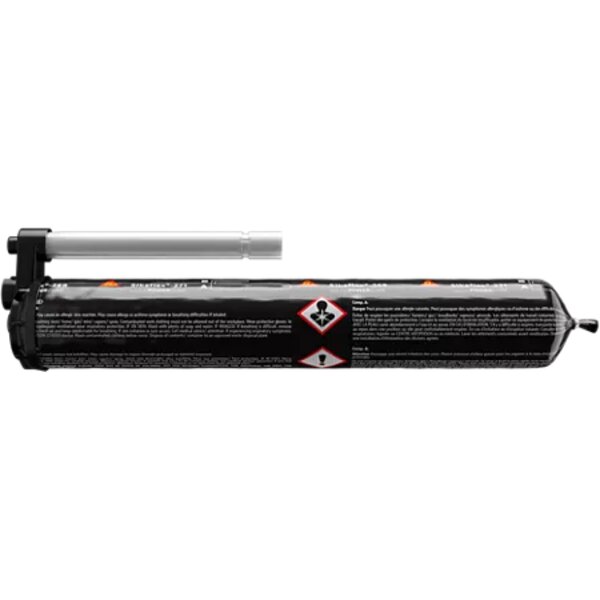
What Sikaflex®-268 PowerCure is and why choose it
Sikaflex®-268 PowerCure from Sika is an accelerated polyurethane adhesive and sealant system developed specifically for demanding rail and commercial vehicle applications. Used for both structural assembly bonding and direct glazing, it combines fast curing with excellent weathering resistance and outstanding resistance to a wide variety of rail and vehicle cleaning agents. Thanks to Sika’s PowerCure technology, the cure is largely independent of atmospheric humidity, making it reliable in varying climatic conditions and ideal for exterior joints.
The product is black, solvent-free and non-sag, offering very good processing and tooling characteristics for clean, uniform adhesive beads in production and repair environments.
Main features
- Accelerated curing system: PowerCure technology delivers fast strength build-up, largely independent of ambient humidity.
- Designed for rail and vehicle glazing: Suitable for assembly bonding and direct glazing in the rail industry, commercial vehicles and the repair market.
- Excellent weathering stability: Formulated for long-term outdoor exposure in exterior joints.
- High resistance to cleaning agents: Resists a wide range of rail and vehicle cleaners when used according to manufacturer guidelines.
- Black-primerless compatible: Compatible with Sika’s black-primerless bonding process.
- Very good non-sag behaviour: Maintains bead geometry on vertical and overhead applications.
- Good mechanical performance: High elongation and tensile strength for durable, flexible joints.
- Solvent-free formulation: Contains no added solvents.
- Compliance with rail fire standard: Passes EN45545-2 R1 / R7 HL3.
Technical specifications
- Chemical base: Polyurethane
- Colour: Black
- Cure mechanism: Moisture-curing, accelerated by PowerCure technology
- Density (uncured): 1.3 kg/l
- Non-sag properties: Very good
- Application temperature: 10 – 35 °C
- Open time: approx. 30 minutes (23 °C / 50 % r.h.)
- Shrinkage: 1 %
- Shore A hardness: 55 (CQP023-1 / ISO 48-4)
- Tensile strength: 6 MPa (CQP036-1 / ISO 527)
- Elongation at break: 500 % (CQP036-1 / ISO 527)
- Tear propagation resistance: 13 N/mm (CQP045-1 / ISO 34)
- Tensile lap-shear strength: 4.5 MPa (CQP046-1 / ISO 4587)
- Service temperature range: -50 to 90 °C
- Shelf life: 9 months (storage below 25 °C)
- Packaging: PowerCure Pack 600 ml
Cure mechanism and early strength build-up
Sikaflex®-268 PowerCure cures by reaction with moisture supplied by the accelerator paste, making the process largely independent from atmospheric humidity. Typical tensile lap-shear strength development at 23 °C / 50 % r.h. is:
- 2 h: 0.2 MPa
- 3 h: 1 MPa
- 4 h: 2 MPa
- 6 h: 3.5 MPa
Chemical resistance
- Resistant to: fresh water, seawater, diluted acids and diluted caustic solutions; a wide range of rail cleaning agents when used as directed.
- Temporarily resistant to: fuels, mineral oils, vegetable and animal fats and oils.
- Not resistant to: organic acids, glycolic alcohol, concentrated mineral acids, concentrated caustic solutions and solvents.
Some aggressive rail cleaners (for example those containing phosphoric acids) may significantly influence durability. Exposure time must be minimised, correct dilution observed and thorough rinsing performed after cleaning. Newly introduced cleaning products should be tested beforehand.
Applications and use cases
- Rail industry assembly bonding: Structural bonding of exterior and interior components where high mechanical strength and weathering resistance are required.
- Direct glazing in rail vehicles: Bonding of windows and windscreens with very good tooling properties and non-sag behaviour.
- Exterior joints on rail stock: Sealing of joints exposed to weather and regular cleaning with rail-specific cleaning agents.
- Commercial vehicle glazing and assembly: Direct glazing and component bonding on buses, coaches and other commercial vehicles.
- Repair market: Re-bonding and resealing of glazing and exterior joints during maintenance and refurbishment.
The product is intended for professional, experienced users. Tests with actual substrates and real conditions must be carried out to ensure adhesion and compatibility. Manufacturer advice should be sought, especially for materials prone to stress cracking.
Method of application
Surface preparation
- Substrates must be clean, dry and free from grease, oil and dust.
- Surface treatment depends on the specific substrate and is crucial for a durable bond.
- All pre-treatment steps must be verified by preliminary tests on original substrates under actual assembly conditions.
Application
- Set up the PowerCure Dispenser according to the PowerCure User Manual.
- If application is interrupted for more than 15 minutes, replace the mixer.
- Processing temperature range: 10 – 35 °C; optimum temperature for both substrate and adhesive: 15 – 25 °C.
- Open time is significantly shorter in hot and humid climates; parts must be joined within the open time. A temperature increase of about 10 °C halves the open time.
- To obtain a uniform bond-line thickness, apply the adhesive as a triangular bead.
Tooling and finishing
- Tooling must be completed within the open time of the adhesive.
- Use Sika® Tooling Agent N for finishing. Other agents must be tested for suitability and compatibility.
Removal and cleaning
- Uncured Sikaflex®-268 PowerCure can be removed from tools and equipment using Sika® Remover-208 or another suitable solvent.
- Once cured, the product can only be removed mechanically.
- Hands and exposed skin should be cleaned immediately with hand wipes such as Sika® Cleaner-350H or a suitable industrial hand cleaner and water. Solvents must not be used on skin.
FAQ
1. What is Sikaflex®-268 PowerCure used for?
It is used as a polyurethane adhesive and sealant for assembly bonding and direct glazing in the rail and commercial vehicle industries, including exterior joints exposed to weather and cleaning agents.
2. Can it be used outdoors?
Yes. The product offers excellent weathering stability and is designed for exterior joints on rail vehicles and similar applications.
3. What is the recommended application temperature range?
The adhesive should be applied between 10 and 35 °C, with an optimal substrate and product temperature between 15 and 25 °C.
4. How long is the open time?
The typical open time is about 30 minutes at 23 °C and 50 % relative humidity. In warmer and more humid conditions the open time is significantly shorter.
5. How fast does it build strength?
At 23 °C and 50 % relative humidity, typical tensile lap-shear strength is approximately 0.2 MPa after 2 hours, 1 MPa after 3 hours, 2 MPa after 4 hours and 3.5 MPa after 6 hours.
6. What is the service temperature range once cured?
Typical service temperature is from -50 to 90 °C.
7. Is it resistant to cleaning agents and fuels?
It is resistant to many rail cleaning agents when used as specified, and temporarily resistant to fuels, mineral oils and vegetable/animal fats and oils. It is not resistant to organic acids, glycolic alcohol, concentrated mineral acids, concentrated caustic solutions or solvents.
8. How should Sikaflex®-268 PowerCure be stored and what is its shelf life?
It should be stored below 25 °C in a dry, well-ventilated place with the container tightly closed. Under these conditions the typical shelf life is 9 months.
9. Is the product solvent-free?
Yes, Sikaflex®-268 PowerCure is solvent-free.
10. Who should use this product?
It is intended only for professional, experienced users. Adequate training is required before industrial or professional use, and tests on actual substrates and conditions are necessary to ensure adhesion and compatibility.
Section 14 – Transport information
According to the available transport data, Sikaflex®-268 PowerCure Part A is not regulated as a dangerous good for the main transport modes:
- ADR (road): Not regulated as a dangerous good.
- IMDG (sea): Not regulated as a dangerous good.
- IATA (air): Not regulated as a dangerous good (cargo and passenger).
No special transport class, UN number or packing group is assigned for the product as supplied.
Section 8 – Personal protective measures
Sikaflex®-268 PowerCure Part A is classified as a respiratory and skin sensitiser and as harmful to aquatic life with long lasting effects. Appropriate personal protective equipment and handling measures are required during use.
Exposure controls and ventilation
- Maintain airborne concentrations below applicable occupational exposure limits.
- Ensure good general ventilation; use local exhaust extraction in confined or mixing areas.
- Avoid breathing mist or vapours.
Eye and face protection
- Wear safety glasses with side shields conforming to EN166.
Hand protection
- Wear chemical-resistant, impervious gloves complying with EN 374.
- Suitable for short-term use or splash protection: butyl rubber/nitrile rubber gloves with thickness greater than 0.1 mm.
- Suitable for prolonged exposure: Viton gloves with thickness around 0.4 mm and breakthrough time greater than 30 minutes.
- Remove and dispose of contaminated gloves.
Skin and body protection
- Wear protective clothing such as safety shoes (EN ISO 20345), long-sleeved workwear and long trousers.
- For mixing and stirring operations, additional rubber aprons and protective boots are recommended.
Respiratory protection
- If ventilation is inadequate, use appropriate respiratory protection.
- Select a properly fitted, NIOSH-approved air-purifying or air-fed respirator based on anticipated exposure levels.
- Use an organic vapour filter (Type A): A1 for concentrations below 1000 ppm, A2 below 5000 ppm, A3 below 10000 ppm.
General hygiene measures
- Do not eat, drink or smoke when handling the product.
- Wash hands before breaks and after work.
- Persons with a history of skin sensitisation, asthma, allergies or chronic respiratory diseases should not work in processes where this mixture is used.
*Contenido generado por IA