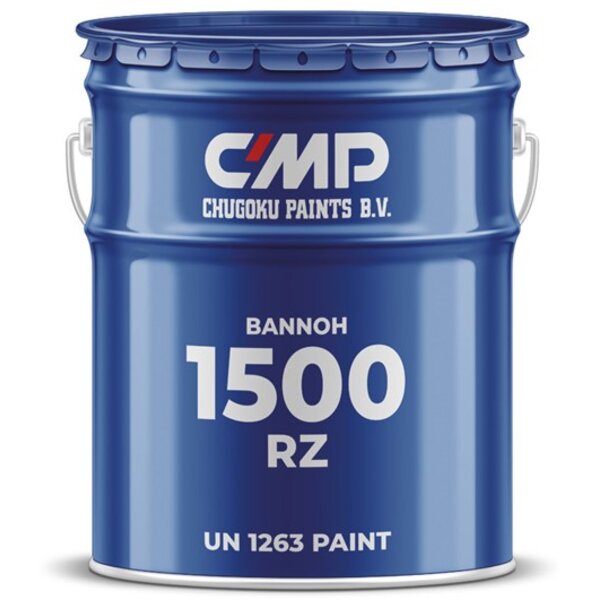
What is BANNOH 1500 RZ PART A and why choose it
BANNOH 1500 RZ PART A is the base component of BANNOH 1500 R Z, a high-solids, two-pack epoxy anticorrosive tie coat from Chugoku. Designed for professional marine use, it is applied together with the corresponding hardener to form a tough, abrasion-resistant film with excellent resistance to fresh and sea water.
This binder coat is optimised for use between anticorrosive primers and antifouling systems on ship hulls and also works as an anticorrosive coating for decks and superstructures. Its smooth surface and low Friction Increase Ratio (FIR) help maintain vessel efficiency while offering reliable overcoatability with a wide range of Chugoku antifoulings and finishes.
Main features
- High-solids epoxy binder: Epoxy coating with a volume solids content of 64 ±2% for high-build applications.
- Excellent water and seawater resistance: Suitable for hulls and exposed marine structures.
- Smooth surface and low FIR: Provides a smooth profile that helps subsequent antifoulings achieve low friction.
- Outstanding overcoatability: Compatible as a tie coat with multiple Chugoku antifouling series and epoxy topcoats.
- Tough, abrasion-resistant film: Designed to withstand mechanical stress on hulls, decks and superstructures.
- Wide application window: Can be applied down to -5 °C with suitable curing times and up to 85% relative humidity.
- Professional application methods: Airless spray for high productivity; brush or roller for touch-up and smaller areas.
Technical specifications
Product and composition
- Type: Epoxy coating / epoxy paint.
- System: Two-pack product (Base + Hardener).
- Product name (base): BANNOH 1500 RZ PART A (BANNOH 1500 R Z BASE).
- Mixing ratio (by volume): Base 81 : Hardener 19.
- Colours: Grey, Plum, Black.
Physical data
- Volume solids (VS): 64 ±2 % (ISO 3233).
- VOC (theoretical): 319 g/l.
- Density of base: 1.45 g/ml (ISO 2811).
- Flash point (mix): 25 °C (ISO 13736).
- State: Liquid.
Film thickness and spreading rate
- Recommended wet film thickness: 156 – 391 µm.
- Recommended dry film thickness: 100 – 250 µm.
- Theoretical spreading rate: 6.4 – 2.6 m²/l (depending on DFT).
Application conditions and equipment
- Application methods: Airless spray, brush, roller.
- Minimum steel temperature: -5 °C.
- Maximum relative humidity: 85% RH.
- Surface temperature: At least 3 °C above the dew point.
- Thinner: EPOXY THINNER A (also EPOXY THINNER G in some specifications).
- Thinning: 0 – 15% by volume.
- Airless spray tip size: Graco 619, 621, 623.
- Airless pump output pressure: 15 – 25 MPa.
Drying and overcoating (typical values at 250 µm DFT)
- -5 °C: Surface dry 30 h; hard dry 66 h; minimum overcoat interval 66 h.
- 0 °C: Surface dry 16 h; hard dry 42 h; minimum overcoat interval 42 h.
- 5 °C: Surface dry 14 h; hard dry 20 h; minimum overcoat interval 20 h.
- 10 °C: Surface dry 5 h; hard dry 12 h; minimum overcoat interval 12 h.
- 20 °C: Surface dry 3 h; hard dry 8 h; minimum overcoat interval 8 h.
- 30 °C: Surface dry 2 h; hard dry 6 h; minimum overcoat interval 6 h.
- Drying and overcoating times increase with higher film thickness.
Surface preparation and compatible systems
- Substrate: Steel structures for marine service.
- New steel: Consultar ficha técnica del fabricante.
- Repair/maintenance:
- Remove oil, grease, salts and contaminants with fresh water cleaning at high pressure and dry thoroughly.
- Abrasive blast to minimum Sa2 (ISO 8501-1:2007) or power tool cleaning to St3 (ISO 8501-1:2007).
- Water jetting: Consult CMP representative.
- Preferable preceding coats: BANNOH 1500, CERABOND 2000, EPICON ZINC RICH PRIMER B-2 and similar anticorrosive primers.
- Preferable subsequent coats (examples): SEA GRANDPRIX series, SEAFLO NEO series, SEATENDER series, UNY MARINE HS M, EPICON MARINE FINISH, SEAFLO NEO SL Z, SEAFLO NEO SL, SEAGRANDPRIX 1000 L, EPICON FINISH HB.
Applications and use cases
- Exterior hull tie coat: Applied between epoxy anticorrosive systems and antifouling paints on underwater hulls, boottops and topsides.
- Decks and superstructures: Anticorrosive coating for exposed decks and upper works where mechanical resistance and water resistance are required.
- Newbuilding projects: Used as part of specified coating schemes in shipyards (procedures to be defined by the yard and CMP representatives).
- Repair and maintenance: Suitable for large-scale refurbishment and onboard maintenance where existing coatings are properly prepared.
- High-build applications: Where a thick, durable epoxy layer with smooth finish is needed in a limited number of coats.
FAQ
Is BANNOH 1500 RZ PART A a standalone product?
No. BANNOH 1500 RZ PART A is the base component of a two-pack epoxy system and must always be mixed with the specified hardener (BANNOH 1500 R Z Hardener) in a ratio of 81:19 by volume.
Where is this product typically used on a vessel?
It is used as a binder coat on exterior hulls between anticorrosive primers and antifouling paints, and as an anticorrosive coating on decks and superstructures.
What are the recommended application methods?
Professional application by airless spray is recommended for most areas. Brush or roller can be used for stripe coats, small areas or touch-up; in these cases additional coats may be necessary to reach the specified film thickness.
What is the minimum steel temperature for application?
The minimum recommended substrate temperature is -5 °C, provided it is at least 3 °C above the dew point and the relative humidity does not exceed 85%.
Which thinner should be used?
Use EPOXY THINNER A (and, where specified, EPOXY THINNER G), with a thinning ratio of 0–15% by volume depending on application conditions.
Can it be applied in confined spaces?
Yes, but confined spaces such as tanks and voids must be well ventilated during application and curing to remove vapours and promote proper curing.
Is BANNOH 1500 R Z BASE classified as flammable?
Yes. According to its safety data, it is classified as a flammable liquid, with a flash point of 25 °C for the mixed product.
What about environmental hazards?
The base component is classified as harmful to aquatic organisms with long lasting effects. Avoid release to the environment and handle waste according to local regulations.
Section 14 – Transport information
The following summary is based on the Safety Data Sheet for BANNOH 1500 R Z BASE (Part A):
- UN number: UN 1263.
- UN proper shipping name: PAINT / PINTURA.
- Transport hazard class: Class 3 (flammable liquids).
- Packing group: III.
- ADR/RID/ADN: UN 1263, Class 3, Packing group III, label 3.
- IMDG: UN 1263, Class 3, Packing group III, label 3, not classified as marine pollutant for the base component.
- IATA: UN 1263, Class 3, Packing group III, label 3.
- Special precautions:
- Transport only in tightly closed, upright containers.
- Containers that are not properly cleaned may contain highly flammable or explosive vapours.
- Ensure personnel know what to do in case of accident or leakage.
Section 8 – Personal protection measures
Key exposure control and personal protective equipment (PPE) requirements for handling BANNOH 1500 R Z BASE, summarised from Section 8 of its Safety Data Sheet:
Engineering controls
- Provide adequate general and, where necessary, local exhaust ventilation to keep solvent vapour and spray mist below occupational exposure limits.
- When dry sanding, cutting or welding on the dry film, avoid dust and fumes; use wet methods where possible or local exhaust plus respiratory protection.
Respiratory protection
- When exposure may exceed limits, use a half-mask respirator complying with EN 140 fitted with combined particulate and organic vapour filters in accordance with EN 14387 (for example A2P3) with a protection factor of at least 10.
Hand protection
- Use chemical resistant gloves tested according to EN 374.
- Recommended materials for repeated or prolonged contact:
- Polyethylene (PE) gloves, minimum thickness 0.062 mm.
- Viton/butyl rubber gloves, typical thickness around 0.70 mm.
- For splash or short-term exposure: PE gloves (0.062 mm) and/or Viton/butyl gloves; nitrile gloves can also provide good resistance depending on thickness.
- Inspect gloves before use, replace regularly and immediately if damaged. Use PE under-gloves beneath other gloves in challenging conditions such as high exposure or unknown composition.
Eye and face protection
- Wear safety goggles or face shield designed to protect against liquid splashes, conforming to EN 16321 or EN 166.
Skin and body protection
- Wear antistatic protective clothing made from natural fibres or heat-resistant synthetic fibres (EN ISO 13688).
- Avoid contact with skin; do not use solvents to clean paint from skin. Wash with lukewarm water and soap or suitable skin cleaner.
General safety and hygiene measures
- Keep away from heat, hot surfaces, sparks and open flames. No smoking.
- Avoid breathing vapours, spray mist or sanding dust.
- Do not eat, drink or smoke in the application area.
- Store containers tightly closed in a dry, well-ventilated place between 0 and 40 °C, away from direct sunlight and oxidising, strongly acidic or strongly alkaline materials.
- Prevent the product from entering drains or watercourses.
Contenido generado por IA