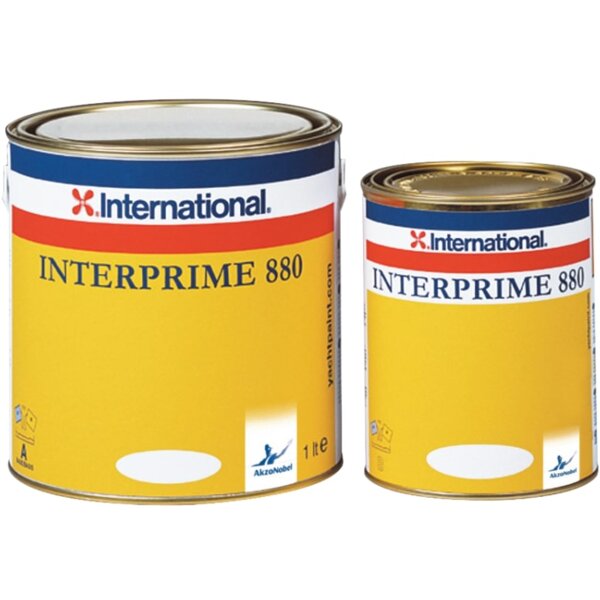
What is INTERPRIME 880 PART B and why choose it
INTERPRIME 880 PART B is the converter/hardener (SDS code YPA883) of the two-component epoxy high-performance finishing primer Interprime 880 from International Náutica. It is a professional-use, solvent-borne component designed to be mixed 1:1 by volume with the base component to create a high-build epoxy primer system for exterior use. The formulation is optimized for application by spray over a wide temperature range and provides the reactive backbone that gives the finished primer its mechanical strength and durability.
Main characteristics
- Part of a two-component epoxy primer system for high-performance finishes on yachts and metal structures.
- Designed for exterior use as part of a coating system.
- Contributes to a durable, sandable epoxy film suitable as a base for polyurethane topcoats.
- Solvent-borne formulation with fast evaporation solvents such as butanone and n-butyl acetate for efficient spray application.
- Supplied as Part B hardener (YPA883), to be mixed 1:1 by volume with Interprime 880 base.
- Classified as flammable liquid (Flam. Liq. 2, H225) with very flammable liquid and vapours.
Technical specifications
- Product type: Two-component epoxy coating hardener (Part B, YPA883).
- Intended use: Component of a two-pack exterior coating system.
- Mix ratio with base: 1:1 by volume (as supplied, for Interprime 880 system).
- Physical state: Liquid.
- Colour (Part B): Orange.
- Odour: Amine-like.
- Boiling point (initial): Approximately 79°C.
- Flash point: -7°C (closed cup, Pensky-Martens).
- Viscosity (kinematic): approx. 40 mm²/s at ambient temperature; 38 mm²/s at 40°C (DIN EN ISO 3219).
- Density: approx. 0.962 g/cm³ (DIN EN ISO 2811-1).
- Explosion limits (approx.): lower 1.4 % v/v, upper 11.3 % v/v in air (driven by butan-1-ol content).
- VOC status: Product falling under Directive 2004/42/CE on VOC. Consultar ficha técnica del fabricante.
- Water solubility: Not soluble in cold water.
- Stability: Stable under normal storage and handling conditions.
- Reactivity: No specific test data; avoid contact with oxidizing materials.
Applications and use cases
INTERPRIME 880 PART B is intended exclusively for professional and industrial users as the hardener component of the Interprime 880 epoxy primer system in exterior environments. Typical uses, when correctly mixed with the corresponding base component, include:
- Professional coating of yacht hulls and superstructures as part of a high-build epoxy primer under polyurethane topcoats.
- Industrial and professional maintenance coatings on suitably prepared metal, composite and wood substrates where a two-component epoxy primer is specified.
Use only as part of the specified two-component system and follow the complete product technical data sheet for surface preparation, mixing, application and overcoating schedules.
FAQ – INTERPRIME 880 PART B
-
Is INTERPRIME 880 PART B a complete primer?
No. It is the converter/hardener (Part B, YPA883) of a two-component epoxy primer system and must be mixed 1:1 by volume with the corresponding base component of Interprime 880.
-
For what type of use is this product intended?
It is intended for professional and industrial exterior use as part of a two-pack coating system.
-
Why is it classified as highly flammable?
Due to the presence of organic solvents such as butanone, n-butyl acetate, toluene and others, the mixture has a flash point of -7°C and is classified as Flam. Liq. 2 (highly flammable liquid and vapour).
-
Can it cause skin or eye irritation?
Yes. It is classified as Skin Irrit. 2 (H315) and Eye Irrit. 2 (H319) and can cause skin irritation and serious eye irritation. It may also cause skin sensitisation (H317).
-
Does it have any specific health hazards?
It may cause drowsiness or dizziness (STOT SE 3, H336), suspected of damaging the unborn child (Repr. 2, H361d) and may cause damage to organs after prolonged or repeated exposure (STOT RE 2, H373). It also presents aspiration hazard due to certain solvents in the mixture.
-
Is INTERPRIME 880 PART B environmentally hazardous?
The mixture is classified as Aquatic Chronic 4 (H413): it may be harmful to aquatic organisms with long-lasting effects. Avoid release to the environment.
-
How should waste and residues be disposed of?
Waste and residues must be treated as hazardous. Do not discharge into drains or waterways. Dispose of via an authorised waste contractor, in accordance with local and national regulations. The applicable EWC code for waste paint and varnish containing organic solvents or other hazardous substances is 08 01 11*.
-
Is this product suitable for consumer or DIY use?
No. The safety data sheet specifies use for professional and industrial users only.
Section 14 – Transport information
- UN number: UN1263.
- UN proper shipping name: PINTURAS / PAINT.
- Transport hazard class: Class 3 (flammable liquids) for ADR/RID, IMDG and IATA.
- Packing group: II.
- Environmental hazards: Not classified as marine pollutant or environmentally hazardous for transport (ADR/IMDG/IATA: No).
- Special provisions (ADR/RID): Special provision 640 (C); Tunnel restriction code (D/E).
- Emergency schedules (IMDG): EmS F-E, S-E.
- Bulk transport (IMO instruments): Not applicable.
- User transport precautions: Transport within user premises only in tightly closed, upright containers that are secured to prevent falling or damage. Ensure personnel know what to do in case of accident or spillage.
Section 8 – Individual protection measures
Exposure controls and personal protection
- General industrial hygiene: Do not eat, drink or smoke while handling the product. Wash hands, forearms and face thoroughly after handling and before breaks. Remove contaminated clothing and protective equipment before entering eating areas and wash before reuse. Ensure emergency eye wash stations and safety showers are close to workstations.
- Engineering controls: Use only with adequate ventilation. Apply local exhaust or other engineering controls to keep airborne concentrations below occupational exposure limits and below the lower explosion limit. Use explosion-proof ventilation equipment.
Eye and face protection
- Use chemical splash safety goggles complying with approved standards where a risk assessment shows potential for liquid splashes, spray, mists or vapours.
Hand protection
- Wear chemical-resistant, impermeable protective gloves complying with EN 374 whenever handling the product.
- For prolonged or frequently repeated contact, gloves of protection class 6 are recommended (penetration time > 480 minutes according to EN 374): recommended materials Viton or nitrile, thickness ≥ 0.38 mm.
- For anticipated short contact, gloves of protection class 2 or higher are recommended (penetration time > 30 minutes according to EN 374): recommended material nitrile, thickness ≥ 0.12 mm.
- Replace gloves regularly and immediately if any signs of damage or degradation appear. Performance may be reduced by physical/chemical damage or poor maintenance.
Skin and body protection
- Select protective clothing based on the specific work task and associated risks, approved by a specialist.
- Where ignition due to electrostatic charges is possible, use antistatic protective clothing. For best protection, use an antistatic ensemble including coveralls, boots and gloves compliant with EN 1149.
- Wear appropriate protective footwear and any additional skin protection required, depending on the operation.
Respiratory protection
- Where ventilation is insufficient to maintain exposure below limits, wear respiratory protection selected on the basis of a risk assessment and compliant with relevant standards.
- Recommended: half-mask respirator conforming to EN 140 equipped with A/P2 filter (or better) during application and handling.
- Dry sanding, flame cutting or welding on dried paint films can generate hazardous dust and fumes. Wet sanding or wet abrading is preferable. If exposure cannot be prevented by extraction, appropriate respiratory protection must be used.
Environmental exposure controls
- Check emissions from ventilation equipment and process installations to ensure compliance with environmental protection regulations. Install scrubbers, filters or modify process design if required to reduce emissions.
Contenido generado por IA