What it is and why choose it
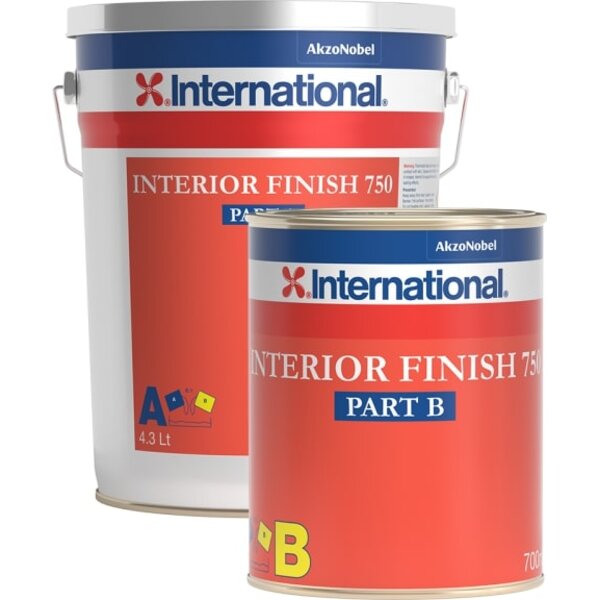
INTERIOR FINISH 750 PART B from International Náutica is the converter/curing component of the high quality two-pack polyurethane Interior Finish 750 system for interior areas. The system is designed for demanding marine and industrial interiors such as engine rooms, cabins, trims, bilges and lockers, providing a durable, chemical-resistant, high gloss finish that is easy to clean and maintain.
When used as part of an approved Interior Finish 750 system over the recommended Interior Primer, it can form a coating scheme with Surface Spread of Flame (SSoF) certification, supporting compliance with marine safety standards. The product can be applied by conventional spray, brush or roller, allowing efficient coating of both large areas and difficult-to-access zones.
Main features
- Two-pack polyurethane interior finish system: PART B acts as the curing agent for Interior Finish 750, a high quality, high gloss polyurethane coating for interior use.
- High coverage and durability: Engineered to resist wear and tear in challenging interior environments, with excellent resistance to common chemicals and ease of cleaning.
- Flexible application methods: Compatible with brush, roller and conventional spray, with clear recommendations for thinning and film thickness.
- Fire performance within system: When used as part of an approved interior system, the coating scheme can achieve Surface Spread of Flame (SSoF) certification.
- Colour range (system information): Available in a range of off-white and pastel shades including RAL 9003 white, RAL 9010 white, RAL 7035 light grey and RAL 7038 grey (colour is defined by the combined A+B mixture).
- Chemical-resistant formulation: Helps interior surfaces remain pristine and easy to maintain over time.
- Professional-grade product: Classified as a flammable, hazardous mixture; intended for professional and industrial users with appropriate safety controls.
Technical specifications
- Product type: Two-component coating system for interior use (polyurethane).
- Use: Interior two-component coating; for engine rooms, cabins, trims, bilges, lockers and general interior areas.
- Colour options (mixed system):
- YIC757 – white binder base
- YIC750 – RAL 9003 white
- YIC755 – RAL 9010 white
- YIC752 – RAL 7035 light grey
- YIC753 – RAL 7038 grey
- Finish: High gloss (for satin finish use Interior Finish 770).
- Specific gravity: 1.28.
- Volume solids: 51%.
- Mix ratio (A:B by volume): 6:1.
- Converter / curing agent code: YIC700.
- Typical shelf life: Base – 3 years; Converter – 2 years.
- VOC (as supplied): 440 g/L.
- VOC (EU Solvent Emissions Directive 1999/13/EC): 345 g/kg.
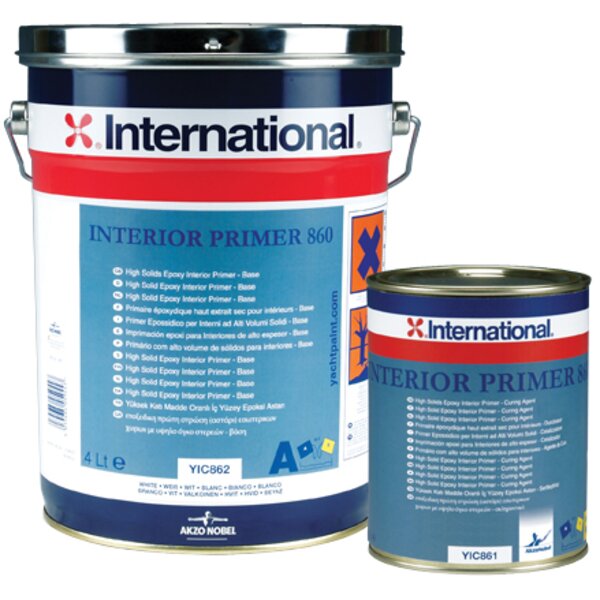
- Recommended primers: Interior Primer 860 or Interior Primer 333WB (EU only), depending on substrate.
- Number of coats: 1–2.
- Recommended DFT per coat:
- 25 microns (1 mil) dry by brush.
- 40 microns (1.6 mil) dry by spray.
- Recommended WFT per coat:
- 49 microns (2 mil) by brush.
- 78 microns (3.2 mil) by spray.
- Theoretical coverage (per coat):
- 20.5 m²/L (835 ft²/gal) by brush.
- 12.8 m²/L (522 ft²/gal) by spray.
- Practical coverage (per coat):
- 18.5 m²/L (754 ft²/gal) by brush.
- 7.7 m²/L (314 ft²/gal) by spray.
- Application methods: Brush, conventional spray, roller. Airless spray not recommended.
- Recommended thinners: YTA100, Thinner No. 16, Thinner 910, Thinner 920 (system information).
- Pot life (mixed material):
- At 10°C: 8 hours.
- At 23°C: 4 hours.
- At 35°C: 3 hours.
- Drying times (system, at recommended thickness):
- Hard dry: 24 h (10°C); 8 h (23°C); 4 h (35°C).
- Touch dry: 8 h (10°C); 4 h (23°C); 2 h (35°C).
- Dry to walk on: 48 h (10°C); 24 h (23°C); 16 h (35°C).
- Overcoating intervals with Interior Finish 750:
- At 10°C: minimum 24 h, maximum unlimited.
- At 23°C: minimum 8 h, maximum unlimited.
- At 35°C: minimum 4 h, maximum unlimited.
- Flash point (mixture): 33°C (closed cup, Pensky-Martens).
- Boiling point (approx.): 139°C.
- Density (mixture): 1.319 g/cm³ (DIN EN ISO 2811-1).
- Viscosity (kinematic): 212 mm²/s at room temperature; 280 mm²/s at 40°C (DIN EN ISO 3219).
- Flammability classification: Flammable liquid, Category 3 (Flam. Liq. 3, H226).
- Other hazard classifications (CLP): Skin Irrit. 2 (H315), Eye Irrit. 2 (H319), STOT SE 3 (H336), STOT RE 2 (H373), Aquatic Chronic 3 (H412).
Applications and use cases
- Engine rooms and technical spaces: High durability and chemical resistance help protect interior steel and aluminium surfaces exposed to oils, fuels and maintenance chemicals.
- Cabins and accommodation areas: High gloss off-white and pastel colours provide a clean, bright look that is easy to wipe down.
- Trims, lockers and storage areas: Suitable for coated metal, laminate, gelcoat and powder-coated substrates when correctly prepared and primed.
- Bilges and wet areas: Can be used in bilges and other interior zones where occasional water exposure is expected, when the substrate is correctly prepared and primed (not for permanent immersion).
Substrate preparation (system information)
- Steel: Degrease with 600 Wipedown Solvent or Thinner 910. Gritblast to SSPC-SP10/NACE 2 (Sa 2½) near white metal. If blasting is not possible, grind with 24–36 grit discs to a clean, bright, well-roughened surface (SSPC-SP-3 / St3). Prime with Interior Primer 860 or Interior Primer 333WB (EU only).
- Steel with shop primer: Degrease, ensure the shop-primed surface is clean and correctly profiled, then prime with Interior Primer 860 or 333WB (EU only).
- Aluminium: Degrease. For wet areas, additionally scrub with a maroon 3M Scotch-Brite pad (7447). Prime with Interior Primer 860 or 333WB (EU only).
- Stainless steel: Degrease, then light gritblast to produce a profile of about 50 microns (2 mils). Prime with Interior Primer 860 or 333WB (EU only).
- Laminates: Only over resin-impregnated laminates with no exposed fibres. Degrease and scrub with maroon Scotch-Brite, then prime with Interior Primer 860 or 333WB (EU only).
- Gelcoat: Degrease, sand with 80-grit paper, remove sanding debris thoroughly, then prime with Interior Primer 860.
- Powder-coated surfaces: Degrease, scrub with maroon Scotch-Brite and prime with Interior Primer 860.
Application conditions and limitations
- Ambient, substrate and product temperature must be between 10°C and 35°C.
- Substrate temperature must be at least 3°C/5°F above the dew point to prevent condensation.
- Maximum relative humidity during curing: 80%.
- Not suitable for permanently immersed surfaces.
- Do not apply over conventional (one-pack) coatings.
FAQ
-
Is INTERIOR FINISH 750 PART B suitable for exterior surfaces?
The data provided only refers to interior use. For exterior applications, Consultar ficha técnica del fabricante.
-
Can this product be used on permanently immersed areas such as underwater hulls or tanks?
No. The system is stated as not suitable for permanently immersed surfaces.
-
What primers should be used before applying the Interior Finish 750 system?
The recommended primers are Interior Primer 860 or Interior Primer 333WB (EU only), selected according to the substrate.
-
How many coats are normally required?
The technical information specifies 1–2 coats, depending on the desired film build and service conditions.
-
How long can I work with the mixed product before it gels?
Pot life is approximately 8 hours at 10°C, 4 hours at 23°C and 3 hours at 35°C. Pot life decreases as temperature and mix volume increase.
-
When can the coated surface be walked on?
At recommended film thickness, the surface is typically walkable after about 48 hours at 10°C, 24 hours at 23°C and 16 hours at 35°C.
-
Which application methods are recommended?
Brush, roller and conventional spray are recommended. Airless spray is not recommended.
-
Can the product be applied in confined spaces?
Yes, but continuous ventilation is required during application and drying to extract solvent vapours for health, safety and proper curing.
-
Is this product suitable for consumer use?
The safety documentation specifies professional, industrial and consumer use for the Interior Finish 750 RAL9003 mixture, but INTERIOR FINISH 750 PART B is a hazardous component and should only be handled by suitably trained users following all safety and regulatory requirements.
-
Where can I find detailed curing schedules for specific film builds or environments?
Consultar ficha técnica del fabricante.
Section 14 – Transport information
- UN number: UN1263.
- UN proper shipping name: PAINT.
- Transport hazard class: Class 3 (flammable liquids).
- Packing group: III.
- Environmental hazards: Not classified as environmentally hazardous for transport according to the provided data.
- Transport within user’s premises: Always transport in closed, upright and secure containers. Ensure personnel transporting the product know what to do in case of accident or spillage.
- ADR/RID additional information: Tunnel code (D/E).
- IMDG additional information: Emergency schedules F-E, S-E.
- Transport in bulk according to IMO instruments: Not applicable.
Section 8 – Individual protection measures
Exposure controls and personal protection
- Engineering controls: Use only with adequate ventilation. Employ process enclosures or local exhaust to keep airborne concentrations below occupational exposure limits and below the lower explosive limit. Use explosion-proof ventilation equipment.
- General hygiene: Wash hands, forearms and face thoroughly after handling and before eating, drinking or smoking. Remove contaminated clothing and protective equipment before entering eating areas. Ensure eyewash stations and safety showers are close to work areas.
Personal protective equipment (PPE)
- Eye and face protection: Wear chemical splash goggles or equivalent eye protection complying with an approved standard whenever there is a risk of splashes, mists or vapours. If eye contact occurs, rinse immediately with plenty of water for at least 10 minutes and seek medical advice if irritation persists.
- Hand protection:
- Use chemical-resistant, impervious gloves complying with relevant standards when handling the product.
- For prolonged or frequently repeated contact: gloves with protection class 6 (breakthrough time > 480 minutes according to EN374) are recommended. Suggested materials: Viton or nitrile, thickness ≥ 0.38 mm.
- For brief contact: gloves with protection class ≥ 2 (breakthrough time > 30 minutes according to EN374). Suggested material: nitrile, thickness ≥ 0.12 mm.
- Replace gloves regularly and immediately if any damage or deterioration is observed.
- Skin and body protection:
- Wear appropriate protective clothing such as overalls to prevent skin contact. When there is risk of ignition from static electricity, use anti-static protective clothing including overalls, boots and gloves (see EN 1149).
- Select additional skin protection (including footwear) based on the specific task and associated risks, with specialist approval where necessary.
- Respiratory protection:
- Select a respirator meeting the appropriate standard based on hazard and exposure assessment.
- Where ventilation is inadequate, wear a respirator conforming to EN140 with type A/P2 filter or better.
- During dry sanding, flame cutting or welding of the dry paint film, wet methods should be used wherever possible; if exposure cannot be avoided, use suitable respiratory protection.
*Contenido generado por IA