What is Propeller Primer and why choose it?
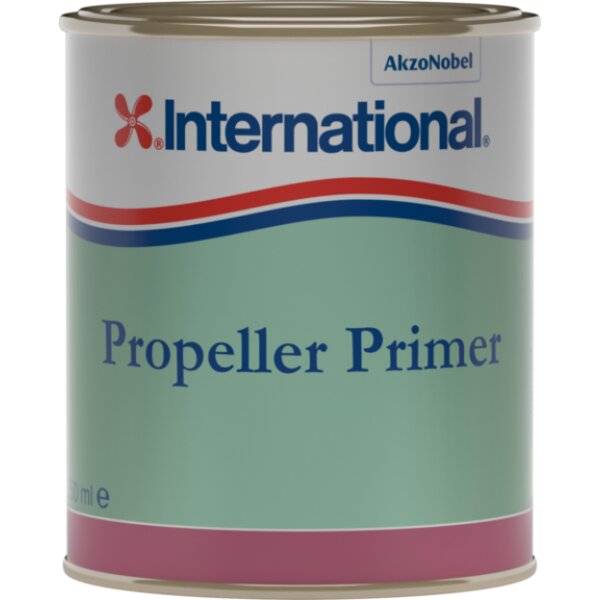
Propeller Primer from International Náutica is a quick-drying, one-part primer designed specifically for underwater metals such as outdrives, outboard legs, propellers and sterngear. Using Dual-Activated Bonding Technology, it delivers excellent adhesion to a wide range of submerged metallic substrates. When overcoated with the recommended International antifoulings, it forms a unified coating system that resists dynamic and cavitation forces, helping to protect propellers and underwater metal parts from fouling build-up.
Its brush-application formulation, low odour (VOC 17 g/l, <20 g/l) and fast drying times make it particularly suitable for professional and demanding DIY users who need reliable adhesion and durable protection in marine environments.
Main features
- Quick drying one-part primer for underwater metals.
- Optimised for outdrives, outboard legs, propellers, shafts, brackets, zinc/galvanised steel and sterngear.
- Dual-Activated Bonding Technology for excellent adhesion on bronze, aluminium, stainless steel and factory enamelled surfaces.
- Forms a unified system when overcoated with recommended International antifoulings, resisting dynamic and cavitation forces.
- Easy brush application; spray application is not recommended.
- Low odour solvent-borne coating with VOC (as supplied) 17 g/l.
- Suitable for professional and consumer use on exterior marine applications.
Technical specifications
- Product type: Solvent-borne one-part primer for underwater metals.
- Colour: YPA180 – Red.
- Finish: Matt.
- Specific gravity: 1.12.
- Volume solids: 46%.
- Typical shelf life: 2 years.
- VOC (as supplied): 17 g/l.
- Unit size: 250 ml.
- Number of coats: 1–2 coats.
- Theoretical coverage: 10 m²/l at 100 microns WFT.
- Practical coverage: 9 m²/l.
- Recommended DFT per coat (brush): 35–46 microns.
- Recommended WFT per coat (brush): 75–100 microns.
- Application method: Brush only (do not spray).
- Touch dry at 10°C: 1 hour.
- Touch dry at 25°C: 30 minutes.
- Touch dry at 35°C: 20 minutes.
- Minimum application temperature (product, ambient and substrate): 10°C / 50°F.
- Maximum application temperature (ambient, product, substrate): 35°C / 95°F.
- Substrate temperature: At least 3°C / 5°F above dew point and below 35°C / 95°F.
Drying and overcoating intervals
Drying (touch dry):
- 10°C (50°F): 1 hour.
- 25°C (77°F): 30 minutes.
- 35°C (95°F): 20 minutes.
Overcoating times by substrate temperature:
- 10°C (50°F)
- Propeller Primer over Propeller Primer: 60 minutes min, 24 hours max.
- Interspeed Extra: 4 hours min, 24 hours max.
- Trilux 33: 4 hours min, 24 hours max.
- Trilux Hard Antifouling: 4 hours min, 24 hours max.
- Trilux Prop-O-Drev: 4 hours min, 24 hours max.
- Trilux Propeller: 4 hours min, 24 hours max.
- 25°C (77°F)
- Propeller Primer over Propeller Primer: 30 minutes min, 24 hours max.
- Interspeed Extra: 3 hours min, 24 hours max.
- Trilux 33: 3 hours min, 24 hours max.
- Trilux Hard Antifouling: 3 hours min, 24 hours max.
- Trilux Prop-O-Drev: 3 hours min, 24 hours max.
- Trilux Propeller: 3 hours min, 24 hours max.
- 35°C (95°F)
- Propeller Primer over Propeller Primer: 20 minutes min, 24 hours max.
- Interspeed Extra: 2 hours min, 24 hours max.
- Trilux 33: 2 hours min, 24 hours max.
- Trilux Hard Antifouling: 2 hours min, 24 hours max.
- Trilux Prop-O-Drev: 2 hours min, 24 hours max.
- Trilux Propeller: 2 hours min, 24 hours max.
If the maximum overcoating interval is exceeded, sand the surface with 240 grade wet and dry paper before overcoating.
Applications and use cases
Recommended substrates
- Outdrives and outboard legs.
- Propellers and shafts.
- Sterngear and brackets.
- Bronze.
- Bare aluminium.
- Stainless steel.
- Zinc and galvanised steel.
- Factory enamelled surfaces.
- Previously antifouled or painted underwater metals (after complete removal of previous coatings).
Surface preparation guidelines
Adhesion depends heavily on the quality of substrate preparation. The following steps are specified for different substrates:
- General cleaning: Thoroughly clean and degrease using commercial detergents, steam cleaners or pressure washers. Remove all detergent residues before sanding.
- Bare bronze: Clean thoroughly and sand with 80 grit paper to bright metal. Avoid excessive abrasion that could alter propeller profile. Clean and dry, then apply primer as soon as possible.
- Bare aluminium: Degrease with solvent or Super Cleaner. Sand with 24–120 grit aluminium-compatible paper (coarser grades preferred for adhesion). Clean thoroughly, allow to dry completely and apply the first coat within 8 hours.
- Stainless steel: Final wipe with suitable cleaning solvent, then grind with 24–36 grit abrasive discs to a uniform, clean, bright metal. If grinding is not possible, sand with 24–80 grit paper to a bright metal surface. Remove all residues and dust and prime as soon as possible after preparation.
- Zinc/galvanised steel: Degrease with solvent or Super Cleaner. Sand with 60–120 grit paper. Clean thoroughly, dry completely and prime as soon as possible.
- Factory enamelled surfaces: Clean thoroughly and sand with 80–120 grit paper. Apply primer promptly after preparation.
- Previously antifouled/painted surfaces: Use Interstrip to remove all traces of previous coatings, then prepare the surface as above for the relevant substrate.
Application instructions
- Mixing: Stir well before use.
- Thinning: Thinning is not recommended.
- Application method: Apply by brush only. Do not spray.
- Number of coats: Apply 1–2 full coats.
- Overcoating: Overcoat only with recommended International antifoulings according to the stated overcoating intervals.
- Cleaner: Use clean potable water for cleaning.
- Important conditions: Do not use below 10°C / 50°F. Do not overcoat with 2-component products. Ensure ambient, product and substrate temperatures are between 10°C / 50°F and 35°C / 95°F, with substrate at least 3°C / 5°F above dew point.
FAQ
1. On which materials can I use Propeller Primer?
It is suitable for bronze, aluminium, stainless steel, zinc/galvanised steel and factory enamelled surfaces, including outdrives, outboard legs, propellers and sterngear.
2. How many coats are recommended?
The product data specifies 1–2 coats of Propeller Primer, followed by the recommended International antifouling.
3. Can I spray-apply this primer?
No. Spray application is not recommended; the product is designed for application by brush only.
4. At what temperatures can I apply Propeller Primer?
Apply only when ambient, product and substrate temperatures are between 10°C / 50°F and 35°C / 95°F, with the substrate at least 3°C / 5°F above the dew point.
5. Which antifoulings can I use over this primer?
The overcoating table specifies International products such as Interspeed Extra, Trilux 33, Trilux Hard Antifouling, Trilux Prop-O-Drev and Trilux Propeller. Overcoat only with recommended antifoulings.
6. What happens if the maximum overcoating time is exceeded?
If the maximum overcoating interval is exceeded, the surface must be sanded with 240 grade wet and dry paper before applying the next coat or antifouling.
7. Is Propeller Primer low odour?
Yes. The product is described as low odour with VOC 17 g/l (less than 20 g/l).
8. Can leftover product be disposed of in household waste?
No. Remainders of Propeller Primer cannot be disposed of through the municipal waste route or dumped without permit. Disposal must be arranged in consultation with the relevant authorities.
9. Is the product classified as hazardous for transport?
No. According to the transport information, Propeller Primer Red is not regulated as dangerous goods by ADR/RID, IMDG or IATA.
10. Is this product suitable for interior use?
The identified use in the safety data sheet is a solvent-borne coating for exterior use.
Section 14 – Transport information
- UN number / ID number: Not regulated under ADR/RID, IMDG or IATA.
- UN proper shipping name: Not regulated.
- Transport hazard class: Not applicable.
- Packing group: Not applicable.
- Environmental hazards: Not classified as environmentally hazardous for transport.
- Transport within user’s premises: Always transport in closed containers that are upright and secure. Ensure that persons transporting the product know what to do in the event of an accident or spillage.
- Transport in bulk according to IMO instruments: Not applicable.
Section 8 – Personal protective measures
The following individual protection measures are specified in the safety data sheet for Propeller Primer Red:
- General hygiene: Wash hands, forearms and face thoroughly after handling chemical products, before eating, smoking and using the lavatory and at the end of the working period. Use appropriate techniques to remove potentially contaminated clothing and wash before reuse.
- Eye and face protection: Use safety eyewear complying with an approved standard when a risk assessment indicates potential exposure to liquid splashes, mists, gases or dusts. If contact is possible, safety glasses with side-shields should be used unless a higher level of protection is indicated.
- Hand protection: Wear chemical-resistant, impervious gloves complying with an approved standard if a risk assessment indicates this is necessary. For prolonged or frequently repeated contact, a glove with protection class 6 (breakthrough time > 480 minutes according to EN374) is recommended, for example Viton or nitrile with thickness ≥ 0.38 mm. For brief contact, a glove with protection class 2 or higher (breakthrough time > 30 minutes according to EN374) such as nitrile with thickness ≥ 0.12 mm is recommended. Replace gloves regularly and if damaged.
- Body protection: Select personal protective clothing for the body based on the task and risks involved; it should be approved by a specialist before handling the product.
- Other skin protection: Choose appropriate footwear and any additional skin protection measures according to the task and risks involved, with specialist approval.
- Respiratory protection: Based on hazard and potential exposure, select a respirator that meets the appropriate standard or certification. Respirators must be used according to a respiratory protection program to ensure proper fitting and training. Dry sanding, flame cutting and welding of the dry paint film can generate dust and hazardous fumes; wet sanding/flatting should be used wherever possible. If exposure cannot be avoided with local exhaust ventilation, suitable respiratory protective equipment should be used.
- Engineering controls: Good general ventilation is usually sufficient to control worker exposure to airborne contaminants. Emissions from ventilation or work process equipment should be checked to ensure compliance with environmental protection legislation; fume scrubbers or filters may be required in some cases.
*Contenido generado por IA