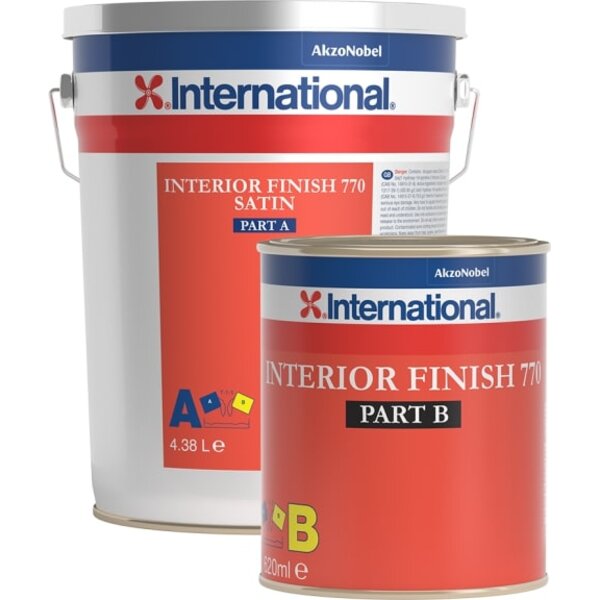
What is INTERIOR FINISH 770 PART A and why choose it?
INTERIOR FINISH 770 PART A from International Náutica is the base component of a high quality two-pack polyurethane interior coating. When mixed with its dedicated curing agent YIC700, it produces a durable satin finish specifically designed for marine and industrial interiors, including engine rooms, cabins, trims, bilges and lockers. Its spray-optimised formulation delivers a smooth, even surface and a uniform low-glare sheen that is ideal for deckheads and areas where full gloss is not desired.
Part of the AkzoNobel YSC Toner platform, Interior Finish 770 can be tinted to a wide range of off-white and pastel colours, making it suitable for both technical spaces and visible accommodation areas.
Main features
- Two-pack polyurethane system: combines Part A (white base) with curing agent YIC700 for a hard, long-lasting interior finish.
- Satin appearance: low-glare, uniform sheen suitable for deckheads and areas where a gloss finish is not appreciated.
- Spray-applied for professional results: specifically formulated for airless and conventional spray, giving a smooth, even film.
- Wide colour choice: available as a white binder base (YIC770) and in multiple off-whites and greys (including RAL9010, RAL9016, RAL7035, RAL7038 and others) via the YSC Toner system.
- Good film build: recommended 50 µm dry film thickness per coat, with 1–2 coats typically required.
- Professional drying properties: touch dry in approximately 1–2 hours at 10–23°C and hard dry within 1–4 days depending on temperature.
- Compatible with specialist primers: designed to be applied over Interior Primer 860, Interior Primer 333WB or Epoxy GP Coating on suitably prepared substrates.
- Engine-room capable: satin finish suitable for technical interiors such as engine rooms, bilges and lockers.
- Hazard-labelled professional product: flammable liquid and vapour; causes skin and eye irritation; may cause damage to organs through prolonged or repeated exposure; harmful to aquatic life with long lasting effects.
Technical specifications
- Product type: Two-pack polyurethane interior finish (Part A base component)
- Brand: International Náutica (AkzoNobel)
- Finish: Satin
- Colour options (examples):
- YIC770 – White binder base
- YIC782 – Pure White RAL9010
- YIC783 – Cloud White
- YIC784 – Agate Grey RAL7038
- YIC785 – Matterhorn White
- YIC786 – Oyster White
- YIC787 – Light Grey RAL7035
- YIC788 – Traffic White RAL9016
- YIC789 – Pegasus Grey
- Specific gravity: approx. 1.3 g/cm³ (Part A)
- Volume solids: approx. 52 %
- Mix ratio with YIC700: 14:1 by volume, 11:1 by weight
- Recommended number of coats: 1–2
- Recommended DFT per coat: 50 µm dry
- Recommended WFT per coat: 100 µm wet
- Theoretical coverage: approx. 10 m²/L per coat
- Practical coverage: approx. 6 m²/L per coat (depending on conditions and application technique)
- VOC content (as supplied): approx. 442 g/L
- Typical shelf life: approx. 3 years for Part A and 2 years for Part B, when stored correctly
- Touch dry:
- Approx. 2 h at 10°C
- Approx. 1 h at 15–35°C
- Hard dry:
- Approx. 4 days at 10°C
- Approx. 2 days at 15°C
- Approx. 1 day at 23–35°C
- Overcoating interval with Interior Finish 770: minimum when the coat is tacky; maximum times quoted are without sanding. Sanding between coats is recommended for best appearance.
- Flash point: approx. 23°C (closed cup, Pensky–Martens)
- Boiling point: approx. 139°C
- Density (mixed paint reference – white base): approx. 1.342 g/cm³
Applications and use cases
Typical areas of use
- Engine rooms and machinery spaces
- Cabins and accommodation areas
- Interior trims and linings
- Bilges and lockers
- Deckheads and overhead panels where a satin, non-gloss surface is preferred
Suitable substrates (with appropriate primer)
- Steel: grit-blasted to Sa 2½ or mechanically ground to a clean, bright profile of 50–75 µm, then primed with Interior Primer 860, Interior Primer 333WB or Epoxy GP Coating.
- Steel with shop primer: degreased and clean from rust, dust, oil and other contaminants; overcoated with Interior Primer 860, Interior Primer 333WB or Epoxy GP Coating.
- Aluminium (dry areas): degreased and scrubbed with maroon 3M Scotch-Brite 7447, then primed with Interior Primer 860, Interior Primer 333WB or Epoxy GP Coating.
- Stainless steel: degreased and lightly grit-blasted to a 50 µm profile, then primed with Interior Primer 860, Interior Primer 333WB or Epoxy GP Coating.
- Laminates: resin-impregnated laminates (no exposed fibres), degreased and scuffed with maroon 3M Scotch-Brite 7447, then primed with Epoxy GP Coating or Interior Primer 860.
- Gelcoat: degreased, sanded with 80-grit and carefully cleaned of sanding debris before priming with Epoxy GP Coating or Interior Primer 860.
- Powder-coated surfaces: degreased and abraded with maroon 3M Scotch-Brite 7447, then primed with Epoxy GP Coating or Interior Primer 860.
- Wood: sanded with 120-grit; oily timbers such as teak wiped with the recommended thinners (cloths changed frequently) before priming with Epoxy GP Coating or Interior Primer 860.
Application conditions and methods
- Application methods: airless spray or conventional spray (product is formulated primarily for spray application).
- Mixing: stir or shake each component thoroughly, then add the curing agent (YIC700) to Part A and mix well, ensuring the correct mix ratio is achieved.
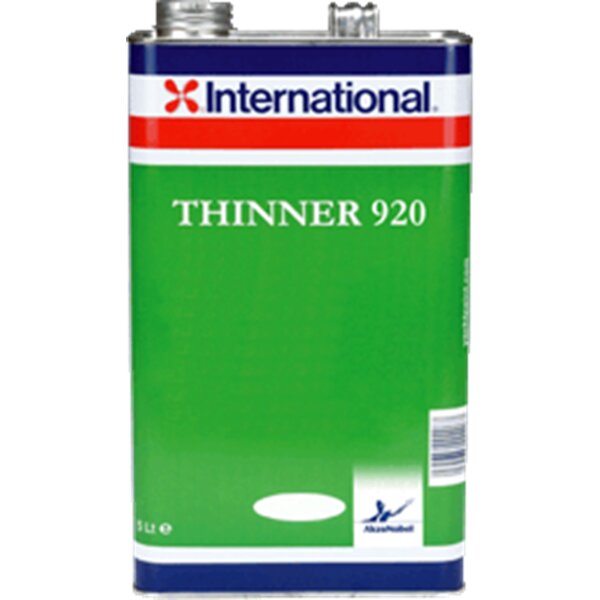
- Thinners: Thinner No. 16, Thinner 910 or Thinner 920, added only after both components are fully mixed.
- Conventional spray thinning: typically 20–30 % with Thinner 910 (YTA910), reducing viscosity to approximately 16–18 seconds in DIN Cup 4.
- Environmental conditions for application:
- Ambient temperature: 10–35°C
- Substrate temperature: 10–35°C
- Product temperature: 10–35°C
- Substrate to be at least 3°C above dew point to avoid condensation.
- Restrictions: not suitable for permanently immersed surfaces; do not apply over conventional (one-pack) coatings.
FAQ – INTERIOR FINISH 770 PART A
-
Is INTERIOR FINISH 770 suitable for use in engine rooms?
Yes. The product description explicitly includes engine rooms, bilges and lockers as suitable interior applications when correctly primed and applied.
-
What appearance does the coating have once cured?
It produces a uniform satin finish, ideal for deckheads and other interiors where a full gloss is not required.
-
How many coats are normally required?
Typically 1–2 coats at 50 µm dry film thickness per coat, depending on colour, opacity and specification.
-
How long should I wait before recoating with INTERIOR FINISH 770?
Recoating is possible once the film is tacky; maximum recoating times are given without sanding. Sanding between coats is recommended for best aesthetics.
-
Can INTERIOR FINISH 770 be applied by brush or roller?
The product is specifically formulated for airless and conventional spray. Other methods are not specified in the technical documentation.
-
On which primers can I apply INTERIOR FINISH 770?
It is designed to be applied over Interior Primer 860, Interior Primer 333WB or Epoxy GP Coating on suitably prepared substrates.
-
Is this product suitable for permanently submerged areas?
No. The technical sheet states that it is not suitable for permanently immersed surfaces.
-
Is INTERIOR FINISH 770 hazardous?
Yes. According to the safety data sheet, it is a flammable liquid and vapour, causes skin and serious eye irritation, may cause damage to organs through prolonged or repeated exposure, and is harmful to aquatic life with long lasting effects.
-
Who is this product intended for?
The safety data sheet states that it is for professional and industrial use. Appropriate training, equipment and safety measures are required.
-
What is the VOC level of INTERIOR FINISH 770 Part A?
The VOC content of Part A as supplied is reported as approximately 442 g/L.
Section 14 – Transport information
Based on the safety data sheet for INTERIOR FINISH 770 white base (Part A):
- UN number / ID number: UN1263
- UN proper shipping name: PAINT
- Transport hazard class: Class 3 (Flammable liquid)
- Packing group: III
- Environmental hazards: not classified as environmentally hazardous for transport.
- ADR/RID tunnel restriction code: (D/E)
- IMDG emergency schedules: F-E, S-E
- Special precautions for user: transport only in securely closed, upright containers. Ensure personnel know what to do in the event of an accident or spillage.
- Transport in bulk according to IMO instruments: not applicable.
Section 8 – Personal protective measures
The following information on individual protection and exposure control is taken from the safety data sheets for INTERIOR FINISH 770 Part A (Spanish and UK versions):
General hygiene measures
- Wash hands, forearms and face thoroughly after handling and before eating, drinking, smoking or using the washroom.
- Do not eat, drink or smoke in mixing or application areas.
- Remove contaminated clothing and protective equipment before entering eating areas and wash contaminated garments before reuse.
Eye and face protection
- Use chemical splash goggles or equivalent eye protection complying with an approved standard whenever there is a risk of splashes or spray.
Hand protection
- Wear chemical-resistant, impervious gloves that comply with EN374 or an equivalent standard.
- For prolonged or frequently repeated contact, gloves with protection class 6 (breakthrough time > 480 minutes according to EN374) are recommended; glove materials such as Viton or nitrile with thickness ≥ 0.38 mm are indicated.
- For brief contact, gloves with protection class 2 or higher (breakthrough time > 30 minutes according to EN374) are recommended; nitrile gloves with thickness ≥ 0.12 mm are suggested.
- Gloves must be replaced regularly and whenever there is any sign of damage, degradation or contamination.
Skin and body protection
- Wear protective clothing suitable for the task, such as coveralls, to avoid skin contact.
- Where there is a risk of ignition due to electrostatic charges, anti-static protective clothing (overalls, boots and gloves with anti-static properties) should be used.
- Appropriate footwear and additional skin protection should be selected based on a risk assessment and approved by a safety specialist.
Respiratory protection
- Use only with adequate ventilation and, where necessary, local exhaust ventilation or process enclosure.
- When ventilation is insufficient, wear a respirator conforming to EN140 fitted with an A/P2-type filter (or better), selected according to the assessed exposure.
- During dry sanding, flame cutting or welding of the dry paint film, hazardous dusts and fumes may be generated; wet sanding is preferred and suitable respiratory protection is required if exposure cannot be otherwise controlled.
Environmental exposure controls
- Emissions from ventilation or process equipment should be checked to ensure compliance with environmental regulations.
- Where necessary, fume scrubbers, filters or engineering modifications should be used to reduce emissions.
*Contenido generado por IA