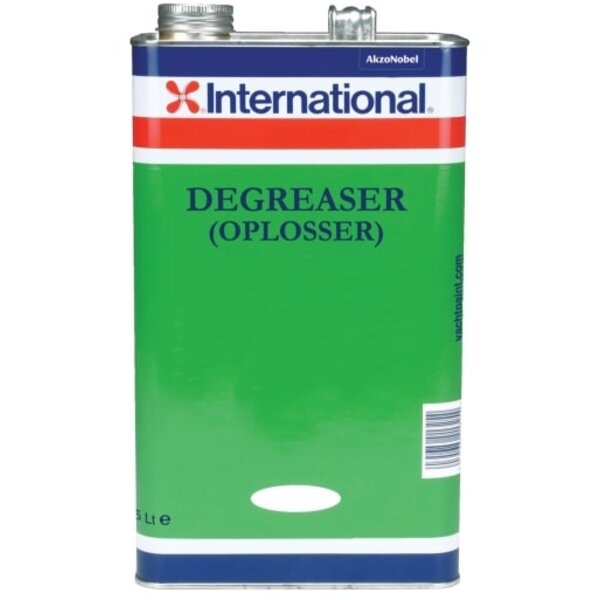
What is Degreaser (Oplosser) and why choose it?
Degreaser (Oplosser) by International Náutica is a professional cleaning solvent designed to remove surface contaminants such as waxes, greases and sanding residues. Its blend of acetone, toluene and butan-1-ol provides powerful degreasing performance for professional and industrial users who need a reliable paint-related cleaning product with fast action and controlled evaporation.
Main features
- Professional-grade cleaning solvent specifically developed to eliminate waxes, oils, greases and residues from sanding.
- High solvent power thanks to a formulation based on acetone, toluene and butan-1-ol.
- Zero solids content (0% by volume), leaving no residue on the treated substrate.
- Low density around 0.83 g/cm³, which facilitates application and rapid evaporation.
- Suitable for professional and industrial use as a detergent and degreasing solvent.
- Classified as paint-related material (UN1263), ideal as part of surface preparation systems.
Technical specifications
- Product name: Degreaser (Oplosser)
- Brand: International Náutica
- Product type: Solvent / Detergent for cleaning and degreasing
- Color code: ITA080
- Appearance: Colourless liquid with solvent odour
- Density: 0.83 g/cm³ (approx.)
- Solids by volume: 0%
- VOC content: 830 g/l
- Typical storage time: 2 years
- Recommended storage temperature: between 5°C and 35°C
- Container size: 5 l
- Physical state: Liquid
- Boiling point: 56°C (approx.)
- Flash point: 4°C (closed cup, Pensky-Martens)
- Kinematic viscosity (ambient): 4 mm²/s (DIN EN ISO 3219)
- Kinematic viscosity (40°C): 3 mm²/s (DIN EN ISO 3219)
- Water solubility: Not soluble in cold water (OECD TG 105)
- Classification (CLP): Flam. Liq. 2; Skin Irrit. 2; Eye Dam. 1; Repr. 2; STOT SE 3; STOT RE 2; Asp. Tox. 1; Aquatic Chronic 3
- Main hazardous components: acetone, toluene, butan-1-ol
Applications and use cases
- Surface cleaning before subsequent operations, where waxes, greases and sanding residues must be removed.
- Professional environments requiring an efficient solvent detergent for degreasing substrates.
- Industrial use as part of maintenance and preparation processes where a powerful solvent cleaner is needed.
- Paint-related processes where a dedicated solvent for cleaning and degreasing is specified as “paint related material”.
FAQ – Frequently asked questions
1. What type of contaminants does Degreaser (Oplosser) remove?
It is developed to eliminate waxes, greases and sanding residues from surfaces.
2. Is this product intended for home use?
No. The safety data sheet specifies that it is for professional and industrial use only.
3. Does the product leave any residue on the surface?
No. It has 0% solids by volume, so it does not leave solid residues once it has evaporated.
4. How should I store the container?
Store it in its original, tightly closed container, in a cool, dry and well-ventilated area, protected from direct sunlight and kept between 5°C and 35°C.
5. What is the typical shelf life?
The usual storage time indicated for the product is 2 years under recommended conditions.
6. Is Degreaser (Oplosser) flammable?
Yes. It is classified as a highly flammable liquid with a flash point of 4°C and must be kept away from heat, hot surfaces, sparks and open flames.
7. Can I dispose of leftover product down the drain?
No. Residues must not be discharged into urban waste systems or landfills without authorisation. Disposal must be agreed with the competent authorities.
8. What personal protection should I use when handling it?
Use appropriate personal protective equipment including chemical-resistant gloves, protective clothing and eye/face protection, and observe the ventilation and respiratory protection guidance described in Section 8 of the safety data sheet.
Section 14 – Transport information
- UN number (ADR/RID, IMDG, IATA): UN1263
- UN proper shipping name (ADR/RID, IMDG): PRODUCTOS PARA LA PINTURA
- UN proper shipping name (IATA): PAINT RELATED MATERIAL
- Transport hazard class: Class 3 (flammable liquids)
- Packing group: II
- Environmental hazards: Not classified as dangerous for the environment for transport purposes.
- Special provisions (ADR/RID): 640 (C)
- Tunnel restriction code (ADR/RID): (D/E)
- Emergency schedules (IMDG): F-E, S-E
- Special precautions for users: Within user premises, always transport in closed containers kept upright and secure, and ensure that personnel know what to do in case of accident or spillage.
- Transport in bulk according to IMO instruments: Not applicable.
Section 8 – Individual protection measures
Engineering controls
- Use only with adequate ventilation and, where necessary, local exhaust ventilation.
- Ventilation and process equipment must be explosion-proof to keep vapour concentrations below occupational exposure limits and below the lower explosive limit.
General hygiene measures
- Do not eat, drink or smoke in areas where the product is handled.
- Wash hands, forearms and face thoroughly after handling and before breaks.
- Remove contaminated clothing and protective equipment before entering eating areas and wash them before reuse.
- Ensure that emergency eye-wash stations and safety showers are available close to the work area.
Eye and face protection
- Use safety goggles for chemical splashes and/or a face shield when there is a risk of liquid splashes or vapours.
- If there is an inhalation risk, a full-face respirator may be required.
Hand protection
- Wear chemical-resistant, impermeable gloves compliant with EN374.
- For frequent or prolonged contact, use class 6 gloves (penetration time > 480 min) such as Viton or nitrile gloves with thickness ≥ 0.38 mm.
- For short contact, use class 2 or higher gloves (penetration time > 30 min) such as nitrile gloves with thickness ≥ 0.12 mm.
- Replace gloves regularly and whenever signs of damage or degradation are observed.
Body and skin protection
- Select protective clothing according to the specific task and related risks.
- In areas with risk of ignition from electrostatic charges, use antistatic protective clothing (for example coveralls, boots and gloves with antistatic properties) in line with EN 1149.
- Use appropriate safety footwear and any other additional skin protection as advised by a specialist.
Respiratory protection
- When ventilation is insufficient or exposure values may be exceeded, use a suitable respirator that meets the applicable standards and is used within a formal respiratory protection programme.
- Select the type of respirator based on a risk assessment and ensure correct fit, training and maintenance.
Environmental exposure controls
- Check emissions from ventilation and process equipment to ensure compliance with environmental legislation.
- Where necessary, use scrubbers, filters or make process changes to reduce emissions to acceptable levels.
Contenido generado por IA