What Ultra 300 is and why choose it
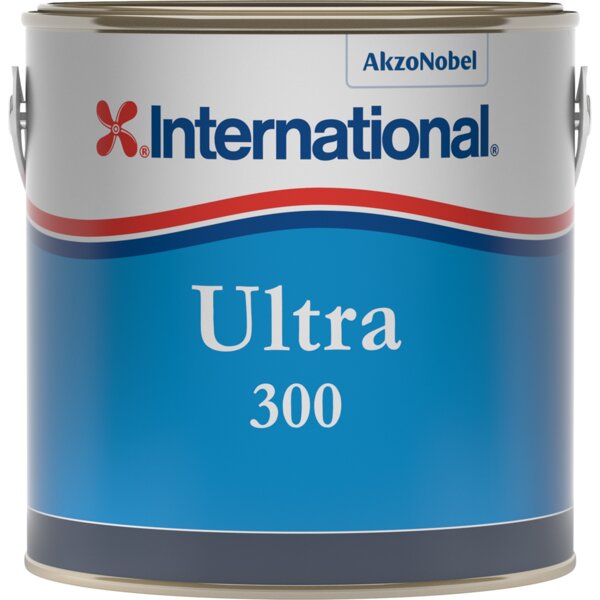
Ultra 300 from International Náutica is a premium hard antifouling coating designed to protect boat hulls operating in both fresh and salt water. Its hard, scrubbable film is effective against fouling organisms such as slime, aquatic plants and animals, delivering up to one year of antifouling performance. Ultra 300 can be burnished to achieve a smoother finish for maximum slip through the water and can be scrubbed and cleaned in service, making it particularly suitable for fast powerboats and demanding users.
Main features
- Premium hard antifouling effective against a wide range of fouling organisms, slime and aquatic growth.
- For fresh and salt water – suitable for vessels operating in varied environments.
- Hard, scrubbable finish providing up to 12 months of protection and allowing in-service cleaning.
- Burnishable surface – can be polished to a smoother finish to maximise hydrodynamic slip and speed.
- Wide colour range: Black (YBB723), Navy (YBB724), Blue (YBB725), Green (YBB726), Dark Grey (YBB727), Dover White (YBB728), Red (YBB729).
- Matt finish with an average specific gravity of 1.9 and volume solids of 58%.
- Versatile application methods: brush, roller or professional airless spray.
- Compatible substrates: suitably primed GRP, wood, steel/iron and lead.
- Typical shelf life of 2 years when stored correctly between 5°C and 35°C out of direct sunlight.
- Solvent-borne formulation with VOC content (as supplied) of 364 g/l (197 g/kg per EU Solvent Emissions Directive 1999/13/EC).
Technical specifications
General product data
- Product type: Solvent-borne hard antifouling coating.
- Brand: International Náutica.
- Product name: Ultra 300.
- Finish: Matt.
- Specific gravity: 1.9 (average).
- Volume solids: 58% (average).
- Typical shelf life: 2 years.
- VOC (as supplied): 364 g/l (average).
- VOC (EU Solvent): 197 g/kg (average), EU Solvent Emissions Directive 1999/13/EC.
- Available unit sizes: 750 ml, 2.5 l, 5 l.
Drying and immersion times
- Touch dry:
- 5°C: 1 hour
- 15°C: 45 minutes
- 23°C: 30 minutes
- 35°C: 20 minutes
- Minimum time before immersion:
- 5°C: 24 hours
- 15°C: 12 hours
- 23°C: 8 hours
- 35°C: 6 hours
- Maximum immersion time: 6 months between 5°C and 35°C.
Overcoating intervals (with Ultra 300)
- 5°C: Minimum 16 hours (no maximum stated).
- 15°C: Minimum 10 hours (no maximum stated).
- 23°C: Minimum 6 hours (no maximum stated).
- 35°C: Minimum 4 hours (no maximum stated).
Coverage, film thickness and number of coats
- Recommended number of coats:
- By brush/roller: 2 coats of 60 µm dry film thickness each (total DFT 120 µm) for 12 months protection.
- By spray: 1 coat of 120 µm dry film thickness (total DFT 120 µm) for 12 months protection.
- Recommended DFT per coat:
- Brush/roller: 60 µm dry.
- Spray: 120 µm dry.
- Recommended WFT per coat:
- Brush/roller: 103 µm wet.
- Spray: 206 µm wet.
- Theoretical coverage:
- Brush/roller: 10 m²/l per coat.
- Spray: 5 m²/l per coat.
- Practical coverage (allowing for losses):
- Brush/roller: 9 m²/l per coat.
- Spray: 3 m²/l per coat.
Application methods and parameters
- Application methods: Brush, roller, professional airless spray.
- Airless spray parameters:
- Pressure: 176–210 bar / 2500–3050 psi.
- Tip size: 517–521.
- Thinning: Thinning is not recommended; incorrect film thickness can compromise antifouling performance.
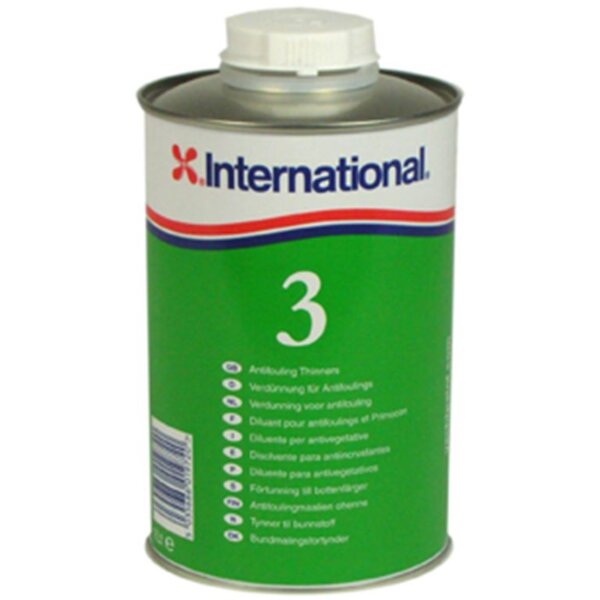
- Cleaner: YTA085 Thinner No. 3.
- Product temperature during application: Minimum 5°C / 41°F, maximum 35°C / 95°F.
- Ambient temperature during application: Minimum 5°C / 41°F, maximum 35°C / 95°F.
- Substrate temperature during application: At least 3°C / 5°F above the dew point and below 35°C / 95°F.
Substrate compatibility and priming
- Suitable substrates: GRP (fibreglass), wood, steel/iron, lead.
- Unsuitable substrates: Aluminium/alloy substrates and zinc-sprayed surfaces.
- Overcoating existing antifouling:
- Can be applied directly over most existing antifoulings in sound condition, except VC17m/PTFE antifoulings.
- If the existing antifouling is incompatible or unknown, seal with a suitable International Paint barrier/sealer coat.
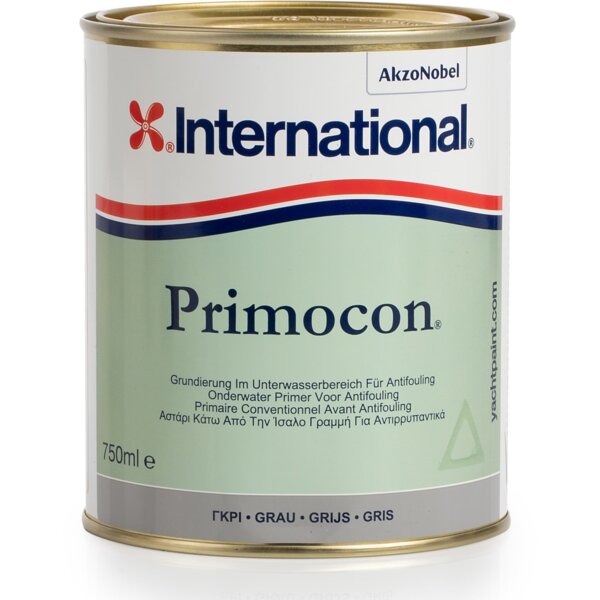
- Bare GRP: Prime with Gelshield 200 for osmosis protection, or Primocon or Interprotect.
- Steel/Iron/Lead/Wood: Prime with Interprotect or Primocon.
Surface preparation
- Previously antifouled surfaces in good condition:
- Remove all fouling and contamination, including the leached layer.
- Use high-pressure fresh water washing (3000 psi / 207 bar) and/or scraping and wet sanding with 80–120 grade abrasive paper.
- Do not dry sand.
- Previously antifouled surfaces in poor condition:
- Use Interstrip to remove all traces of antifouling.
- High-wear areas: Apply an additional stripe coat on chines, rudders, sterngear and all leading edges.
Applications and use cases
- Fast powerboats: Burnishable, hard coating designed to maximise slip and withstand high water flow, making it ideal for fast motor vessels.
- Leisure and consumer boats: Suitable for consumer use on GRP, wooden, steel/iron and lead hulls operating in marinas, rivers, lakes and coastal waters.
- Professional applications: Can be spray-applied by professionals for larger vessels or where controlled film build and productivity are important.
- Boats requiring in-season cleaning: Hard, scrubbable surface allows periodic hull cleaning or light wet sanding to maintain performance.
- Vessels stored ashore between seasons: Maximum immersion time of 6 months offers flexibility for launch planning within the season.
FAQ
1. How long does Ultra 300 protect my boat?
When applied at the recommended total dry film thickness of 120 µm (two coats by brush/roller or one coat by spray), Ultra 300 provides up to one year of antifouling performance.
2. Can Ultra 300 be used in both fresh and salt water?
Yes. Ultra 300 is formulated for vessels operating in both fresh and salt water.
3. On which substrates can I apply Ultra 300?
It can be used over suitably primed GRP, wood, steel/iron and lead. It is not suitable for aluminium/alloy substrates or zinc-sprayed surfaces.
4. Can I apply Ultra 300 over my existing antifouling?
Ultra 300 can be applied directly over most existing antifoulings that are in sound condition, except VC17m/PTFE antifoulings. If compatibility is uncertain, a suitable International Paint barrier/sealer coat should be used.
5. Is thinning required?
No. Thinning is not recommended because it can reduce the dry film thickness and compromise antifouling performance.
6. How should I prepare a previously painted hull in good condition?
Remove all fouling and contamination, including the leached layer, using high-pressure fresh water washing (3000 psi / 207 bar) and/or scraping and wet sanding with 80–120 grade paper. Do not dry sand.
7. What are the recommended environmental conditions during application?
Product and ambient temperatures should be between 5°C and 35°C. The substrate should be at least 3°C above the dew point and not above 35°C.
8. Can the coating be burnished or sanded smooth?
Yes. Ultra 300 can be burnished to achieve a smoother finish for improved slip through the water. Any sanding of antifouling must be carried out wet, not dry.
9. How should leftover product and empty tins be disposed of?
Do not pour paint into watercourses or discard tins into the environment. Use designated waste facilities and allow paints to harden before disposal. Follow local regulations.
10. Does Ultra 300 contain biocides?
Yes. The product contains biocides and is classified as very toxic to aquatic life with long lasting effects. Avoid release to the environment and follow all safety recommendations.
Section 14 – Transport information
- UN number / ID number: UN1263.
- UN proper shipping name: PAINT.
- Transport hazard class: Class 3 (flammable liquid).
- Packing group: III.
- Environmental hazards:
- Classified as environmentally hazardous for transport.
- Marine pollutants (IMDG): dicopper oxide, zinc oxide.
- The environmentally hazardous substance mark / marine pollutant mark is not required when transported in individual containers of ≤5 l or ≤5 kg.
- ADR/RID:
- UN1263, PAINT, Class 3, Packing Group III.
- Tunnel restriction code: D/E.
- The environmentally hazardous substance mark is not required for packages ≤5 l or ≤5 kg.
- IMDG:
- UN1263, PAINT, Class 3, Packing Group III.
- Marine pollutant: dicopper oxide, zinc oxide.
- Emergency schedules: F-E, S-E.
- Marine pollutant mark not required for packages ≤5 l or ≤5 kg.
- IATA:
- UN1263, PAINT, Class 3, Packing Group III.
- The environmentally hazardous substance mark may appear if required by other transport regulations.
- Special precautions for users:
- Transport within the user’s premises only in closed containers that are upright and secure.
- Ensure that persons transporting the product know what to do in case of accident or spillage.
- Transport in bulk according to IMO instruments: Not applicable.
Section 8 – Personal protective measures
General hygiene measures
- Eating, drinking and smoking should be prohibited in areas where the product is handled, stored or processed.
- Wash hands, forearms and face thoroughly after handling and before eating, smoking or using the lavatory.
- Contaminated work clothing should not leave the workplace and must be washed before reuse.
- Ensure that eyewash stations and safety showers are close to the workstation.
Required personal protective equipment (PPE)
- Eye / face protection:
- Wear chemical splash goggles and/or a face shield complying with an approved standard whenever there is a risk of splashes, mists, gases or dusts.
- If inhalation hazards exist, a full-face respirator may be required instead of goggles.
- Hand protection:
- Wear chemical-resistant, impervious gloves complying with EN374 or equivalent.
- For prolonged or frequently repeated contact: gloves with protection class 6 (breakthrough time > 480 minutes) such as Viton or nitrile, thickness ≥ 0.38 mm.
- For brief contact: gloves with protection class ≥ 2 (breakthrough time > 30 minutes) such as nitrile, thickness ≥ 0.12 mm.
- Replace gloves regularly and whenever damaged or degraded.
- Skin and body protection:
- Wear suitable protective clothing selected according to the task and risks, approved by a specialist.
- Where there is a risk of ignition from static electricity, wear anti-static protective clothing including overalls, boots and gloves conforming to EN 1149.
- Use appropriate footwear and additional skin protection as required.
- Respiratory protection:
- Use only with adequate ventilation and suitable local exhaust where necessary.
- When ventilation is insufficient or exposure limits may be exceeded, wear a respirator conforming to EN140 with type A/P2 filter or better, selected and used within a respiratory protection programme.
- Dry sanding, flame cutting and/or welding of the dry paint film will generate dust and/or hazardous fumes; wet sanding/flatting should be used wherever possible. If exposure cannot be avoided, suitable respiratory protection is required.
Additional safety considerations
- Ultra 300 is a flammable liquid and vapour; keep away from heat, hot surfaces, sparks, open flames and other ignition sources. No smoking.
- Do not breathe vapour or mist. Avoid release to the environment; the product is very toxic to aquatic life with long lasting effects.
- Children should be kept away until treated surfaces are dry.
*Contenido generado por IA