What is 96º Alcohol Cidas and why choose it
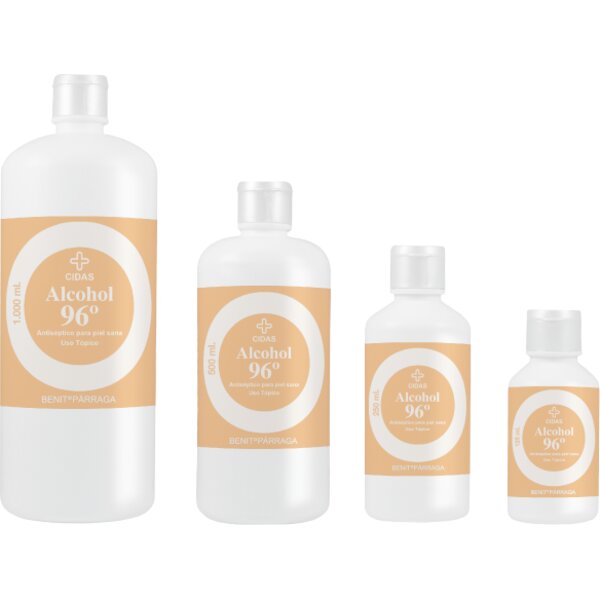
96º Alcohol Cidas is a high-purity ethanol solution (96°) boosted with benzalkonium chloride, designed as an antiseptic, bactericidal and levuricidal product for healthy skin. Classified as a biocide main group PT1, it is indicated for pre-injection skin preparation and for sanitary, clinical and hospital use where effective skin disinfection is required.
The formulation complies with key UNE standards for medical antiseptics and disinfectants, ensuring proven bactericidal and levuricidal activity and suitability for surgical hand disinfection. Its high ethanol content (99.9% ethanol 96° in the formulation) provides rapid action, while benzalkonium chloride at 0.1% enhances the disinfectant performance.
Main features
- Type of product: Antiseptic, bactericidal and levuricidal solution for healthy skin.
- Active composition: Ethyl alcohol 96° (ethanol) 99.9% and benzalkonium chloride 0.1%.
- Intended use: Prepares the skin for injections; use in sanitary, clinical and hospital environments.
- Biocidal classification: Biocide, main group PT1.
- Activity tested according to UNE standards:
- UNE-EN 13727:2012 + A2:2015 – quantitative suspension test for bactericidal activity in the medical area (phase 2, step 1).
- UNE-EN 13624:2014 – quantitative suspension test for fungicidal or levuricidal activity in medicine (phase 2, step 1).
- UNE-EN 12791:2016 + A1:2018 – surgical hand disinfection (phase 2/step 2).
- Physical form: Colourless liquid with neutral odour.
- pH: 7 – 7.2.
- Solubility: Miscible with water; soluble in ethanol, ether and chloroform.
- Safety classification (CLP): Flammable liquid Category 2 (H225) and eye irritant Category 2 (H319).
- Use restrictions: External use only; not suitable for oral use and not effective against spores.
- Incompatibilities: Incompatible with anionic detergents; avoid contact with strong oxidants and alkali metals.
Technical specifications
Composition
- Ethyl alcohol 96° (ethanol): 99.9% – CAS 64-17-5 – Index 603-002-00-5.
- Benzalkonium chloride: 0.1% – CAS 63449-41-2 – Index 612-140-00-5.
Physical and chemical properties
- Appearance: Liquid, colourless.
- Odour: Neutral.
- Molecular weight: 40 g/mol.
- pH: 7 – 7.2.
- Melting/freezing point: -114 °C.
- Initial boiling point: 78 °C (ethanol).
- Flash point: 12 °C (Method Abel - NF EN ISO 13736/IP170).
- Auto-ignition temperature: 422.7 °C (ethanol).
- Relative density: 0.80578 g/ml (20 °C).
- Dynamic viscosity: 1.4 cP (15 °C).
- Explosion limits: 2 – 12 vol %.
- Flammability: Highly flammable liquid and vapour; vapours heavier than air and can form explosive mixtures.
- Biodegradability: Readily biodegradable; not bioaccumulative.
Regulatory and authorisation data
- Biocide registration (A.E.M. y P.S.): 387-DES (formulated product).
- Manufacturer authorisation (disinfectants): 7540-DS (Benito Parraga S.L.).
- UFI: DXS9-M0Q1-A00T-GJQJ.
- CLP hazard statements:
- H225 – Highly flammable liquid and vapour.
- H319 – Causes serious eye irritation.
- Typical packaging material: HDPE bottle, semi-transparent, with tamper-evident hinge cap.
Available formats and logistics
- Primary packaging: HDPE bottles, semi-transparent, with hinge cap.
| Code |
Capacity |
Material |
Units per box |
EAN-13 |
DUN |
| 3510 |
125 ml |
HDPE |
40 |
8420728033159 |
Consultar ficha técnica del fabricante. |
| 3520 |
250 ml |
HDPE |
24 |
8420728033258 |
18420728035204 |
| 3530 |
500 ml |
HDPE |
24 |
8420728033357 |
18420728035303 |
| 3540 |
1000 ml |
HDPE |
12 |
8420728033456 |
18420728035402 |
Pallet configuration
| Product |
Capacity |
Units/box |
Boxes per layer |
Layers per pallet |
Boxes per pallet |
Total units |
Pallet height |
Box weight |
Pallet weight |
| Cidas |
125 ml |
40 |
9 |
9 |
81 |
3240 |
1.35 m |
5.2 kg |
422 kg |
| Cidas |
250 ml |
24 |
10 |
8 |
80 |
1920 |
1.43 m |
5.64 kg |
478 kg |
| Cidas |
500 ml |
24 |
6 |
7 |
42 |
1008 |
1.52 m |
10.96 kg |
481 kg |
| Cidas |
1000 ml |
12 |
9 |
5 |
45 |
540 |
1.40 m |
10.56 kg |
500 kg |
Applications and use cases
- Pre-injection skin preparation: Indicated to disinfect healthy skin before injections.
- Healthcare environments: Designed for sanitary, clinical and hospital use with disinfectant activity.
- Surgical hand disinfection: Complies with UNE-EN 12791 for surgical hand disinfection (phase 2/step 2).
- Routine antisepsis of healthy skin: Suitable where bactericidal and levuricidal action is required on intact skin.
Directions for use
- Apply on healthy, clean and dry skin.
- With clean hands, soak a cotton pad with 10 ml of product.
- Apply for three minutes and allow to evaporate completely.
- Do not mix with other products; do not rinse. Let dry.
- Use with caution in children under two years. External use only.
FAQ
1. What is 96º Alcohol Cidas used for?
It is an antiseptic, bactericidal and levuricidal solution for healthy skin, indicated to prepare the skin before injections and for disinfectant use in sanitary, clinical and hospital environments.
2. Can it be used on damaged or sensitive skin?
Use is not recommended on sensitive persons, on extensive areas of skin or for prolonged periods. Avoid contact with eyes, mucous membranes and diseased or sensitive skin areas.
3. Is 96º Alcohol Cidas suitable for oral use or mouth rinses?
No. It is for external use only and is not suitable for oral use.
4. Does it work against spores?
No. The product is not effective against spores.
5. How should it be applied for pre-injection skin disinfection?
Apply on clean, dry, healthy skin using a cotton pad soaked with 10 ml of product, rub for three minutes and allow to evaporate completely without rinsing.
6. With which substances is it incompatible?
It is incompatible with anionic detergents and should not be mixed with other products. It should also be kept away from strong oxidising agents and alkali metals.
7. What hazards are associated with this product?
It is a highly flammable liquid and vapour and causes serious eye irritation. Vapours may form explosive mixtures with air.
8. How should accidental contact with eyes be handled?
Rinse cautiously with water for several minutes, remove contact lenses if present and easy to do, and continue rinsing. If eye irritation persists, seek medical advice.
9. How should the product and its container be disposed of?
The content or container should be disposed of according to current regulations on waste treatment. Empty contaminated packaging must be treated as hazardous waste.
Section 14 – Transport information
Transport data according to ADR / RID / IMDG / IATA / ADN:
- UN number: 1170.
- Proper shipping name: Ethanol solution (Ethyl alcohol in solution) / Etanol en solución (alcohol etílico en solución).
- Transport hazard class: 3 (flammable liquid).
- Packing group: II.
- Environmental hazards: Not classified as dangerous for the environment; not a marine pollutant.
- Limited quantities: 1 L (ADR, IMDG, ADN, RID); 1 L for limited quantities in passenger and cargo aircraft (IATA, code Y341).
- Selected ADR details:
- Classification code: F1.
- Special provisions: 144, 601.
- Excepted quantities: E2.
- Packing instructions: P001, IBC02, R001; mixed packing provision MP19.
- Tunnel restriction code: D/E.
- Hazard identification number (Kemler): 33.
- Road transport note: For road transport, the product is exempt from ADR as limited quantity (LQ4).
Section 8 – Individual protection measures
Technical measures
- Ensure adequate ventilation and organisational measures to limit emissions, dispersion and exposure.
- Avoid accumulation of electrostatic charges; ensure proper grounding of equipment.
- Use explosion-protected installations, extraction systems and equipment.
Personal protective equipment (PPE)
- General: The type of PPE must be selected according to the concentration and amount of hazardous substance at the specific workplace.
- Body protection: Wear suitable protective clothing. Avoid neoprene garments for continuous ethanol exposure.
- Hand protection:
- Chemical-resistant gloves tested according to EN 374.
- Suitable materials: Viton / butyl rubber, nitrile rubber, polyvinyl chloride (PVC).
- Recommended breakthrough time: > 8 hours.
- Eye protection: Tight-fitting safety goggles according to EN 166.
- Respiratory protection:
- If ventilation is insufficient, use suitable respiratory equipment.
- Half mask (EN 140) or full face mask (DIN EN 136) with AP filter type (EN 141), adapted to the concentration of harmful substances.
- If concentration is exceeded, use self-contained breathing apparatus (EN 137).
- Thermal hazards: No special protection required under normal conditions of use; use specific equipment in case of exposure to heat sources.
Hygiene measures
- Maintain good industrial hygiene.
- Wash hands and exposed areas with mild soap and water before eating, drinking, smoking or leaving the workplace.
- Do not eat, drink or smoke while using the product.
- Remove contaminated clothing, wash separately and before reuse.
Environmental exposure controls
- Avoid release to the environment.
- Comply with applicable environmental protection legislation.