What is SIKAFLEX 290 DC PRO and why choose it
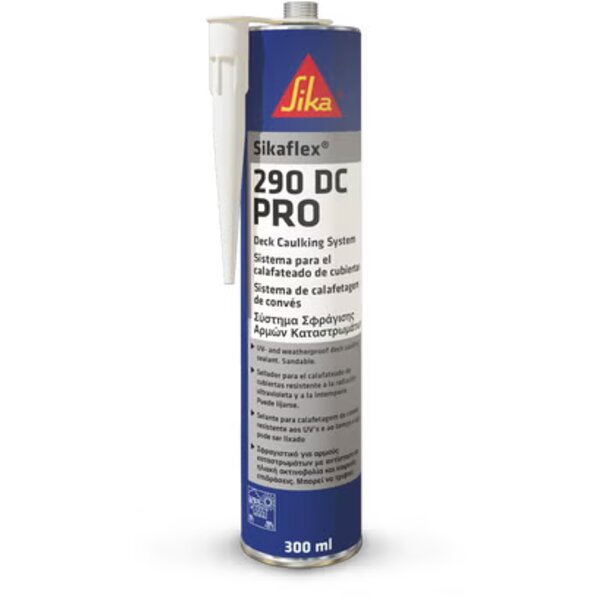
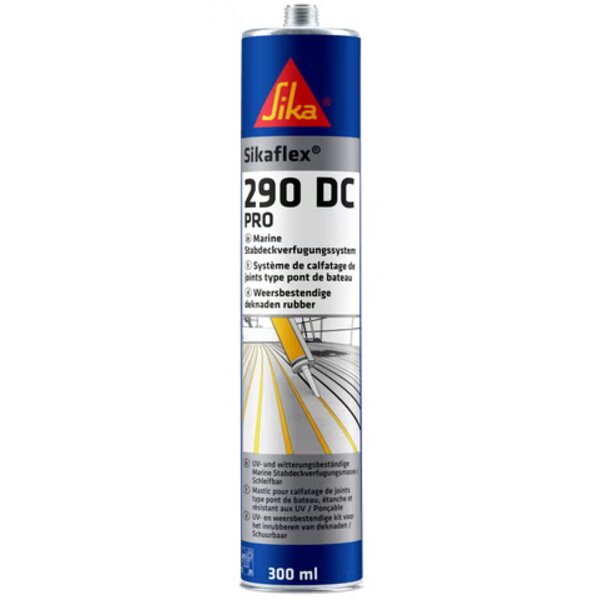
SIKAFLEX 290 DC PRO is a one-component polyurethane sealing compound specifically formulated for watertight caulking of traditional wooden boat and yacht decks. It cures with atmospheric moisture to form a flexible elastomer that can be sanded once cured. The sealant is resistant to UV radiation, weathering and sea water, making it suitable for long-term use in demanding marine environments.
Main features
- One-component reactive polyurethane (PUR) sealing compound.
- Moisture-curing system.
- Designed for caulking joints in traditional wooden decks on boats and yachts.
- UV-resistant and weather-resistant.
- Sea water and fresh water resistant.
- Non-corrosive behaviour on typical substrates.
- Forms an elastic, sandable joint after curing.
- Good resistance to fresh, salt and calcareous waters and to most water-based cleaners.
- Manufactured under ISO 9001 quality management and environmental protection systems.
Technical specifications
- Chemical base: One-component polyurethane.
- Colour: Black.
- Curing mechanism: Reaction with atmospheric moisture.
- Density (uncured): Approx. 1.3 kg/l.
- Consistency: Thixotropic, non-sag (Sikaflex-290 DC); slightly thixotropic, applicable on slopes up to approx. 5° to the horizontal (Sikaflex-290 DC SL (VP)).
- Application temperature: Ambient temperature.
- Skin formation time (23°C / 50% r.h.): Approx. 70 minutes (Sikaflex-290 DC); approx. 100 minutes (Sikaflex-290 DC SL (VP)).
- Shrinkage: Approx. 3%.
- Hardness: Approx. Shore A 40 (ISO 868).
- Tensile strength: Approx. 3 N/mm² (ISO 8339).
- Elongation at break: Approx. 600% (ISO 8339).
- Tear propagation resistance: Approx. 10 N/mm (ISO 34).
- Movement capability: 10%.
- Service temperature range: Permanent -40°C to +90°C.
- Service life (shelf life, stored below 25°C): 12 months in cartridges and unipacs; 9 months in drums.
- Physical form: Paste.
- Solubility: Insoluble in water.
- VOC content (EU): Approx. 2.66% (w/w).
Curing behaviour
- Cures by reaction with atmospheric moisture; curing rate slows down at low temperatures due to lower air humidity.
Chemical resistance
- Long-term resistance to fresh water, salt water and calcareous water.
- Resistant to most water-based cleaners.
- Not resistant to organic solvents, acids, alkaline solutions or cleaners containing chlorides.
- Brief contact with gasoline or lubricants has no significant effect on durability.
Packaging
- Cartridge: 300 ml (Sikaflex-290 DC).
- Unipac: 600 ml and 1000 ml (Sikaflex-290 DC).
- Drum: 23 l and 195 l (Sikaflex-290 DC and Sikaflex-290 DC SL (VP)).
Applications and use cases
- Exclusive use for caulking joints in traditional wooden decks on boats and yachts.
- Suitable for marine deck joints where a UV-resistant, flexible and sandable sealing compound is required.
FAQ
1. What is SIKAFLEX 290 DC PRO used for?
It is used exclusively for watertight caulking of joints in traditional wooden decks on boats and yachts.
2. Is the product UV-resistant?
Yes, it is resistant to ultraviolet radiation, making it suitable for exposed marine deck applications.
3. Can the cured sealant be sanded?
Yes, after curing the product forms a flexible elastomer that can be sanded.
4. Is SIKAFLEX 290 DC PRO resistant to sea water?
Yes, it is resistant to sea water as well as fresh and calcareous waters.
5. What is the service temperature range of the cured joint?
The recommended permanent service temperature range is approximately -40°C to +90°C.
6. How long is the shelf life?
When stored below 25°C, the shelf life is approximately 12 months for cartridges and unipacs and 9 months for drums.
7. What type of curing mechanism does it use?
It cures by reaction with atmospheric moisture.
8. Does it contain isocyanates?
Yes, the safety data sheet indicates that the product contains isocyanates.
Section 14 – Transport information
- ADR (road transport): Not classified as dangerous goods.
- IMDG (maritime transport): Not regulated; not classified as a marine pollutant.
- IATA (air transport): Not regulated.
Section 8 – Personal protective measures
Exposure controls
- General workplace ventilation is usually sufficient to control airborne contaminants.
- Where ingredients with exposure limits are present, process enclosure, local exhaust ventilation or other engineering controls may be required to keep exposure below statutory limits.
Hygiene measures
- Wash hands, forearms and face thoroughly after handling the product, before eating, drinking or smoking and at the end of the work shift.
- Use appropriate techniques to remove contaminated clothing and wash it before reuse.
Respiratory protection
- No special respiratory protection is normally required under recommended handling conditions.
Hand protection
- Use chemical-resistant, impervious gloves that comply with approved standards when handling the product if a risk assessment indicates this is necessary.
- Recommended glove materials: butyl rubber or nitrile rubber.
Skin and body protection
- Select personal protective equipment for the body based on the specific task and risks involved, and have it approved by a specialist.
- Recommended: preventive skin protection with a protective cream.
Environmental exposure control
- Emissions from ventilation systems or process equipment should be checked to ensure compliance with environmental protection legislation.
- Where necessary, use fume scrubbers, filters or process equipment modifications to reduce emissions to acceptable levels.
*Contenido generado por IA