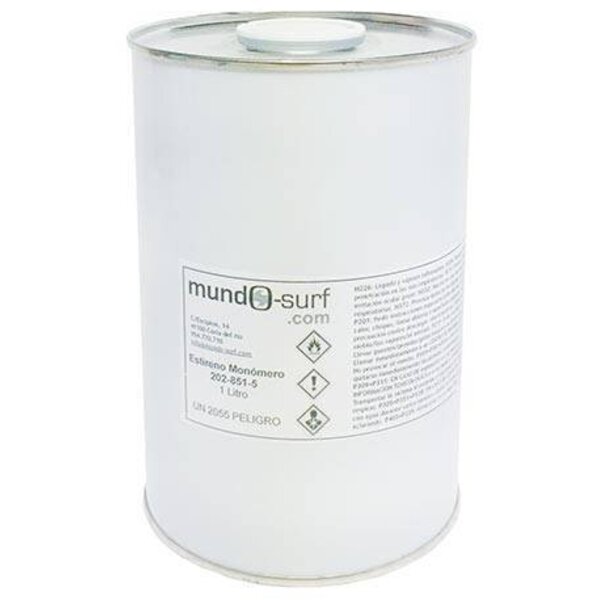
What is STYRENE MONOMER 1LT and why choose it
STYRENE MONOMER 1LT from Laminados y complementos is a 1‑litre packaging of styrene monomer, a clear, colourless, flammable liquid used as a key reactive diluent and building block in polyester and vinyl ester resins, gelcoats and composite laminating systems. It is widely used in fibreglass and reinforced plastic manufacturing as well as in the production of polystyrene and other styrenic polymers. Information below is based on generic data for styrene monomer (CAS 100‑42‑5) and may not be fully specific to this brand or batch.
Main features
- Chemical type: Styrene monomer (vinylbenzene / ethenylbenzene), typically supplied stabilized to prevent premature polymerisation.
- Appearance: Clear, colourless, oily liquid with a characteristic aromatic odour (unverified for this specific product).
- High reactivity: Acts as a reactive monomer, copolymerising with unsaturated polyester resins and other monomers.
- Excellent diluent for resins: Reduces viscosity of polyester and vinyl ester resins while becoming part of the final polymer network (no inert solvent residue).
- Versatile industrial use: Commonly used in composites, castings, coatings and as raw material for polystyrene and styrenic copolymers.
- Flammable liquid: Classified as a flammable liquid; must be handled away from ignition sources with appropriate ventilation (classification details may vary by supplier and legislation).
Technical specifications
The following specifications are typical for styrene monomer and are provided as indicative, non‑verified values. Actual values for STYRENE MONOMER 1LT from Laminados y complementos may differ and should be confirmed in the official technical or safety data sheet.
- Chemical name: Styrene
- Synonyms: Vinylbenzene, ethenylbenzene, phenylethene, styrol (not exhaustive)
- CAS number: 100‑42‑5 (generic for styrene monomer)
- Physical state: Liquid at ambient temperature
- Colour: Colourless to slightly yellow (may darken on ageing or exposure to light/heat)
- Odour: Characteristic aromatic odour
- Flash point: Typically around 31–32 °C (closed cup, indicative only, not product‑specific)
- Boiling point: Approximately 145–146 °C (indicative)
- Density: Around 0.90–0.91 g/cm³ at 20 °C (indicative)
- Solubility: Practically insoluble in water; miscible with many organic solvents (indicative)
- Packaging size: 1 litre container
Applications and use cases
STYRENE MONOMER 1LT is intended for professional and industrial use. Typical applications, based on generic usage of styrene monomer, include:
- Unsaturated polyester and vinyl ester resins: Used as reactive diluent to adjust viscosity and reactivity of resins for laminating, infusion and casting processes.
- Fibreglass and composite laminates: For manufacturing and repair of FRP (fibre‑reinforced plastic) parts such as boat hulls, panels, tanks, vehicle parts and general laminates.
- Gelcoats and topcoats: As monomer component in gelcoat formulations to achieve proper crosslinking and surface finish.
- Casting and moulding: In filled or unfilled resin systems for cast parts, decorative elements and tooling (when used according to the resin manufacturer recommendations).
- Polystyrene and styrenic polymers (upstream use): Industrial production of polystyrene and copolymers such as ABS, SAN or SBR, where styrene monomer is the essential building block (information of general nature, not specific to this packaging).
FAQ
-
Is this styrene monomer already inhibited or stabilized?
Commercial styrene monomer is normally supplied with a stabilizer (inhibitor) to prevent unwanted polymerisation during storage and transport. The exact type and concentration of inhibitor for STYRENE MONOMER 1LT from Laminados y complementos is not verified here and should be confirmed in the official product documentation.
-
Can STYRENE MONOMER 1LT be used to thin polyester resin?
Styrene monomer is commonly used as a reactive diluent for unsaturated polyester resins. However, the maximum addition level and compatibility depend on the specific resin system. Follow the resin manufacturer’s recommendations and test on a small scale before full‑scale use.
-
Is styrene monomer suitable for DIY use?
Styrene monomer is a flammable and hazardous industrial chemical that can cause irritation and other health effects upon inhalation or skin contact. Its use is generally recommended for trained personnel with adequate ventilation and protective equipment. For occasional DIY work, ready‑formulated resins with lower free‑styrene emission may be more appropriate.
-
How should I store STYRENE MONOMER 1LT?
In general, styrene monomer should be stored in tightly closed, correctly labelled containers, in a cool, well‑ventilated place away from heat sources, direct sunlight and ignition sources. Storage conditions and shelf life for this specific product should be confirmed in the supplier’s safety or technical data sheet.
-
Can styrene monomer be mixed with acetone or other solvents?
Styrene monomer is miscible with many organic solvents, but adding non‑reactive solvents to resin systems can affect curing, mechanical properties and VOC emissions. Any modification should be evaluated carefully, and compatibility checked with the resin manufacturer. The supplier’s documentation should be consulted before mixing.
-
What are the main hazards of styrene monomer?
Styrene monomer is typically classified as a flammable liquid and vapour and may cause irritation to eyes, skin and respiratory tract. Prolonged or repeated exposure may have additional health effects depending on concentration and exposure route. Exact hazard statements for this product must be verified in the official safety data sheet.
-
Is this product suitable for food‑contact applications?
Compliance of styrene‑based materials with food‑contact regulations depends on the final polymer, residual monomer content and specific legislation. This description does not confirm suitability for food‑contact use. Regulatory compliance must be checked with the manufacturer and applicable standards.
Section 14 – Transport information (generic, not product‑specific)
The following transport information is indicative and based on generic data for styrene monomer transported in bulk or standard packages. Classification for STYRENE MONOMER 1LT from Laminados y complementos must be confirmed in the official safety data sheet and transport documents.
- UN number: UN 2055 (Styrene monomer, stabilized) – generic reference, not verified for this product.
- UN proper shipping name: Styrene monomer, stabilized (generic).
- Transport hazard class: Class 3 (flammable liquid), generic classification.
- Packing group: Typically Packing Group III for many commercial styrene monomer products (to be verified for this specific formulation and region).
- Recommended transport conditions: Keep containers tightly closed, upright and secured. Protect from physical damage, excessive heat and direct sunlight. Ensure good ventilation and avoid sources of ignition during loading/unloading.
- Environmental hazards: Styrene monomer can be harmful to aquatic life at sufficient concentrations. Avoid release to the environment. Exact classification for aquatic hazard, if any, must be checked in the official SDS.
- Regulatory variations: Specific labelling, limited quantity provisions and tunnel restrictions may vary depending on the mode of transport (road, sea, air) and local regulations. Always follow current ADR, IMDG, IATA or relevant regulations applicable in your country.
Section 8 – Individual protection measures (generic guidance)
The following information is based on typical recommendations for handling styrene monomer in an industrial or professional environment. Actual requirements for STYRENE MONOMER 1LT from Laminados y complementos must be verified in the official safety data sheet and according to local regulations and risk assessment.
Engineering controls
- Ensure adequate general and, if necessary, local exhaust ventilation to keep vapour concentrations below applicable occupational exposure limits.
- Use closed or contained systems where feasible to minimise vapour exposure.
Personal protective equipment (PPE)
- Eye and face protection: Use safety goggles with side shields or a face shield where there is a risk of splashes. Eye protection should comply with relevant standards (for example, EN 166 or equivalent; to be verified regionally).
- Hand protection: Wear suitable chemical‑resistant protective gloves (for example, nitrile rubber or other material compatible with aromatic hydrocarbons, selection to be confirmed with glove manufacturer data). Replace gloves regularly and immediately if any sign of degradation or perforation appears.
- Skin and body protection: Use chemical‑resistant protective clothing (long sleeves, long trousers or coveralls) to avoid skin contact. In situations with possible splashes, additional apron or suit may be required.
- Respiratory protection: When ventilation is insufficient to maintain exposure below applicable limits, or in confined spaces, use an appropriate respiratory protection device. For many styrene applications, an organic vapour respirator with suitable filter may be recommended, but selection must be based on concentration, exposure time and local regulations.
- Hygiene measures: Avoid inhalation of vapours and contact with skin or eyes. Do not eat, drink or smoke in work areas. Wash hands and exposed skin thoroughly after handling, and remove contaminated clothing and protective equipment before entering eating areas.
*Contenido generado por IA