What is WEST SYSTEM 610 Six10 Epoxy Adhesive and why choose it
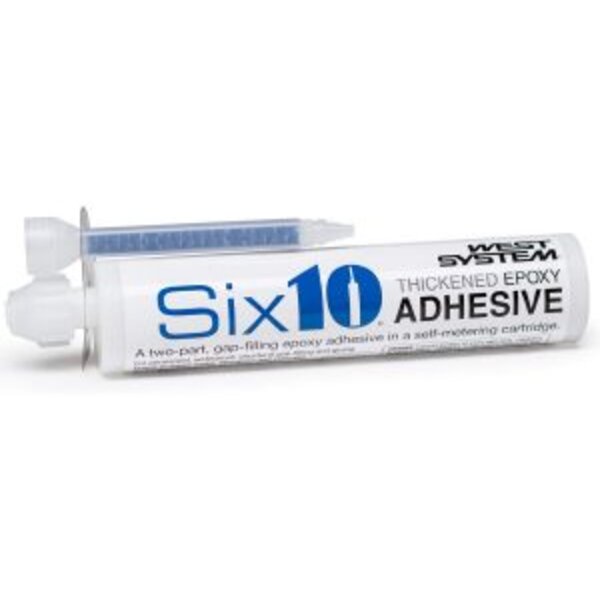
WEST SYSTEM 610 Six10 Epoxy Adhesive is a two-part, pre-thickened, gap-filling epoxy in a self-metering cartridge. It combines the mechanical strength and durability of WEST SYSTEM epoxies with the convenience of a standard caulking gun, making it ideal for structural, waterproof bonding in boatbuilding, repair and general construction applications. Its non-sag, thixotropic consistency allows it to bridge gaps and form smooth fillets, while its “shear thinning” behavior lets it wet out surfaces and light reinforcing fabrics without separate precoating.
Information in this description is based on manufacturer technical and safety data sheets, but some details (such as typical cartridge volume) should still be confirmed against the official technical data sheet for your specific region and packaging.
Main features
- Pre-thickened, gap-filling epoxy: Smooth, non-sag paste consistency for filling voids and bonding uneven or poorly fitting surfaces.
- Self-metering cartridge: Coaxial cartridge with internal piston automatically dispenses resin and hardener at the correct 2-part ratio through a static mixing nozzle.
- Use with standard caulking guns: Designed to fit most conventional sealant/caulk guns for easy, controlled application.
- Thixotropic (shear-thinning): Thick enough not to run or drip, but becomes more workable under pressure, allowing good wet-out of substrates and light to moderate fiberglass or carbon fabrics.
- Structural, waterproof bonds: Formulated for permanent, high-strength, moisture-resistant bonding suitable for marine and demanding structural repairs.
- Wide material compatibility: Bonds properly prepared wood, metals, fiberglass and other composites, concrete/masonry and many other common construction materials.
- Long open time: Extended working time helps with complex assemblies and longer glue lines.
- Controlled cure profile: Cures to a solid in a matter of hours (at moderate temperature), reaching working strength over the next days.
- Off-white paste: Paste-like appearance that can be tooled to form neat fillets and bond lines.
Technical specifications
The following values are indicative, based on manufacturer technical data. Always verify critical parameters in the latest official technical data sheet before use.
- Product type: Two-part, thickened epoxy adhesive in a self-metering cartridge.
- Physical form (mixed): Off-white, paste-like epoxy adhesive.
- Mixing: Automatic mixing in the static mixer; no manual proportioning or mixing required.
- Viscosity (mixed at 72 °F / 22 °C): Gel-like, non-sag consistency (thixotropic).
- Working / open time: Approx. 42 minutes in the static mixer at about 72 °F (22 °C) (manufacturer data; check current TDS for exact times).
- Cure to solid: Approx. 5–6 hours at 72 °F (22 °C) (unverified for other temperatures and film thicknesses).
- Cure to working strength: Typically 1–4 days depending on temperature and bond line thickness (to be confirmed in TDS).
- Minimum recommended application temperature: Around 10 °C (50 °F).
- Hardness (Shore D): Approx. 80 (manufacturer laboratory value).
- Tensile strength: Approx. 6,000–6,500 psi (laboratory value, not a design allowable).
- Flexural strength: Approx. 11,000 psi range (indicative value).
- Heat deflection temperature: Approximately 127 °F (around 53 °C) in standardized tests.
- Appearance (Part A resin): Off-white paste; mild odor.
- Flash point (Part A): > 93 °C (non-flammable paste under normal conditions).
- Typical cartridge size: Around 190 ml (this figure may vary by market and should be verified on the product label or official TDS).
Applications and use cases
- Marine repairs and construction: Ideal for stitch-and-glue boatbuilding, bonding stringers and frames, attaching hardware with high load transfer, and forming fillets along bulkheads and joints.
- Fiberglass laminate repair: Suitable for bonding and rebuilding locally damaged laminate areas, bonding core material, and attaching reinforcing patches with light to moderate fabrics.
- Wood bonding: Structural bonding of plywood, solid timber, veneers and other wood components, especially where gaps or irregularities exist.
- Metal bonding: Adheres to properly prepared metals (abrasion + degreasing) for attaching brackets, fittings and reinforcement plates.
- Composite parts: Bonding and secondary bonding of composite panels, profiles, and reinforcing elements where a strong, non-sag adhesive is required.
- Concrete and masonry: Point-and-shoot application for bonding fixtures, patching small defects and anchoring items to mineral substrates (after correct surface preparation).
- General structural repair: Filling and bonding in high-stress areas where a conventional fluid laminating epoxy would be too runny.
FAQ – WEST SYSTEM 610 Six10 Epoxy Adhesive
-
Is 610 Six10 Epoxy Adhesive pre-mixed or do I have to mix it myself?
The product is supplied in a two-chamber cartridge. Resin and hardener are kept separate and are automatically proportioned and mixed when expressed through the static mixing nozzle, so no manual measuring or mixing is needed.
-
Can I apply Six10 with a regular caulking gun?
Yes. The cartridge is designed to fit standard caulking guns, giving point-and-shoot convenience similar to sealants while delivering a structural epoxy adhesive.
-
What materials does Six10 bond to?
When surfaces are properly prepared, Six10 bonds to wood, metals, fiberglass and other composites, as well as concrete and many other common construction materials. Always clean and abrade surfaces according to the manufacturer’s recommendations.
-
Is it suitable for underwater or permanently wet environments?
Six10 cures to a waterproof, structural epoxy adhesive and is formulated for demanding marine and outdoor use. For immersion or permanently wet service, follow WEST SYSTEM surface preparation and coating guidance and verify suitability in the official technical data.
-
How long do I have to work with the adhesive once it is dispensed?
At around 22 °C (72 °F), the working time in the static mixer and on the joint is approximately 40–45 minutes, depending on mass and ambient conditions. Higher temperatures shorten working time; lower temperatures extend it.
-
When can I remove clamps or load the joint?
At moderate room temperature, Six10 typically cures to a solid in about 5–6 hours and reaches useful handling or working strength between 1 and 4 days. For critical structural applications, allow a full cure and consult the latest technical data sheet for design guidance.
-
Can I use Six10 to wet out fiberglass or carbon fabric?
Although it is pre-thickened, its shear-thinning behavior allows it to wet out light to moderate reinforcing fabrics when worked into the fibers. For heavy fabrics or laminating over large areas, a lower-viscosity laminating epoxy may be more efficient.
-
Does Six10 shrink during cure?
Like other WEST SYSTEM epoxies, Six10 has very low shrinkage compared with many conventional adhesives. Exact shrinkage values are not specified here and should be checked in the official technical data sheet if critical.
-
What is the shelf life of 610 Six10?
When stored sealed in a cool, dry place within the temperature range recommended by the manufacturer, Six10 typically remains usable for several years. Always check the packaging and latest technical data for region-specific shelf-life guidance.
-
Where can I find the official safety and technical information?
The manufacturer provides an up-to-date Safety Data Sheet (SDS) and Technical Data Sheet (TDS) for this product. For precise, legally relevant and design-critical information, always consult those official documents.
Section 14 – Transport information (summary)
The following transport information is summarized from the manufacturer’s Safety Data Sheet for WEST SYSTEM Six10 Part A resin and may vary slightly between components and jurisdictions. For any shipment, especially international transport, always refer to the full, current SDS and applicable transport regulations.
- US DOT / TDG (road/land): Not regulated as a dangerous good under DOT/TDG in the supplied form.
- IMDG (sea transport): Classified as UN 3077, Environmentally hazardous substance, solid, n.o.s., Class 9 (miscellaneous dangerous substances and articles), Packing Group III, marine pollutant.
- IATA (air transport): Classified as UN 3077, Environmentally hazardous substance, solid, n.o.s., Class 9, Packing Group III.
- General transport precautions:
- Keep containers tightly closed and protected against physical damage during transport.
- Prevent leakage to the environment; avoid transporting with incompatible materials (strong acids, bases, amines, oxidizers) where possible.
- Ensure labeling and documentation comply with applicable local and international regulations.
These transport details are derived from SDS data and are not a substitute for the full regulatory information in the official Safety Data Sheet.
Section 8 – Individual protection measures (PPE) summary
Six10 epoxy components can cause skin irritation, serious eye irritation and allergic skin reactions. The following key personal protective measures are summarized from the manufacturer’s Safety Data Sheet and are intended as general guidance only. Always adapt PPE to your specific working conditions and regulatory requirements.
- Engineering controls: Use adequate local or general ventilation to keep airborne levels of vapors, mists and any dust from associated operations below recommended exposure limits.
- Hand protection: Wear chemically resistant protective gloves (for example, suitable nitrile or other gloves rated for epoxy systems). Inspect and replace gloves regularly.
- Eye/face protection: Use appropriate eye protection such as safety glasses with side shields or chemical splash goggles; a face shield may be required for splash-intensive operations.
- Skin and body protection: Wear suitable protective clothing (long sleeves, long trousers or coveralls) to prevent repeated or prolonged skin contact. Use chemical-resistant aprons where splashes are likely.
- Respiratory protection: Under normal, well-ventilated conditions, respiratory protection may not be necessary. Where ventilation is insufficient or airborne concentrations may be elevated (spraying, heated use, confined spaces), use suitable respiratory protection selected according to expected exposure levels and local regulations.
- Hygiene measures: Avoid contact with skin and eyes. Do not eat, drink or smoke when using this product. Wash hands and any exposed skin thoroughly after handling and before breaks. Remove contaminated clothing and launder before reuse.
- Environmental precautions: Avoid release to the environment. Prevent uncured product from entering drains, soil or surface waters.
This PPE overview does not replace the full Safety Data Sheet. For detailed, up-to-date safety recommendations, consult the official SDS supplied by WEST SYSTEM or your distributor.
Contenido generado por IA