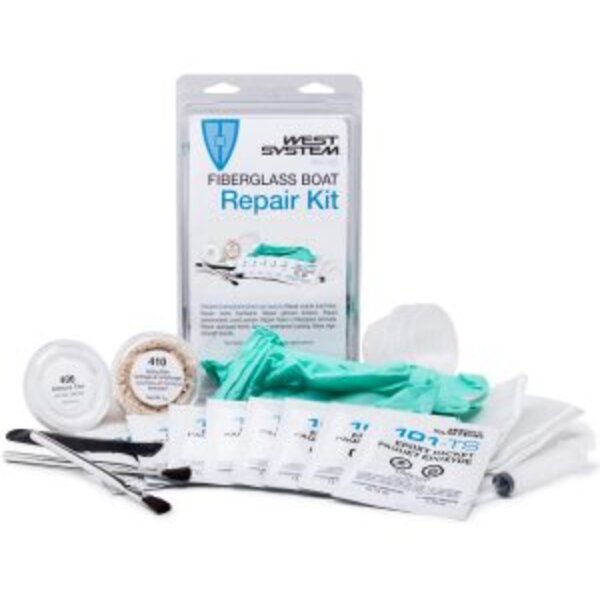
What is the West System 105 Glass Fibre Repair Kit and why choose it?
The West System 105 Glass Fibre Repair Kit is a complete fiberglass repair solution designed for small to medium structural and cosmetic repairs on glass fibre (GRP) boats and composite parts. It combines West System 105 epoxy resin with 205 fast hardener, glass fabrics, fillers and application tools in one compact pack, so you can repair cracks, scratches, gelcoat blisters, loose fittings and localized laminate damage without needing additional products. This kit is widely used in marine maintenance because it offers reliable adhesion, high mechanical strength and a professional finish on a wide range of fiberglass repair jobs.
Main features
- Complete repair system in one pack: includes resin, hardener, glass reinforcements, fillers, mixing accessories and basic PPE for immediate use.
- Based on West System 105 epoxy resin and 205 fast hardener: proven marine-grade system for strong, durable, moisture-resistant laminates and bonds.
- Suitable for structural and cosmetic repairs: ideal for cracks, scratches, small holes, delaminations and hardware reinforcement on fiberglass structures.
- Versatile fillers included: milled glass fibre and microsphere blend allow you to create structural bonding pastes or lightweight fairing compounds, depending on the job.
- Glass fabrics matched to typical boat repairs: supplied with biaxial and woven glass tapes, plus peel ply strip for clean, smooth, low‑finishing laminates.
- Easy handling for DIY and professional users: pre‑measured components, mixing pots, brushes, syringes and reusable mixing stick simplify accurate dosing and application.
- Compact, portable kit: convenient for on‑board emergency repairs or workshop use where space and stock levels are limited.
Technical specifications
Some data in this section is based on typical published kit contents and should be verified against the official West System technical documentation for critical applications.
- Resin: West System 105 epoxy resin (approx. 250 g) [unverified exact mass].
- Hardener: West System 205 fast hardener (approx. 50 g) [unverified exact mass].
- Glass reinforcements (typical kit contents):
- Biaxial glass tape, approx. 1 m x 125 mm, about 450 g/m².
- Plain weave glass tape, approx. 1 m x 75 mm, about 175 g/m².
- Peel ply tape, approx. 1 m x 100 mm, for clean, textured laminates ready for bonding or finishing.
- Fillers:
- 402 milled glass fibre filler for high‑strength structural bonding and edge reinforcement.
- 409 microsphere blend for lightweight fairing and profiling [exact grade may vary by region].
- Application accessories (typical):
- Mixing pots (approx. 3 units).
- Reusable mixing stick (approx. 1 unit).
- Glue/application brushes (approx. 2 units).
- Application syringes (typically 1–2 units, for injecting resin into cracks or confined areas).
- Nitrile protective gloves (usually 2–3 pairs, quantity may vary by batch).
For precise curing times, mixing ratios, coverage rates and performance data, consult the official West System technical documentation for 105/205 epoxy and the specific 105 Glass Fibre Repair Kit version supplied.
Applications and use cases
- Boat hull and deck repairs:
- Repair of cracks and scratches in fiberglass hulls and decks.
- Refilling and re‑laminating gelcoat blister areas after proper surface preparation.
- Reinforcement of stressed areas around cleats, winches and other deck hardware.
- Local laminate restoration:
- Repair of damaged or punctured zones in solid laminates, typically up to around 1" (25 mm) diameter and about 1/4" (6 mm) thickness, or smaller holes in thicker laminates.
- Re‑bonding of small delaminated panels, skins or deck sections on GRP structures.
- Structural reinforcement and bonding:
- Bonding and glassing of small brackets, supports and hardware backing pads inside lockers or cabins.
- Adding localized stiffeners or pads using biaxial tape and epoxy‑filler mixes.
- Fairing and cosmetic work:
- Profiling and smoothing repaired areas with epoxy/microsphere fairing blends.
- Preparing a stable, sandable base for subsequent priming and painting in above‑waterline areas.
- General composite repair:
- Small repair jobs on non‑marine fiberglass components, such as car body parts, panels or molded composite items, where an epoxy‑based repair is appropriate.
FAQ
-
What type of damage can the 105 Glass Fibre Repair Kit fix?
The kit is intended for local repairs on fiberglass, such as cracks, scratches, small holes, gelcoat blister areas and limited delamination zones, as well as reinforcement around fittings and hardware on GRP hulls and decks.
-
Is this kit suitable for all boat materials?
It is designed specifically for glass fibre (GRP) and other compatible composite laminates. It is not formulated for direct use on bare aluminum, steel or most plastics without appropriate preparation and, where required, compatible primers or adhesion systems. Always verify substrate compatibility before use.
-
Can I use the kit for load‑bearing structural repairs?
Many small structural repairs on fiberglass components can be carried out with this kit, provided proper design, preparation and lamination procedures are followed. For critical or highly loaded structures, consult the vessel manufacturer or a qualified professional and confirm design requirements using the official West System data.
-
Does the kit include everything I need to start?
It includes resin, hardener, glass fabrics, fillers, mixing pots, brushes, syringes, a mixing stick and several pairs of gloves. You will still need your own surface preparation tools (such as cutting tools, abrasives, cleaning solvents and masking), as well as primers and topcoats if you intend to repaint the area.
-
What is the mixing ratio for the epoxy?
The 105 resin and 205 fast hardener system has a specific mix ratio defined by West System (typically expressed by weight or volume in the product manual). Because this ratio is critical for proper curing, always follow the official West System instructions provided with the kit.
-
Can the mixed epoxy be sanded and painted?
Once fully cured and properly washed (if required) and sanded, West System epoxy surfaces can generally be faired and overcoated with compatible primers and paints. Follow the paint manufacturer’s recommendations for epoxy substrates and the West System surface preparation guidelines.
-
How long does the epoxy take to cure?
Curing time depends on temperature, film thickness and the amount of hardener used. With 205 fast hardener, usable working time and full cure will vary with conditions. Always refer to the official West System curing tables for accurate open time and cure schedules.
-
Can I store leftover components for future repairs?
Unopened resin, hardener and dry materials can usually be stored for future use if kept in their original containers, tightly sealed and protected from moisture and extreme temperatures. Shelf life and storage limits should be checked in the official West System documentation.
-
Is this kit suitable for underwater or below‑waterline repairs?
West System epoxy is widely used in marine environments, including below‑waterline areas, when correctly applied and overcoated with suitable protective systems. For submerged or continuously immersed zones, ensure that preparation, laminate design and overcoating systems are compatible and follow West System guidance.
-
Where can I find detailed safety and technical information?
For full safety, handling and performance information, consult the official West System safety data sheets (SDS) and technical manuals corresponding to 105 resin, 205 hardener and the 105 Glass Fibre Repair Kit.
Section 14 – Transport information
The following transport guidance is general and not a substitute for the official safety data sheet. Always verify with the current SDS for regulatory compliance.
- Depending on local classification and packaging, the components of the kit (epoxy resin and hardener) may be subject to transport regulations for chemical products. Consult the SDS for exact UN number, hazard class and packing group, if applicable.
- Transport the kit in its original packaging, tightly closed, upright and protected from physical damage.
- Avoid exposure to extreme temperatures during transport. Do not leave the kit in direct sunlight, near heat sources or in freezing conditions.
- Ensure containers are secured to prevent movement and leaks in vehicles or on board vessels.
- Keep away from foodstuffs, beverages and animal feed during transport.
- In case of accidental spillage during transport, follow the emergency measures indicated in the SDS (contain the spill, avoid skin contact and ventilate the area).
Section 8 – Personal protective measures
This section summarizes typical personal protection measures recommended for handling epoxy resin systems. For precise, product‑specific requirements, consult the official West System safety data sheets.
- General hygiene measures:
- Avoid skin and eye contact with resin, hardener, mixed epoxy and sanding dust from cured epoxy.
- Do not eat, drink or smoke while using the product. Wash hands and exposed skin thoroughly after work.
- Hand protection:
- Wear chemical‑resistant disposable gloves (for example nitrile gloves, typically supplied in the kit). Change gloves regularly and immediately if damaged or contaminated inside.
- Eye and face protection:
- Use safety glasses with side shields or a face shield when there is a risk of splashes during mixing and application.
- Skin and body protection:
- Wear suitable protective clothing such as long sleeves, long trousers and, where necessary, an apron or disposable coverall to prevent skin contact.
- Respiratory protection:
- Work in well‑ventilated areas. When adequate ventilation cannot be ensured, or when sanding cured epoxy, use an appropriate respirator with filters suitable for organic vapours and/or particulates as specified in the SDS.
- Ventilation:
- Ensure good general ventilation and, if necessary, local exhaust ventilation, especially in confined spaces such as cabins or lockers.
- Environmental protection:
- Avoid release of liquid resin, hardener or contaminated cleaning solvent into drains or the environment. Collect waste and dispose of it in accordance with local regulations.
*Contenido generado por IA