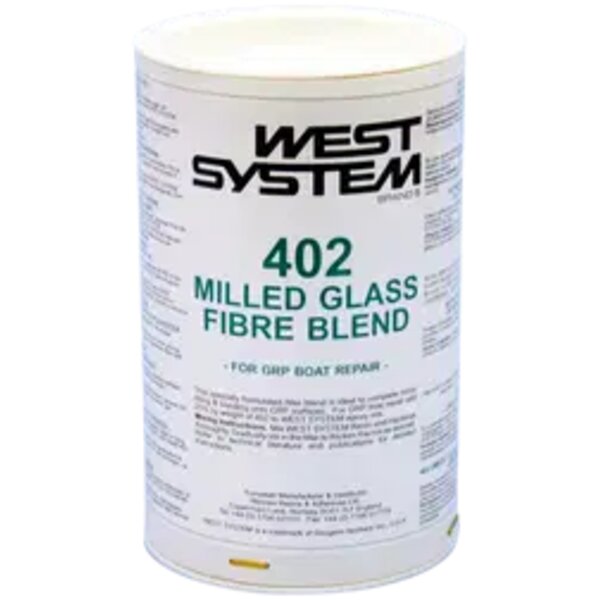
What is WEST SYSTEM 402 Milled Glass Fibre Blend and why choose it
WEST SYSTEM 402 Milled Glass Fibre Blend is a high-density adhesive filler composed of finely milled glass fibres blended with other fillers. Designed to be mixed with WEST SYSTEM epoxy, it creates a very strong, tough and resilient paste for small semi-structural repairs, filling voids and restoring damaged fibreglass laminates. It is especially valued in marine and composite repair where high mechanical strength and good adhesion are required in a compact, easy-to-handle powder.
When combined with epoxy at approximately 25% by weight (unverified typical value based on publicly available information), 402 produces a thick, brushable or trowelable paste that can be held in place with tape or peel ply to obtain a smooth finish after curing. This makes it a versatile choice for boatyards, repair professionals and advanced DIY users who need a reliable structural filler for glass fibre laminates.
Main features
- High-density adhesive filler based on milled glass fibres for semi-structural and structural-type repairs on glass fibre laminates.
- Excellent mechanical strength of the cured epoxy/filler mix, designed to deliver strong, tough and impact-resistant repairs.
- Ideal for void filling in damaged or degraded fibreglass laminates, including deeper cavities and local core losses.
- Good adhesion to fibreglass when used with WEST SYSTEM epoxy, suitable for bonding and reinforcement applications.
- Fine fibre blend that can be stippled or worked into place with a brush or spatula for detailed repairs.
- Off-white colour in powder form and after curing, helping inspection and subsequent overcoating or fairing.
- Multi-purpose thickener to convert liquid epoxy into a gap-filling, thixotropic adhesive paste.
- Compatible with WEST SYSTEM epoxy systems, commonly paired with WEST SYSTEM 105 resin and corresponding hardeners (compatibility with other systems should be verified in each case).
Technical specifications
Data below are indicative summaries from publicly available, non-authoritative sources and may not be exhaustive. For precise and updated information, always check the latest official documentation from the manufacturer.
- Product type: High-density blended adhesive filler based on milled glass fibres.
- Physical form: Fine, loose fibre/powder blend.
- Colour (powder and cured mix): Off-white.
- Primary function: Thickening epoxy resin/hardener mixtures to produce a high-strength, gap-filling adhesive or repair paste.
- Typical mix ratio with epoxy (by weight, not verified): Approx. 25–30% filler relative to mixed epoxy to obtain a thick paste consistency, depending on desired viscosity.
- Intended substrate: Glass fibre-reinforced laminates and other suitably prepared composite or marine substrates, in combination with compatible epoxy.
Applications and use cases
- Small semi-structural repairs on fibreglass laminates
- Local reinforcement and rebuilding of damaged areas in GRP laminates.
- Repairs of hard edges and impact zones on small craft (unverified typical application).
- Void filling and cavity repair
- Filling deeper voids caused by damage, wear or previous poor repairs in glass fibre laminates.
- Restoring material continuity before applying new layers of reinforcement fabric or finishing coats.
- Marine and boat repair
- Repair of local osmotic damage blisters (after appropriate substrate preparation and according to expert instructions).
- Rebuilding profiles and edges on foils, rudders and centerboards (applications cited in non-official sources).
- Gap-filling adhesive
- Conversion of liquid epoxy into a thixotropic adhesive paste for bonding components where small gaps or irregularities must be bridged.
- Composite maintenance
- Local reinforcement or bonding on composite parts where high mechanical performance is a priority and sanding/fairing can be completed afterwards.
The suitability of this product for any specific project must always be evaluated by the user, taking into account design requirements, loads, environmental conditions and compatibility with other materials involved in the system.
FAQ – WEST SYSTEM 402 Milled Glass Fibre Blend
1. What is WEST SYSTEM 402 Milled Glass Fibre Blend used for?
It is used as a high-density filler to thicken WEST SYSTEM epoxy, creating a strong, gap-filling paste for small semi-structural repairs, void filling and reinforcement of glass fibre laminates.
2. Can it be used on materials other than fibreglass?
Its primary design is for glass fibre laminates. In practice, users may apply it on other properly prepared substrates together with compatible epoxy, but each case should be individually evaluated and confirmed with the manufacturer’s guidance.
3. How much 402 filler should I add to the epoxy?
Publicly available guidance suggests around 25–30% by weight relative to the mixed epoxy to obtain a thick paste, but this value is not officially confirmed here and should be checked against the most recent manufacturer instructions. Always mix test batches first.
4. Does the mixture remain sandable after curing?
Yes, once cured, the epoxy/402 filler mix can generally be sanded and shaped. Being a high-density filler with milled glass fibres, it is typically tougher and harder to sand than low-density fairing fillers.
5. Can I use 402 for fairing large areas?
It is optimised for strength and adhesion rather than easy sanding. For extensive fairing, lower-density fairing fillers from the same system are usually preferred, while 402 is kept for high-strength local repairs and voids.
6. What colour is the cured mixture?
The cured epoxy/402 blend is typically off-white, which helps visual inspection and subsequent coating. Exact shade may vary depending on epoxy and pigment systems used.
7. Is 402 compatible with all epoxy brands?
It is designed for use with WEST SYSTEM epoxy. Although it may work with other epoxies, compatibility, performance and warranty aspects are not guaranteed and should be verified with the respective epoxy manufacturer.
8. Can I use it for below-waterline repairs on boats?
When used correctly with appropriate epoxy systems and repair procedures, it is commonly used in marine applications, including below-waterline zones. However, correct surface preparation, encapsulation and coating systems are critical. Refer to up-to-date, official manufacturer instructions for below-waterline repairs.
9. How should the substrate be prepared before application?
In general, the surface must be clean, dry, free from contaminants and mechanically keyed (abraded) to ensure good adhesion. The exact preparation method depends on the substrate and repair type and should follow current technical recommendations.
10. Where can I find exact safety and handling instructions?
Exact and up-to-date safety information, including hazard statements and protective measures, is available in the official Safety Data Sheet (SDS) and other manufacturer documents, which should always be consulted before use.
Section 14 – Transport information
The following is a generic, non-verified summary based on typical information for similar filler products and should not be considered a substitute for the official Safety Data Sheet (SDS):
- UN number: Not classified as hazardous for transport, according to non-official secondary sources for similar products (information not verified for this specific batch).
- Proper shipping name: Generally transported as non-dangerous goods; no specific UN shipping name indicated in non-official summaries.
- Transport hazard class: Commonly stated as "Not regulated" for road, sea and air transport for comparable milled glass fibre fillers, but this must be confirmed in the current SDS for WEST SYSTEM 402.
- Packing group: Not normally assigned where the product is not classified as dangerous for transport.
- Environmental hazards: Not typically classified as dangerous to the environment for transport; avoid uncontrolled release to the environment.
- Special precautions for user: Keep container closed to prevent dust release; handle in a way that avoids damage to packaging and dispersion of the powder during loading and unloading.
These notes are indicative only. For legally valid and up-to-date transport classifications (ADR/RID, IMDG, IATA, etc.), always rely exclusively on the current official SDS and regulatory documentation provided by the manufacturer or distributor.
Section 8 – Exposure controls and personal protection
The information below is a general, non-verified summary based on typical good practice for handling powdered glass fibre fillers and may not reflect the exact, current requirements for WEST SYSTEM 402. Always consult the official SDS for precise and legally binding information.
8.1 Exposure controls
- Technical controls: Work in well-ventilated areas. Where possible, use local exhaust ventilation or dust extraction to keep airborne dust levels as low as reasonably achievable.
- Organisational measures: Minimise dust-generating operations, avoid dry sweeping, and keep containers closed when not in use. Implement good housekeeping practices to prevent accumulation of dust on surfaces.
8.2 Personal protective equipment (PPE)
- Respiratory protection: When dust may be generated (mixing, pouring, sanding cured material), use an appropriate particulate respirator (for example, a mask with P2/P3-type filtering capability or equivalent, selected and fitted according to local regulations and risk assessment).
- Hand protection: Wear suitable protective gloves resistant to mechanical abrasion and compatible with any epoxy systems handled simultaneously. Change gloves regularly and avoid skin contact with both powder and liquid epoxy mixtures.
- Eye and face protection: Use safety glasses with side shields or chemical splash goggles to prevent dust or splashes of mixed epoxy from entering the eyes.
- Skin and body protection: Wear long sleeves, long trousers and, where appropriate, disposable overalls to prevent irritation from glass fibres and contact with epoxy resins. Avoid handling with bare skin.
- Hygiene measures: Wash hands and exposed skin thoroughly after handling and before eating, drinking or smoking. Do not eat, drink or smoke in work areas. Remove contaminated clothing and wash before reuse.
These recommendations are general in nature and must be adapted by the user to local regulations, workplace risk assessments and the latest official SDS and technical guidance for WEST SYSTEM 402.
*Contenido generado por IA