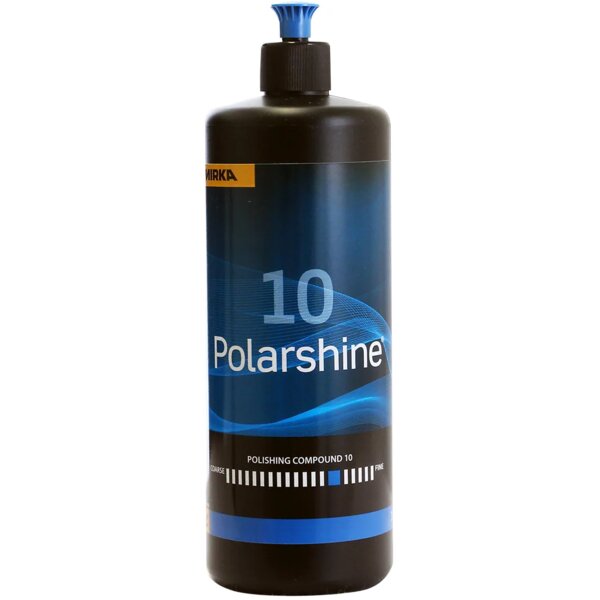
What is Mirka Polarshine 10 Polishing Paste and why choose it
Mirka Polarshine 10 is a medium-coarse, water-based polishing compound designed as an all-round single-step solution for correcting sanding marks and restoring gloss on painted and coated surfaces. Developed to work optimally after sanding with Mirka abrasives, it is suitable for virtually all modern paint systems, including scratch-resistant clear coats. The silicone-free formula makes it compatible with refinishing and repainting processes, while its controlled cut allows you to quickly remove defects and achieve a high gloss finish in one step in many applications. Certain details below are based on publicly available manufacturer information but are not individually verified; always refer to the official technical data sheet for critical decisions.
Main features
- Medium-coarse, all-round polishing compound designed for effective defect removal after sanding, often usable as a single compound system for both cut and gloss.
- Water-based and silicone-free formulation, helping to minimise holograms and residue while remaining compatible with repainting and bodyshop environments.
- For all common paint systems, including clear coats, top coats and many scratch-resistant automotive finishes (information based on manufacturer descriptions, not independently verified).
- Permanent removal of marks rather than temporary filling, when used correctly with appropriate pads and technique.
- Low surface temperature behaviour, formulated to help keep the work surface cooler during polishing, reducing the risk of burning or swelling of sensitive paints.
- Use by machine or by hand, working with rotary or random orbital polishers as well as manual application on small areas.
- Usable after fine sanding steps (for example after P1500–P3000 abrasives, according to manufacturer information) to remove sanding scratches and haze efficiently.
- Suitable for multiple substrates such as clear coats, top coats, polycarbonate, acrylic surfaces, solid surfaces and gelcoats, according to the technical data sheet (not individually verified).
Technical specifications
The following technical characteristics are compiled from publicly accessible technical data sheets and may not be fully up to date. For exact and legally relevant values, consult the current official Mirka documentation.
- Product type: Water-borne polishing compound, medium cut.
- Form: Liquid paste.
- Colour: White (according to technical data sheet, not independently verified).
- Density: Approximately 1.05 kg/l (value based on technical data sheet; treat as indicative only).
- pH: Approx. 7–8 (neutral to slightly alkaline; not independently verified).
- Viscosity: Around 20.5 Pa·s at reference conditions (approximate value, not independently verified).
- Silicone content: Silicone-free according to manufacturer information.
- Storage temperature (recommended): About +5 °C to +35 °C; protect from freezing (indicative information from data sheet).
- Recommended machine speeds (indicative):
- Rotary polisher: approx. 800–2000 rpm.
- Random orbital polisher: approx. 6000–10,000 rpm.
- Typical compatible pads (examples, not exhaustive): Natural lambswool, yellow lambswool, yellow foam, orange foam, depending on the desired level of cut and finish.
Applications and use cases
- Automotive refinishing: Removing P1500–P3000 sanding scratches after paint correction, denibbing or spot repair and restoring gloss on clear coats and top coats.
- Scratch-resistant clear coats: Polishing modern high-solid and scratch-resistant clear coats where controlled cut and low heat generation are important (based on manufacturer information, not independently verified).
- Marine and gelcoat surfaces: Restoring gloss and eliminating sanding marks on gelcoat and other marine finishes, when used with appropriate pads and technique.
- Industrial and OEM coatings: Correcting defects and improving gloss on coated components, panels and furniture where water-based, silicone-free compounds are required.
- Plastics and acrylics: Polishing polycarbonate and acrylic surfaces where compatible, for example display covers, plastic panels or signage (always test on an inconspicuous area first).
- Solid surface materials: Refinishing kitchen and bathroom solid-surface worktops after sanding, blending repairs and restoring a uniform gloss.
- Detailing and reconditioning: One-step or two-step correction on vehicles and coated surfaces where medium defects, wash marring or sanding marks are present.
FAQ
-
What type of polish is Mirka Polarshine 10?
Polarshine 10 is a medium-coarse, water-based polishing compound designed as an all-round solution for defect removal and gloss restoration after sanding. This classification is based on manufacturer descriptions and should be treated as indicative.
-
On which surfaces can I use Polarshine 10?
According to publicly available technical information, it can be used on clear coats, top coats, polycarbonate, acrylic surfaces, solid surfaces and gelcoats, as well as many automotive and industrial paint systems. Always test on a small, inconspicuous area first.
-
Is Polarshine 10 silicone-free?
Yes, manufacturer documentation states that Polarshine 10 is silicone-free, which makes it suitable for use in bodyshops and environments where repainting or coating is required afterwards.
-
Can I use Polarshine 10 by hand, or do I need a machine?
Polarshine 10 can be applied both by machine (rotary or random orbital polisher) and by hand. Machine polishing generally gives faster and more consistent results, especially on larger surfaces, while hand polishing is useful for small or delicate areas.
-
Which pads should I use with this polishing paste?
Typical pad choices, based on technical information, include lambswool pads for stronger cut and foam pads (yellow or orange, depending on the system) for a balance of cut and finish. Choose the pad according to the level of defect removal and final gloss required.
-
From which sanding grits can Polarshine 10 remove scratches?
Manufacturer descriptions indicate it is designed for removing sanding scratches from about P1500 and finer, including typical refinishing steps like P2000–P3000. The exact performance will depend on the substrate, coating and pad used.
-
How should I store Mirka Polarshine 10?
Publicly available technical data indicates a recommended storage temperature of approximately +5 °C to +35 °C and to protect the product from freezing. Store the container tightly closed and avoid extreme heat. For authoritative guidance, always refer to the latest official data sheet.
-
Does Polarshine 10 fill scratches or remove them?
When used correctly, Polarshine 10 is designed to remove sanding marks and defects rather than simply filling them. However, the final result depends on the condition of the surface, the polishing pad and the working technique.
-
Is this product safe for all users?
Safety and handling requirements are described in the official Safety Data Sheet (SDS). While the product is generally used in professional and industrial environments, users should always follow the SDS and local regulations for personal protection and safe use.
-
Where can I find complete and confirmed technical data?
For complete, current and verified information, including detailed technical data, safety instructions and regulatory information, consult the official Mirka technical data sheet and Safety Data Sheet (SDS) for Polarshine 10.
Section 14: Transport information (summary)
The following transport information is a simplified summary derived from publicly available Safety Data Sheet (SDS) content for Mirka Polarshine 10 Polishing Compound and is provided for general orientation only. It is not a substitute for the official SDS, and local regulations may differ. Always rely on the latest official SDS and transport regulations when shipping or handling the product.
- UN number or ID number: Not applicable for ADR/RID, ADN, IMDG or IATA according to available SDS extracts (information not independently verified).
- UN proper shipping name: No dangerous goods / not classified as dangerous goods for transport by road, inland waterways, sea or air according to referenced SDS texts (subject to confirmation in the latest SDS).
- Transport hazard class(es): Not applicable in the cited SDS excerpts, as the product is not classified as dangerous goods for transport.
- Packing group: Not applicable in the SDS excerpts where the product is not classified as dangerous for transport.
- Environmental hazards: According to the SDS excerpts, the product is not classified as environmentally hazardous for transport, but release into the environment should still be avoided. Follow local regulations for spill response and disposal.
- Special precautions for user: Even if not classified as dangerous goods, appropriate general precautions should be followed during transport, such as securing containers, preventing leakage, and avoiding extreme temperatures and freezing. For specific instructions, always consult the current SDS.
Section 8: Individual protection measures (summary)
The following personal protection information is a generalised summary compiled from typical Safety Data Sheet (SDS) content for similar polishing compounds and from publicly available Polarshine 10 documentation where accessible. Exact requirements can vary by country and revision of the SDS. For accurate and legally binding information, always consult the current official Mirka SDS for Polarshine 10.
- General protective and hygiene measures: Avoid contact with eyes and prolonged or repeated contact with skin. Do not ingest. Wash hands thoroughly after handling and before eating, drinking or smoking. Do not eat, drink or smoke while using the product.
- Respiratory protection: Under normal conditions of use with adequate ventilation, special respiratory protection is usually not required. In cases of insufficient ventilation, or if aerosols or mists are generated (for example during intensive machine polishing in confined spaces), use an appropriate, certified respirator as recommended in the SDS and by local regulations. This information is not individually verified and must be confirmed in the official SDS.
- Hand protection: Wear suitable protective gloves resistant to chemicals and oils (for example disposable nitrile gloves or similar, depending on local SDS recommendations). Change gloves regularly and immediately if damaged or contaminated on the inside.
- Eye and face protection: Wear safety glasses with side shields or a face shield when there is a risk of splashes, especially during machine polishing or when working above head height.
- Skin and body protection: Wear suitable work clothing with long sleeves to minimise skin contact. In professional environments, chemical-resistant aprons or overalls may be advisable according to workplace risk assessment.
- Additional protective measures: Ensure adequate general or local exhaust ventilation in enclosed areas. Remove contaminated clothing immediately and wash before reuse. If the product is used in spray form or generates significant mist, additional protective measures may be required according to the SDS and local legislation.
All protective and safety indications above are indicative and may not reflect the latest official SDS version. For workplace safety and regulatory compliance, always consult and follow the current Mirka Polarshine 10 Safety Data Sheet and local occupational safety regulations.
*Contenido generado por IA