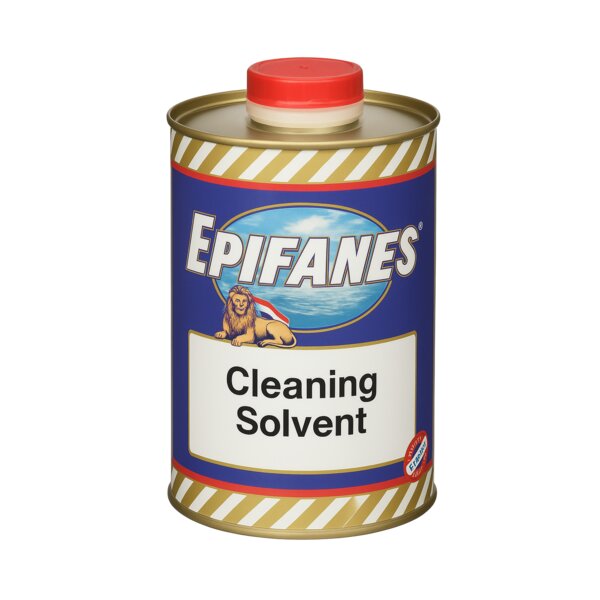
What is Epifanes Cleaning Solvent and why choose it?
Epifanes Cleaning Solvent (Epifanes Reinigingsthinner) is a professional-grade cleaning thinner based on organic solvents. Classified as a washing and cleaning product (including solvent-based) and paint thinner, it is designed for use in industrial and professional environments on wood, metal and plastic products. With a low flash point and a high VOC content, it offers strong dissolving and cleaning power wherever solvent-based surface preparation and maintenance are required.
This product is formulated as a mixture of xylene, acetone, butan-1-ol, ethylbenzene and trace levels of toluene, providing effective action for demanding cleaning and thinning tasks in workshops, construction, maintenance and crafts.
Main features
- Professional-use cleaning thinner: Classified in sector SU22 for professional use in public domains such as administration, education, entertainment, services and craftsmanship.
- Powerful solvent blend: Contains xylene (50–100%), acetone (25–50%), butan-1-ol (2.5–10%), ethylbenzene (2.5–10%) and <0.3% toluene.
- High volatility and strong cleaning action: 100% organic solvent content with a VOC content of 590.1 g/l (4.92 lb/gal).
- Low flash point: Flash point of 2 °C and boiling range starting at 80 °C, classified as a highly flammable liquid (Flam. Liq. 2, H225).
- Optimised for surface-related use: Suitable for use leading to incorporation in or on objects both indoors and outdoors (ERC5, ERC8c, ERC8f) and for wood, metal and plastic products (AC11, AC7, AC13).
- Manual application compatibility: Designed for manual mixing (PROC19) and application with cotton cloth and/or sponge (PROC0).
- Clear hazard and safety guidance: Fully classified and labelled under Regulation (EC) No. 1272/2008 (CLP) with detailed risk and precautionary statements.
Technical specifications
- Product name: Epifanes Cleaning Solvent (Epifanes Reinigingsthinner)
- Product type: Cleaning thinner; washing and cleaning product (including solvent-based); paint thinner
- Physical state: Liquid
- Colour: According to product description
- Odour: Characteristic
- Boiling point (initial): 80 °C
- Flash point: 2 °C
- Auto-ignition temperature: 340 °C
- Explosion limits in air: 2.6–13 Vol %
- Vapour pressure at 20 °C: 233 hPa
- Density at 20 °C: 0.84295 g/cm³
- Solubility in water: Not or only slightly miscible
- Organic solvent content: 100%
- VOC content: 590.1 g/l (4.92 lb/gal)
- Chemical characterisation: Mixture of consecutively supplied substances with non-hazardous impurities
Composition (hazardous components)
- Xylene (CAS 1330-20-7, EINECS 215-535-7) – 50–100%
- Acetone; propanone (CAS 67-64-1, EINECS 200-662-2) – 25–50%
- Butan-1-ol (CAS 71-36-3, EINECS 200-751-6) – 2.5–10%
- Ethylbenzene (CAS 100-41-4, EINECS 202-849-4) – 2.5–10%
- Toluene (CAS 108-88-3, EINECS 203-625-9) – <0.3%
Applications and use cases
- Cleaning thinner: Described as a cleaning thinner (reinigings thinner) for professional use.
- Paint thinner: Categorised as paint thinner for coatings and related applications.
- Washing and cleaning agent: Listed under PC35 for washing and cleaning products (including solvent-based).
- Surface preparation on different substrates: Associated with use on wood products (AC11), metal products (AC7) and plastic products (AC13).
- Manual application methods: Intended for manual mixing (PROC19) and application using a cotton cloth and/or sponge (PROC0).
- Indoor and outdoor professional environments: Identified environmental release categories include ERC5, ERC8c (widespread indoor use leading to incorporation in or on an article) and ERC8f (widespread outdoor use leading to incorporation in or on an article).
FAQ
1. What type of product is Epifanes Cleaning Solvent?
It is a solvent-based cleaning thinner classified as a washing and cleaning product (PC35) and paint thinner, designed for professional use.
2. On which materials can it be used?
The product is associated with wood products (AC11), metal products (AC7) and plastic products (AC13).
3. How is it typically applied?
It is intended for manual mixing (PROC19) and application using a cotton cloth and/or sponge (PROC0) in well-ventilated areas.
4. Is Epifanes Cleaning Solvent flammable?
Yes. It is classified as a highly flammable liquid and vapour (Flam. Liq. 2, H225) with a flash point of 2 °C.
5. Does it contain VOCs?
Yes. The product consists of 100% organic solvents with a VOC content of 590.1 g/l (4.92 lb/gal).
6. Is it suitable for consumer use?
The identified sector of use is SU22, which covers professional use in public domains; it is not described as a consumer product.
7. How should spills be handled?
Spills should be absorbed with liquid-binding material such as sand, diatomaceous earth, acid binders, universal binders or sawdust, with adequate ventilation and disposal according to local regulations.
8. How should the product be stored?
Store in tightly closed, impermeable containers in a cool, dry place, away from ignition sources and in accordance with applicable regulations (e.g. PGS 15).
9. Can it be released into the environment?
No. It should not be released into sewage systems, surface water, groundwater or soil and is classified as hazardous for water (WGK 2, NL).
10. What should be done in case of ingestion?
In case of ingestion, an antidote centre or doctor should be contacted immediately (P301+P310). The product may be fatal if swallowed and enters airways (Asp. Tox. 1, H304).
Section 14 – Transport information
- UN number: UN1993
- UN proper shipping name (ADR): 1993 FLAMMABLE LIQUID, N.O.S. (vapour pressure at 50 °C not more than 110 kPa) (ACETONE, Xylene)
- UN proper shipping name (IMDG, IATA): FLAMMABLE LIQUID, N.O.S. (ACETONE, Xylene)
- Transport hazard class: Class 3 – Flammable liquids
- Label: 3
- Packing group: II
- Environmental hazards: Not classified as a marine pollutant
- Hazard identification number (Kemler): 33
- EMS code: F-E, S-E
- Stowage category (IMDG): B
- ADR limited quantities (LQ): 1 L
- ADR excepted quantities (EQ): Code E2 – 30 ml maximum per inner packaging, 500 ml maximum per outer packaging
- IMDG limited quantities (LQ): 1 L
- IMDG excepted quantities (EQ): Code E2 – 30 ml maximum per inner packaging, 500 ml maximum per outer packaging
- Tunnel restriction code: D/E
- Bulk transport under MARPOL Annex II / IBC Code: Not applicable
Section 8 – Personal protective measures
Exposure control
- Ensure good ventilation or local exhaust at workplaces.
- Avoid aerosol formation and keep away from food and drink.
- Contaminated clothing must be removed immediately and stored separately.
- Wash hands before breaks and at the end of work; avoid contact with skin and eyes.
Respiratory protection
- Use filter A/P2 for organic vapours and particulates when short-term or low-level exposure occurs.
- For intensive or long-term exposure, use independent breathing apparatus.
- Filter AX may also be used as specified in the safety data.
Hand protection
- Wear protective safety gloves that are impermeable and resistant to the product.
- Suitable materials for prolonged contact: nitrile rubber, PVC or Viton, glove thickness >0.35 mm, breakthrough time >480 min (EN374); butyl rubber with 0.7 mm thickness and >480 min breakthrough time (EN374).
- For splash protection, nitrile rubber, PVC or Viton gloves with thickness >0.35 mm and breakthrough time >480 min (EN374) are recommended.
- The exact penetration time must be obtained from the glove manufacturer; durability depends on the specific glove type and manufacturer.
Eye protection
- Wear tightly fitting safety goggles.
Additional personal protection
- Wear suitable protective clothing.
- Use eye, face and hearing protection as indicated in the precautionary statements (P280).
*Contenido generado por IA