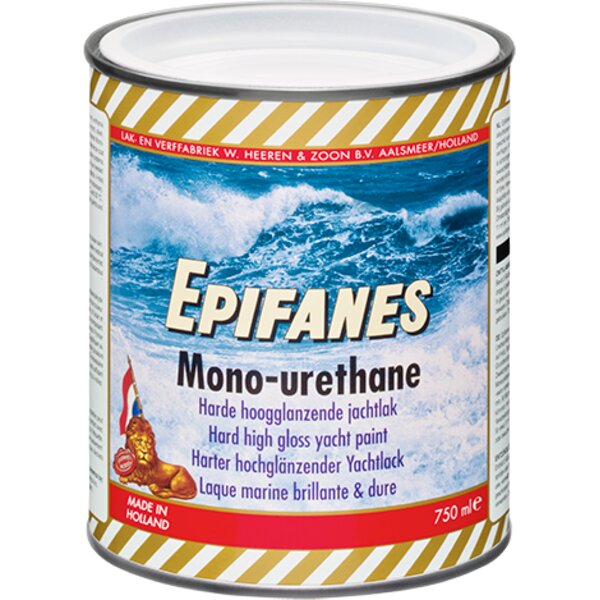
MONO-URETHANE

FROM:

Regular price 36,40€

*VAT not included

Epifanes MONO-URETHANE is a hard, one-component high gloss yacht paint for finishing GRP, steel, wood and aluminium surfaces above the waterline, both inside and outside. It provides superior covering and filling with long-lasting weather durability and gloss, combining the easy application of traditional enamel with the tough durability of a urethane resin-based paint.

*Contenido generado por IA

    Presentation: Container
    Capacity: 750 ml
    Colours:

Features

    Presentation: Container
    Capacity: 750 ml
    Colours:

description

What it is and why choose it

Epifanes Mono-urethane is a hard, one-component, high gloss yacht paint designed as a pigmented finishing coat for professional and consumer use. Based on urethane and alkyd resins, it combines the easy application of traditional enamel with the durability and gloss retention of urethane technology. The coating delivers superior covering and filling power, long-term weather resistance and rapid initial curing, making it suitable for new builds and maintenance on a wide range of yacht substrates above the waterline.

Main features

  • Hard one-component system: oxidative drying finish that achieves a tough, durable film without the need for a separate hardener.
  • High gloss finish: long-lasting gloss retention and weather durability for interior and exterior areas above the waterline.
  • Versatile substrate compatibility: suitable for GRP, steel, wood and aluminium when used with the appropriate Epifanes primers; on intact, well-degreased and sanded GRP, it may be applied without primer.
  • Maintenance-friendly: can be used for overcoating existing one- and two-component paint systems, regardless of brand, provided the surface is well prepared.
  • Efficient coverage: theoretical coverage of about 11 m² per 750 ml at 40 µm dry film thickness (practical coverage depends on substrate and application conditions).
  • Wide colour range: available in 24 standard colours; custom RAL K7 colours can be supplied on request.
  • Application flexibility: designed for brushing, rolling and spraying, with dedicated Epifanes thinners for each method.
  • Professional and consumer use: suitable for both professional applicators (SU22) and private users (SU21).

Technical specifications

  • Product type: one-component, oxidative drying mono-urethane yacht paint
  • Binder base: urethane resin / alkyd resin
  • Gloss level: high gloss
  • Colours: 24 standard colours; custom RAL K7 colours on request
  • Density at 20 °C: approx. 0.95–1.30 g/cm³ depending on colour (typical value from SDS: about 1.1 g/cm³)
  • Viscosity: approx. 40 s (ISO-cup 6 mm / ISO 6 mm)
  • Solids content: approx. 55–60 ± 2 vol.% (about 73.2 % by weight)
  • VOC content: approx. 284 g/l (about 26.8–25.8 % organic solvent content)
  • Recommended film thickness per coat: 70–80 µm wet, corresponding to 40–45 µm dry
  • Theoretical coverage: approx. 11 m² / 120 ft² per 750 ml at 40 µm (1.5 mil) dry film thickness
  • Recommended number of finish coats: 3 full-bodied coats over appropriate primer system
  • Drying times at 35 µm dry film / 65% RH:
    • 10 °C / 50 °F: dust dry ~6 h; sandable/recoatable ~48 h
    • 15 °C / 59 °F: dust dry ~4 h; sandable/recoatable ~36 h
    • 20 °C / 68 °F: dust dry ~3 h; sandable/recoatable ~24 h
    • 25 °C / 77 °F: dust dry ~2 h; sandable/recoatable ~18 h
  • Recommended application temperature (substrate/air): minimum 8 °C / 47 °F, maximum 30 °C / 86 °F
  • Recommended relative humidity during application: 50–85 %
  • Maximum temperature difference between paint and surface: 3 °C / 37 °F
  • Thinner for brush/roller: Epifanes Brushthinner for Paint & Varnish or good quality white spirit
  • Thinner for spray: Epifanes Spraythinner for Paint & Varnish or denatured alcohol
  • Typical spray parameters: 5–15 % thinning; nozzle 1.2–1.5 mm; pressure 2–3 bar; 20–22 s DIN cup 4 mm
  • Packaging: 750 ml; white is also available in 2000 ml
  • Shelf life: approx. 3 years in unopened cans stored dry at 5–30 °C / 41–86 °F
  • Physical state: fluid liquid
  • Flash point: approx. 40 °C
  • Auto-ignition temperature: approx. 210 °C
  • Explosion limits (solvent phase): approx. 0.6–7 vol.%
  • Water miscibility: fully miscible as a mixture; pH not applicable (non-aqueous coating)
  • Hazard classification (CLP): Flam. Liq. 3 H226 (flammable liquid and vapour); STOT SE 3 H336 (may cause drowsiness or dizziness); EUH066 (repeated exposure may cause skin dryness or cracking)

Applications and use cases

Fields of use

  • GRP (fibreglass): interior and exterior above the waterline. On intact, well-degreased and sanded GRP, Epifanes Mono-urethane may be applied without a primer. For bare GRP, cleaning with Epifanes Fibreglass Prep Cleaner and sanding with P220–240 is specified; primer use is optional where the existing laminate is sound.
  • Wood: interior and exterior above the waterline in combination with Epifanes Woodprimer and/or Epifanes Multi Marine Primer or Epifanes Undercoat.
  • Steel: above-water areas over an anti-corrosion primer system. Bare steel should be clean, dry, corrosion free and sanded (P60), then primed with three coats of Epifanes Multi Marine Primer and/or Epifanes Undercoat before finishing.
  • Aluminium: above-water areas on new aluminium prepared with Epifanes Washprimer AQ (not sanded) and followed by Multi Marine Primer/Undercoat as required.
  • Existing paint systems: maintenance of intact one- and two-component coatings (any brand), provided they are well bonded, dry, degreased and sanded (typically P220–240). No primer is required on sound existing paint.

Recommended system build-up

  • Primers:
    • All substrates: Epifanes Multi Marine Primer or Epifanes Undercoat
    • Wood: Epifanes Woodprimer (may be followed by Multi Marine Primer or Undercoat)
    • New aluminium: Epifanes Washprimer AQ (do not sand), followed by appropriate primers
  • Finish: after full curing and sanding of primers with P180–220, apply 3 full coats of Epifanes Mono-urethane Yacht Paint, sanding lightly between coats with P400 or Scotch-Brite by hand.

Application guidance

  • Apply by roller, soft long-haired brush or spray.
  • Distribute the paint evenly and avoid retipping once laid off.
  • Do not apply wet-on-wet and avoid excessively thick wet films to prevent curtains and drying problems, especially on horizontal surfaces.
  • Avoid painting in direct sunlight or strong wind, as rapid solvent loss reduces flow and levelling.
  • If the paint “pulls” or is difficult to apply, up to 10 % Epifanes Brushthinner may be added.
  • Allow each coat to dry thoroughly according to temperature before sanding or recoating.

Compatibility with other Epifanes products

  • Can be recoated with:
    • Epifanes Yacht Enamel
    • Epifanes Nautiforte Yacht Paint
    • Epifanes Satin Finish
    • Epifanes Non-skid Deck Coating
    • Epifanes Flat Black
    • Epifanes Waterline Paint

FAQ

  1. On which substrates can I use Epifanes Mono-urethane?

    According to the technical datasheet, it is suitable for GRP, steel, wood and aluminium above the waterline, as well as for maintenance of existing one- and two-component paint systems, provided the correct primers and surface preparation are used.

  2. Is a primer always required before applying this paint?

    On intact, well-degreased and sanded GRP, a primer is not necessary. On bare GRP, wood, steel and aluminium, Epifanes specifies appropriate primers such as Multi Marine Primer, Undercoat, Woodprimer or Washprimer AQ. Existing, well-bonding paint systems generally do not require a primer.

  3. How many coats should I apply for a durable finish?

    The recommended system is three full-bodied finish coats of Epifanes Mono-urethane Yacht Paint over the appropriate primed surface, with light hand sanding (P400 or Scotch-Brite) between coats.

  4. What coverage can I expect per can?

    The theoretical coverage is about 11 m² (120 ft²) per 750 ml at 40 µm (1.5 mil) dry film thickness. Practical coverage will be lower and depends on surface condition, application method, shape of the object and working conditions.

  5. What are the ideal application conditions?

    Apply between 8–30 °C (47–86 °F) with relative humidity between 50–85 %. Avoid direct sunlight, strong wind and large temperature differences between paint and substrate (maximum 3 °C). Ensure good ventilation and do not apply wet-on-wet.

  6. How long should I wait before sanding or recoating?

    At 20 °C / 68 °F and 35 µm dry film thickness, the coating is typically sandable and recoatable after about 24 hours. At lower temperatures, drying times increase (up to approximately 48 hours at 10 °C), and at higher temperatures they decrease.

  7. Is Epifanes Mono-urethane suitable for spray application?

    Yes. The datasheet provides spray guidelines: 5–15 % thinning, nozzle size 1.2–1.5 mm, pressure 2–3 bar and viscosity of 20–22 seconds in a DIN 4 mm cup. When spraying, hazardous respirable droplets may form; spray mist must not be inhaled.

  8. How should I store this product and how long does it keep?

    Store only in tightly closed original containers in a dry place at 5–30 °C / 41–86 °F. Under these conditions, the shelf life is approximately 3 years for unopened cans.

  9. What hazards are associated with this paint?

    The product is classified as a flammable liquid (Flam. Liq. 3, H226) and may cause drowsiness or dizziness (STOT SE 3, H336). Repeated exposure may cause skin dryness or cracking (EUH066). It must be kept away from heat, sparks, open flames and other ignition sources, and used only with adequate ventilation.

  10. Can I dispose of leftover paint down the drain?

    No. The safety data sheet specifies that the product must not be disposed of with household waste or allowed to reach the sewage system. Disposal of paint and empty packaging has to follow local and national regulations.

Section 14 – Transport information

  • UN number / ID number: UN1263
  • UN proper shipping name: PAINT
  • Transport class: Class 3 (F1) flammable liquids
  • Labels: hazard label 3 (flammable liquid)
  • Packing group: III
  • Marine pollutant: No
  • ADR tunnel restriction code: D/E
  • Hazard identification number (Kemler code): 30
  • EMS code (IMDG): F-E, S-E
  • Stowage category (IMDG): A
  • Limited quantities (ADR/IMDG): 5 L
  • Excepted quantities (ADR/IMDG/IATA): Code E1 (max. 30 ml per inner packaging, 1000 ml per outer packaging)
  • Viscous substance exemption (ADR): Packagings under 450 L may be exempt according to 2.2.3.1.5; above 450 L the product remains classified as 3 F1, packing group III.
  • Bulk transport: not applicable for maritime transport in bulk according to IMO instruments.

Section 8 – Personal protective measures

Exposure control and general safety

  • Ensure sufficient ventilation or local exhaust at the workplace; use only outdoors or in well-ventilated areas.
  • Keep away from heat, hot surfaces, sparks, open flames and all ignition sources. No smoking.
  • Take measures against electrostatic charges.
  • Immediately remove contaminated clothing and wash hands before breaks and after work.

Recommended personal protective equipment (PPE)

  • Respiratory protection: for short or low exposure, use an appropriate breathing filter device. For intensive or prolonged exposure, use breathing apparatus independent of ambient air. A half-face mask for organic vapours and solvents according to EN140 type A1 or A2 is recommended.
  • Hand protection: wear impermeable, chemical-resistant protective gloves. The exact breakthrough time must be obtained from the glove manufacturer.
    • For up to 15 minutes of permanent contact: butyl rubber (BR) gloves are suitable.
    • For splash protection: chloroprene gloves with thickness >0.7 mm and nitrile rubber gloves with thickness >0.3 mm, both with penetration time >60 minutes according to EN 374.
    • Not suitable: strong fabric gloves and leather gloves.
  • Eye/face protection: tightly sealed safety goggles.
  • Body protection: use protective suit or suitable protective clothing resistant to solvents and liquid paint.

Additional health and safety information

  • Do not breathe dust, fumes, gas, mist, vapours or spray.
  • Warning: hazardous respirable droplets may be formed during spraying. Do not inhale spray or mist.
  • In case of ingestion, immediate medical attention is required; gastric irrigation with activated carbon is indicated in the safety data sheet.
  • The product is classified as hazardous for water (water hazard class 2); prevent release into surface water, groundwater and sewage systems.

*Contenido generado por IA

TECHNICAL SHEET

TECHNICAL SHEET

link

SAFETY DATA SHEETS

SAFETY DATA SHEETS

link

Color card

Color card

link

Recently Viewed

37.84€
Ref. Colour Amount*
MU3101.750 Cream 37,60 €
MU3107.750 Deep Green 37,60 €
MU3108.750 Dark Blue 37,60 €
MU3116.750 Bright red 37,60 €
MU3119.750 Black 37,60 €
MU3123.750 Deep Red 37,60 €
MU3124.750 Light Oyster 37,60 €
MU3125.750 Alpine White 37,60 €
MU3126.750 Buff 37,60 €
MU3129.750 37,60 €
MU3137.750 Yellow 37,60 €
MU3140.750 Matterhorn White 37,60 €
MU3165.750 Deep Green 37,60 €
MU3168.750 Green 37,60 €
MU3172.750 Dark Green 37,60 €
MU3201.750 Fleet White 37,60 €
MU3210.750 Flag Blue 37,60 €
MU3212.750 37,60 €
MU3221.750 Stone Gray 37,60 €
MU3233.750 Red Mahogany 37,60 €
MU3242.750 Moon Dust 37,60 €
MU3243.750 Buff 2 37,60 €
MU3248.750 Stark White 37,60 €
MU3253.750 Linen 37,60 €
MUW.750 37,60 €
Page up

Product Quick View Popup

Vendor: Optimal

Product Type: Tops

SKU: 50-ABC

In stock Pre-order Now Sold out Order now, Only 10 left!
$400.00$300.00
Optimal Multipurpose Bootstrap 5 Html Template that will give you and your customers a smooth shopping experience which can be used for various kinds of stores such as fashion..
  • Black
  • Green
  • Orange
  • Blue
  • Red
  • XS
  • S
  • M
  • L
  • XL

Added to your shopping cart successfully.

Added to your shopping cart successfully.
Ditsy Floral Dress

Color: Gray

1 X $113.88

Total: $113.88