What is TRILUX 33 SPRAY and why choose it?
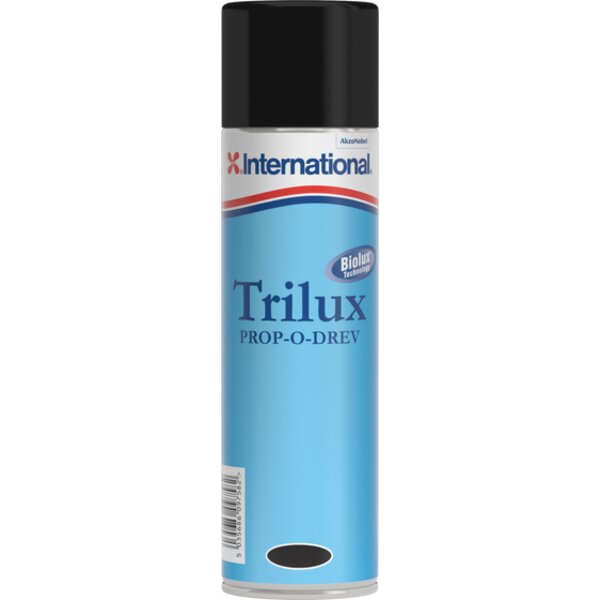
TRILUX 33 SPRAY (Trilux Prop-O-Drev) from International Náutica is a hard antifouling aerosol specially formulated for propellers, outdrives, outboard legs and sterngear. Its aerosol format makes it ideal for awkward shapes and hard-to-reach areas, while providing a durable antifouling film suitable for aluminium, stainless steel, bronze and other suitably primed metals.
Thanks to quick and easy spray application, fast overcoating times and reliable performance when applied at the correct film thickness, TRILUX 33 SPRAY is a practical solution for protecting underwater running gear from fouling in both professional and amateur maintenance.
Main features
- Hard antifouling aerosol specifically developed for propellers, outdrives, outboard legs and sterngear.
- Aerosol spray format that simplifies coating of complex geometries and difficult access areas.
- Quick and easy application: minimum 3 coats with only 30 minutes between coats at 0–35°C.
- Compatible with multiple substrates: suitable for all substrates including bronze, factory enamel finishes and suitably primed aluminium/alloy and zinc-sprayed metals.
- Use over dedicated primer: bare metal and factory enamelled surfaces must be primed with 1–2 coats of Propeller Primer.
- Controlled film build: low volume solids (9% average) and clear coverage guidance help achieve the correct dry film thickness.
- Fast immersion readiness: recommended minimum immersion time of 3 hours across 0–35°C substrate temperatures.
- Biocidal antifouling: contains biocides for antifouling action and is classified as PT21 Antifouling Product (liquid paint).
- Organotin-free technology and compliant with the International Convention on the Control of Harmful Antifouling Systems on Ships, 2001.
- Professional-grade product intended for professional use; in some documentation also suitable for amateur use when following all safety instructions.
Technical specifications
- Product type: Hard antifouling aerosol (PT21 Antifouling Product, liquid paint).
- Recommended use: For propellers, outdrives, outboard legs and sterngear.
- Colours: YBA768 Grey, YBA798 Black.
- Finish: Matt.
- Specific gravity: 0.8.
- Volume solids: 9% (average).
- Typical shelf life: 2 years.
- VOC (as supplied): 691 g/L (subject to Directive 2004/42/EC on VOC).
- Unit size: 500 ml aerosol can.
- Drying – immersion time: minimum 3 hours at 0°C, 15°C, 23°C and 35°C.
- Overcoating interval with TRILUX 33 SPRAY: minimum 30 minutes, no stated maximum (ext), at 0–35°C substrate temperature.
- Number of coats: minimum 3 coats.
- Theoretical coverage: approximately 1 can per medium-sized outdrive.
- Recommended application distance: 10–15 cm (4–10") from surface.
- Viscosity (liquid content): kinematic approx. 1003 mm²/s at room temperature; 800 mm²/s at 40°C (DIN EN ISO 3219).
- Density (liquid content): 0.798 g/cm³ (DIN EN ISO 2811-1).
- Boiling point (initial): 10.1°C.
- Flash point: -33°C (closed cup, Pensky-Martens).
- Heat of combustion: 29.61 kJ/g.
Applications and use cases
Recommended substrates
- Bronze propellers and sterngear.
- Suitably primed aluminium and aluminium alloys (TRILUX 33 SPRAY is not suitable for direct application to bare aluminium).
- Suitably primed zinc-sprayed metals.
- Factory enamelled finishes after appropriate preparation.
Surface preparation
- Bare metal and factory enamel: prime with 1–2 coats of Propeller Primer. This is essential on aluminium and alloy, as TRILUX 33 SPRAY is not suitable for direct application.
- Previously antifouled surfaces: for best results remove existing paintwork. As an alternative, abrade with wet 240 grade paper.
Application method
- Shake the can vigorously. Once the mixing ball is heard, continue shaking for at least 2 minutes before use.
- Spray sparingly at 10–15 cm from the surface.
- Apply a minimum of 3 coats, allowing 30 minutes between coats across the whole recommended temperature range (0–35°C).
- After spraying, invert the can and spray for 2 seconds to clean the nozzle.
- Use VC General Thinner as both thinner and cleaner where required.
- Ensure the full calculated paint quantity is applied, even if this means adding an extra coat, to reach the correct film thickness.
Environmental and application conditions
- Product temperature during application: 0–35°C.
- Ambient temperature: 0–35°C (32–95°F).
- Substrate temperature: minimum 1°C above dew point and maximum 35°C.
Storage and disposal
- Avoid exposure of cans to air and extremes of temperature.
- For the full shelf life to be realised, ensure the container is firmly closed between uses and stored between 5°C/41°F and 35°C/95°F.
- Keep out of direct sunlight.
- Remainders must not be disposed of via normal municipal waste or watercourses; disposal must be arranged in consultation with the relevant authorities.
- Allow paints to harden before disposal whenever possible.
FAQ
-
What is TRILUX 33 SPRAY designed for?
It is a hard antifouling aerosol formulated specifically for outdrives, outboard legs, propellers and sterngear.
-
Can I apply it directly to aluminium?
No. Aluminium and alloy surfaces must first be primed with 1–2 coats of Propeller Primer. TRILUX 33 SPRAY is not suitable for direct application to bare aluminium.
-
How many coats do I need?
The technical documentation specifies a minimum of 3 coats, ensuring the full calculated paint quantity is applied.
-
How long must I wait between coats and before immersion?
Allow at least 30 minutes between coats at 0–35°C. Minimum immersion time is 3 hours at 0°C, 15°C, 23°C and 35°C.
-
What coverage can I expect from one can?
Coverage is approximately one can per medium-sized outdrive.
-
Which colours are available?
The product is available in Grey (YBA768) and Black (YBA798) with a matt finish.
-
How should I store TRILUX 33 SPRAY?
Store in securely closed containers, out of direct sunlight, between 5°C/41°F and 35°C/95°F. Do not expose cans to temperatures above 50°C.
-
Is dry sanding of this antifouling allowed?
No. Antifoulings should only be wet sanded. Never dry sand or burn off old antifouling.
-
Is the product compliant with current antifouling regulations?
Yes. It is an organotin-free conventional antifouling and is stated to be compliant with the International Convention on the Control of Harmful Antifouling Systems on Ships, 2001.
-
Who is allowed to use this product?
The safety documentation classifies it as a professional-use antifouling product. Consultar ficha técnica del fabricante.
Section 14 – Transport information
- UN number / ID number: UN1950.
- UN proper shipping name: AEROSOLS / Aerosols, flammable.
- Transport hazard class: 2 (ADR/RID); 2.1 (IMDG, IATA).
- Packing group: Not applicable for class 2 aerosols.
- Environmental hazards: Classified as environmentally hazardous; marine pollutant substances include copper thiocyanate and zinc oxide.
- Additional ADR/RID information: The environmentally hazardous substance mark is not required when transported in sizes of ≤5 L or ≤5 kg. Tunnel code (D).
- Additional IMDG information: Marine pollutant mark is not required when transported in sizes of ≤5 L or ≤5 kg.
- IATA: The environmentally hazardous substance mark may appear if required by other transport regulations.
- Special precautions for users: Within user premises, always transport in closed, upright and secure containers. Ensure personnel know the procedures in the event of an accident or spillage.
Section 8 – Individual protection measures
- General hygiene measures: Wash hands, forearms and face thoroughly after handling and before eating, drinking or smoking. Contaminated work clothing should not leave the workplace and must be washed before reuse. Ensure eyewash stations and safety showers are close to the work area.
- Eye and face protection: Use chemical splash goggles or equivalent safety eyewear when there is a risk of liquid splashes, mists, gases or dusts.
- Hand protection:
- Wear chemical-resistant, impervious gloves that comply with an approved standard whenever handling the product.
- For prolonged or frequently repeated contact, use gloves with protection class 6 (breakthrough time > 480 minutes, EN374); recommended materials: Viton or Nitrile, thickness ≥ 0.38 mm.
- For brief contact, use gloves with protection class 2 or higher (breakthrough time > 30 minutes, EN374); recommended material: Nitrile, thickness ≥ 0.12 mm.
- Replace gloves regularly and at any sign of damage; effectiveness may be reduced by physical or chemical damage and poor maintenance.
- Body protection: Select protective clothing based on the specific task and risks. Where ignition from static electricity is possible, wear antistatic protective clothing (overalls, boots and gloves) in accordance with EN 1149.
- Other skin protection: Wear appropriate footwear and additional protective garments as required by the risk assessment, approved by a specialist before handling the product.
- Respiratory protection:
- When ventilation is insufficient or exposure limits may be exceeded, wear a respirator conforming to EN140 with type A/P2 filter or better.
- Dry sanding, flame cutting and/or welding of the dry paint film will generate dust and/or hazardous fumes; wet sanding or flatting is preferred. If exposure cannot be avoided by local exhaust ventilation, use suitable respiratory protective equipment.
- Engineering controls: Use only with adequate ventilation. Apply local exhaust ventilation, process enclosures or other engineering controls to keep airborne contaminants below recommended or statutory limits and below the lower explosive limit. Use explosion-proof ventilation equipment.
- Environmental exposure controls: Emissions from ventilation or process equipment must comply with environmental protection legislation. Fume scrubbers, filters or engineering modifications may be required to reduce emissions to acceptable levels.
*Contenido generado por IA