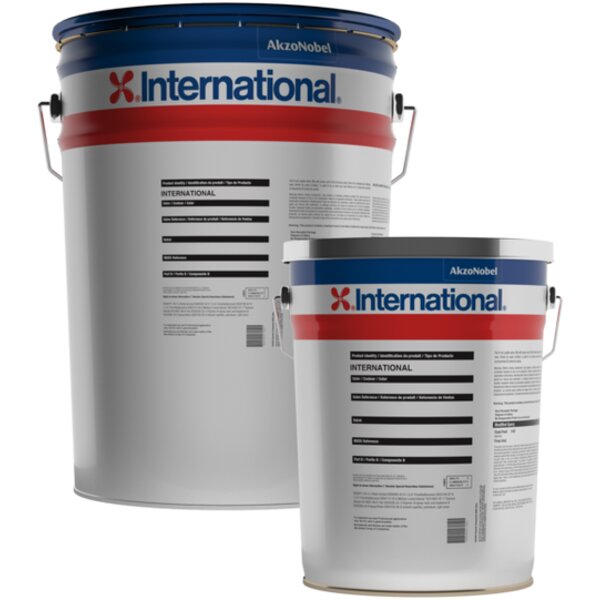
What is ENVIROLINE 2405 PART A INDIVISIBLE KIT and why choose it?
ENVIROLINE 2405 PART A INDIVISIBLE KIT is the base component of Enviroline 2405, an ultra high solids, two-component hybrid epoxy lining system cured with polycyclamine technology. Designed for single-leg (single pump) application, it delivers high corrosion protection with rapid cure in a single-coat scheme. Enviroline 2405 is engineered for the internals of steel storage tanks, pipes and pressure vessels handling crude oil up to 150°C (302°F), and is also suitable for rail cars used to store and transport liquid and dry foodstuffs in compliance with United States FDA regulations.
With 96% volume solids and very low VOC, the system combines high build, excellent chemical resistance and fast return to service, reducing downtime and application costs in demanding industrial environments.
Main features
- Ultra high solids hybrid epoxy – 96% volume solids for high film build with minimal solvent emissions.
- Two-component, polycyclamine cured – advanced epoxy technology for rapid cure and high film strength.
- Single-coat lining system – designed to be applied as a single coat, simplifying application and reducing time on site.
- High corrosion protection – formulated to protect internal steel surfaces in storage tanks, pipes and vessels.
- High-temperature crude oil service – suitable for crude oil up to 150°C (302°F); continuous dry temperature resistance up to 200°C (392°F).
- Low surface energy (36 dynes/cm) – enhances cargo release and cleanability inside tanks and vessels.
- Fast return to service – minimum cure times from 1 day at 40°C to 8 days at 5°C before return to service.
- Application versatility – optimised for airless spray and plural component airless spray; brush and roller suitable for small areas and touch-up.
- Food-contact suitability – Enviroline 2405 meets US FDA regulations for linings in rail cars used to store and transport liquid and dry foodstuffs.
- Very low VOC – approximately 0.37 lb/gal (45 g/L) VOC by EPA Method 24.
Technical specifications
General product data (Enviroline 2405 system)
- Chemistry: Hybrid epoxy lining system, polycyclamine cured (two-component).
- Colour range: Green, Light Grey (this kit is Light Grey Part A).
- Gloss level: Not applicable.
- Volume solids: 96% (ISO 3233, ICF Method).
- Typical dry film thickness (single coat): 400–750 microns (16–30 mils).
- Typical wet film thickness: 417–781 microns (16.7–31.2 mils).
- Theoretical coverage: 1.92 m²/litre at 500 microns DFT; 77 sq.ft/US gallon at 20 mils DFT (based on stated volume solids).
- Practical coverage: Dependent on factors such as surface profile, application method and losses.
Drying and cure times (Enviroline 2405)
Drying time (single coat, overcoating with self)
- At 5°C (41°F): Touch dry 30 h; hard dry 40 h.
- At 10°C (50°F): Touch dry 7 h; hard dry 17 h.
- At 25°C (77°F): Touch dry 2.5 h; hard dry 5 h.
- At 40°C (104°F): Touch dry 1.5 h; hard dry 3 h.
Minimum cure before return to service
- 5°C (41°F): 8 days
- 10°C (50°F): 6 days
- 25°C (77°F): 2 days
- 40°C (104°F): 1 day
A Shore D hardness of 75–80 is indicated as a guideline for suitability to return to service.
Application data
- Recommended substrates: Internals of correctly prepared carbon steel tanks, pipes and vessels.
- Surface preparation (steel): Best performance when abrasive blast cleaned to Sa 3 (ISO 8501-1:2007) or SSPC-SP5. For non high-heat/less aggressive service, minimum Sa 2½ or SSPC-SP10 may be acceptable.
- Recommended surface profile: Sharp, angular 75–125 microns (3–5 mils).
- Application methods: Airless spray; plural component airless spray (recommended). Brush and roller suitable for small areas only, typically achieving 150–200 microns (6–8 mils) DFT per coat.
- Mix ratio (by volume): 2 parts Base (Part A) : 1 part Curing Agent (Part B).
- Working pot life (mixed material): approx. 2 h at 10°C, 60 min at 25°C, 30 min at 40°C.
- Thinner: Do not thin.
- Recommended cleaner: Enviroline 71C (or International GTA203) for equipment cleaning.
- Plural component airless spray: Use suitable proprietary equipment.
- Conventional airless spray: Tip size 0.48–0.73 mm (19–29 thou); minimum fluid pressure 211 kg/cm² (3000 psi) at the tip.
- Minimum mixed paint temperature for airless spray: 20°C (68°F).
Recommended application conditions
- Surface temperature: Always at least 3°C (5°F) above dew point.
- Preferred temperature range – substrate: 21–49°C (70–120°F).
- Preferred temperature range – air: 21–38°C (70–100°F).
- Minimum temperatures: 10°C (50°F) substrate; 5°C (40°F) air.
Regulatory and physical data (Enviroline 2405 mixed system)
- Flash point (typical): Part A >101°C (>214°F); Part B >101°C (>214°F); mixed >101°C (>214°F).
- Product weight (mixed): approx. 1.57 kg/L (13.1 lb/gal).
- VOC (EPA Method 24): approx. 0.37 lb/gal (45 g/L).
Packaging, weight and storage (Part A)
- Pack sizes (Part A within kits): 3 US gal in 5 US gal pail (for 4.5 US gal kit); 12 L in 20 L pail (for 18 L kit). Part A and Part B are also available in 50 US gal units supplied in 55 US gal drums.
- Typical shipping weight Part A: approx. 60.9 lb per 4.5 US gal unit; approx. 20.96 kg per 18 L unit.
- Shelf life: 12 months at 25°C (77°F), subject to re-inspection.
- Storage conditions: Store in dry, shaded conditions away from heat and ignition sources. Keep containers tightly closed.
Applications and use cases
- Internal lining of crude oil storage tanks in refineries, terminals and upstream facilities handling crude up to 150°C (302°F).
- Internal protection of steel pipes and process vessels exposed to corrosive crude and associated service.
- High-temperature dry service – suitable for continuous dry temperatures up to 200°C (392°F).
- Produced water and other aggressive services – use under aggressive conditions, including high-temperature produced water, subject to confirmation against the product’s detailed characteristics.
- Rail car linings – suitable for rail cars intended to store and transport liquid and dry foodstuffs, in line with US FDA requirements.
- Heavily pitted or porous steel – can be spray-applied at approximately 50% of the required film thickness, then worked into pits with a short-nap roller or squeegee before applying the remaining scheme “wet-on-wet”.
FAQ – ENVIROLINE 2405 PART A INDIVISIBLE KIT
-
Is Enviroline 2405 a single-coat or multi-coat system?
Enviroline 2405 is specifically designed as a single-coat lining system applied at 400–750 microns DFT. Stripe coats and touch-up/repair are applied within defined wet-on-wet or surface preparation guidelines.
-
On which substrates can I use ENVIROLINE 2405 PART A with its curing agent?
The system is intended for correctly prepared carbon steel substrates used in tanks, pipes and vessels. It is normally applied directly to steel and is not usually topcoated.
-
What surface preparation is required before application?
For best performance, steel should be abrasive blast cleaned to Sa 3 (ISO 8501-1:2007) or SSPC-SP5 with a sharp, angular 75–125 micron (3–5 mil) profile. For less aggressive or lower temperature service, Sa 2½ / SSPC-SP10 may be acceptable.
-
How is the product mixed and how long is the pot life?
Always mix complete units in the supplied 2:1 volume ratio (Part A:Part B). Mix each part separately with a power agitator, then combine Part B into Part A and mix thoroughly. Working pot life is approximately 2 h at 10°C, 60 minutes at 25°C and 30 minutes at 40°C.
-
Which application methods are recommended?
Plural component airless spray and conventional airless spray are recommended for achieving the specified film build. Brush and roller are suitable only for small areas and touch-up, typically achieving 150–200 microns DFT per coat.
-
Can Enviroline 2405 be used for high-temperature service?
Yes. It is suitable for crude oil service up to 150°C (302°F) and can be used under continuous dry temperatures up to 200°C (392°F). For specific high-temperature or produced water services, the detailed product characteristics must be checked against the duty conditions.
-
Is the system suitable for contact with foodstuffs?
Enviroline 2405 complies with relevant US FDA regulations and is suitable for use in rail cars used to store and transport liquid and dry foodstuffs.
-
What is the VOC level of the mixed coating?
The VOC content is typically around 0.37 lb/gal (45 g/L) determined by EPA Method 24. Actual values may vary slightly with colour and normal manufacturing tolerances.
-
How should repairs and touch-ups be carried out?
For repairs, thoroughly abrade the existing cured film with coarse emery paper, solvent wash, then re-apply Enviroline 2405 in accordance with the specified scheme. Repaired areas must be retested and fully cured before being returned to service.
-
Who should apply this product?
The product is intended for use only by professional applicators in industrial situations, following all relevant health, safety and environmental regulations.
Section 14 – Transport information
According to the Safety Data Sheet for ENVIROLINE 2405 LIGHT GREY PART A, transport is not regulated under ADR/RID, IMDG or IATA.
- UN number / ID number: Not regulated.
- UN proper shipping name: Not regulated.
- Transport hazard class(es): Not classified as dangerous for transport.
- Packing group: Not applicable.
- Environmental hazards (marine pollutant): No.
- Transport in bulk according to IMO instruments: Not applicable.
Special precautions for user: Within the user’s premises, always transport the product in closed containers that are upright and securely fastened. Ensure that personnel involved in transport know the emergency measures to take in case of an accident or spillage.
Section 8 – Individual protection measures
The following personal protection guidance is taken from Section 8 of the Safety Data Sheet for ENVIROLINE 2405 LIGHT GREY PART A and applies during handling, mixing and application by professional users.
Engineering controls and hygiene
- Use process enclosures, local exhaust ventilation or other engineering controls to keep airborne concentrations below any recommended or statutory limits.
- Wash hands, forearms and face thoroughly after handling, before eating, drinking or smoking and at the end of the work period.
- Contaminated work clothing should not leave the workplace and must be washed before reuse.
- Ensure eyewash stations and safety showers are located close to the work area.
Eye and face protection
- Wear safety eyewear complying with an approved standard when a risk assessment indicates potential exposure to liquid splashes, mists, gases or dusts.
- As a minimum, use chemical splash goggles; where a higher level of protection is required, use a face shield or full-face respirator.
Hand protection
- Use chemical-resistant, impervious gloves complying with EN374 or equivalent whenever handling the product.
- For prolonged or frequently repeated contact, use gloves of protection class 6 (breakthrough time >480 minutes), recommended materials: Viton or nitrile with minimum thickness ≥ 0.38 mm.
- For brief contact, use gloves of protection class 2 or higher (breakthrough time >30 minutes), recommended material: nitrile with minimum thickness ≥ 0.12 mm.
- Replace gloves regularly and immediately if damaged. The user must verify that the selected glove type is suitable for the specific working conditions.
Body and skin protection
- Select protective clothing based on the specific task and risks, and have it approved by a safety specialist before use.
- Use appropriate protective footwear and any additional skin protection measures required by the work conditions.
Respiratory protection
- Select a respirator that meets the appropriate standard or certification, based on the hazard and potential exposure.
- Respirators must be used within a formal respiratory protection program to ensure correct fit and training.
- Dry sanding, flame cutting or welding of the dry paint film can generate hazardous dusts and fumes. Wet sanding/flatting is preferred wherever possible.
- If local exhaust ventilation cannot adequately control exposure, wear a respirator conforming to EN140 fitted with a type A/P2 filter or better.
Environmental exposure controls
- Check emissions from ventilation and process equipment to ensure compliance with environmental legislation.
- Where necessary, install fume scrubbers, filters or make engineering modifications to reduce emissions to acceptable levels.
Contenido generado por IA