What it is and why choose it
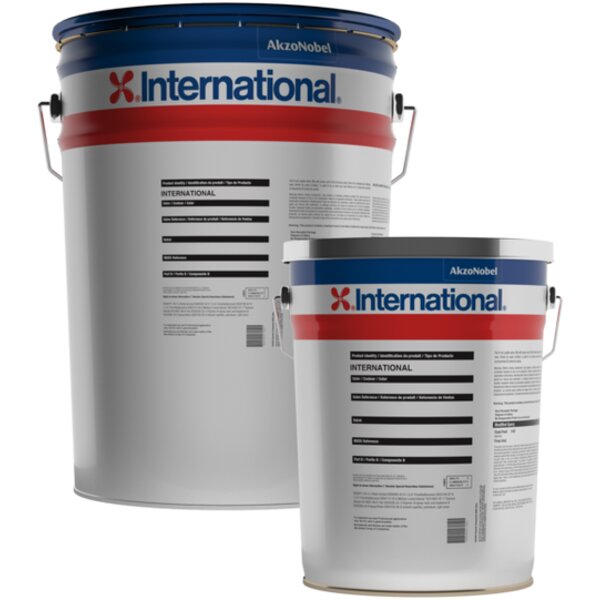
INTERCHAR 3120 PART A INDIVISIBLE KIT is the Part A component (black) of Interchar 3120, a versatile, two-component, modified epoxy intumescent coating designed for cellulosic fire protection of structural steelwork. It is a boron-free, low VOC, high-solids coating that delivers a durable, cosmetically appealing semi-gloss finish while helping to preserve the structural integrity of steel in fire situations.
Independently tested, assessed and certified, Interchar 3120 is suitable for use on both open and closed structural sections and can be applied by airless spray without any reinforcement. Part A is supplied as an indivisible kit size for professional and industrial applicators who require controlled mixing and consistent performance on demanding fire protection projects.
Main features
- Modified epoxy intumescent technology for cellulosic fire protection on structural steelwork.
- Boron-free and low VOC formulation, compliant with EU Solvent Emissions Directive and VOC Directive 2004/42/EC.
- High-solids, high-build coating, typically applied in thicknesses between 0.5 mm and 8 mm (approx. 2 mm per coat).
- Spray-applied material designed for airless spray application; no mesh or reinforcement required.
- Durable semi-gloss finish in light grey (system colour; Part A is black in the mix), suitable with or without recommended topcoats.
- Versatile application: direct-to-metal or over approved primers, compatible with a wide range of primers and topcoats.
- On- or off-site application: allows steelwork to be fabricated and fire-protected away from the construction site.
- Tested and assessed to multiple international fire standards for use on I-sections, hollow sections and cellular beams.
- For professional use only, in industrial and professional environments.
Key technical characteristics
Product data (Interchar 3120 system)
- Product type: Modified epoxy intumescent coating, two-component (this item is Part A).
- Colour (mixed system): Light Grey (Part A – Black; Part B – White).
- Finish: Semi-gloss.
- Volume solids: 100% (measured according to ISO 3233).
- Recommended dry film thickness: Depends on required fire protection; typically 0.5 mm to 8 mm DFT, with a typical 2 mm per coat.
- Theoretical coverage: 1 kg of Interchar 3120 provides 1 mm of fire protection to 0.725 m² (allow for appropriate loss factors).
- Method of application: Airless spray (single-leg recommended; plural-component heated equipment suitable).
- Touch dry / hard dry (2 mm DFT):
- 10°C: Touch dry 16 h, hard dry 33 h.
- 15°C: Touch dry 16 h, hard dry 22 h.
- 25°C: Touch dry 7 h, hard dry 16 h.
- 40°C: Touch dry 3 h, hard dry 4 h.
- Overcoating interval with itself (min): 6 h at 10°C, 15°C, 25°C and 40°C. Maximum: Extended.
- Flash point (typical): Part A >111°C (232°F); Part B >111°C (232°F); mixed >111°C (232°F).
- VOC (Interchar 3120): 0.17 lb/gal (21 g/L) EPA Method 24; 0 g/kg (EU Solvent Emissions Directive 2010/75/EU).
Pack size and physical properties (Part A)
- Unit / kit size: 25 kg (indivisible kit).
- Pack weight Part A (25 kg kit): 17.86 kg; typical product weight Part A: 19.65 kg.
- Pack size (container volume): 20 litre for Part A.
- Colour Part A: Black.
- Physical state: Liquid.
- Odour: Odourless.
- Density (mixed Part A data): 1.486 g/cm³ (DIN EN ISO 2811-1).
- Boiling point (mixed system): 414°C (777.2°F).
- Flash point (Part A): closed cup 111°C (231.8°F) [Pensky–Martens].
- Viscosity (Part A): Kinematic at room temperature 7502 mm²/s; at 40°C 11148 mm²/s (DIN EN ISO 3219).
Mixing and application (system information)
- Mix ratio (by weight): 2.5 parts Part A : 1 part Part B.
- Working pot life (mixed material): 45 minutes at 20°C (68°F); 30 minutes at 40°C (104°F).
- Recommended spray equipment:
- Single-leg airless: pump ratio 70:1, tip size 0.63–0.74 mm (25–29 thou).
- Plural-component airless: heated plural equipment (refer to application guidelines).
- Brush: Suitable for small areas and repair only; multiple coats are needed to achieve required DFT.
- Roller: Not recommended.
- Thinner: International GTA007 (may be thinned up to 8% by volume where required).
- Cleaner: International GTA822 (for flushing and cleaning spray equipment).
- Storage prior to mixing: Components should be stored for at least 24 h at a minimum of 15°C (59°F) and power agitated individually before mixing.
Surface preparation and substrate compatibility
- General: All steel surfaces must be clean, dry and free from contamination. Surfaces should be assessed and treated in accordance with ISO 8504:2000. Oil and grease should be removed as per SSPC-SP1 solvent cleaning.
- Blasted steel:
- Abrasive blast to a minimum of Sa2½ (ISO 8501:2007) or SSPC-SP6.
- Minimum surface profile: 50 µm (2 mils).
- Apply primer and Interchar 3120 before oxidation of the blast-cleaned surface occurs.
- Direct-to-steel: Interchar 3120 can be applied directly to suitable blast-cleaned steel substrates for some environments (consult International Protective Coatings for specific projects).
- Galvanized steel: Prepare by sweep abrasive blasting to a standard similar to Sa1 (ISO 8501:2007) or SSPC-SP7/NACE No.4, typically achieving a profile of 15–25 µm, followed by an approved primer.
- Black steel: Suitable for direct application on black steel (ISO 8501/BS7079) in corrosive categories up to C3 (ISO 12944-2).
Environmental and curing conditions
- Ensure adequate ventilation when applying Interchar 3120 in confined spaces.
- Do not apply at steel or air temperatures below 5°C (41°F) or when relative humidity exceeds 85%.
- Product will not cure adequately below 5°C (41°F); for optimum performance ambient temperature should be above 10°C (50°F).
- Surface temperature must be at least 3°C (5°F) above the dew point.
- Like all epoxies, Interchar 3120 will chalk and discolour on exterior exposure; this does not impair fire performance. For long-term cosmetic finish, overcoat with recommended topcoats.
System compatibility
Interchar 3120 has been tested as part of a coating system for use in fire situations over a wide range of approved primers:
- Intercure 200HS
- Intergard 251, 2511, 251HS, 2509
- Intergard 2575, 269
- Interseal 1052, 670HS
- Interzinc 52
Recommended topcoats over Interchar 3120 include:
- Interfine 1080, 878, 979
- Interthane 870, 990, 990SG
Fire testing and approvals (Interchar 3120 system)
- BS 476 Parts 20–22 – ASFP Yellow Book Rev 5 assessed.
- EN 13381-8 tested and assessed.
- EN 13381-9 tested and assessed for cellular beams.
- ASFP Yellow Book Rev 5 assessed for cellular beams.
- Australian Standards AS 1530.4-2014 and AS 4100.
- GB 14907-2018 (for GB-specified projects, consult AkzoNobel).
Storage and shelf life
- Shelf life: 18 months at 25°C (77°F), subject to re-inspection thereafter.
- Storage conditions: Store in dry, shaded conditions, away from sources of heat and ignition. Keep containers tightly closed.
Applications and use cases
INTERCHAR 3120 PART A INDIVISIBLE KIT is intended for use as part of the Interchar 3120 fire protection system on structural steelwork in cellulosic fire scenarios. Typical structures requiring this protection include:
- Commercial buildings and high-rise developments.
- Industrial complexes and process plants.
- Public and transport buildings such as airport terminals.
- Leisure facilities and convention centres.
- Educational facilities and shopping malls.
- Hotels and mixed-use developments.
The durable epoxy technology allows steelwork to be fabricated and fire-protected off-site, providing flexibility for both new-build and refurbishment projects where controlled shop application is required.
FAQ
-
Is this product the full Interchar 3120 system?
No. INTERCHAR 3120 PART A INDIVISIBLE KIT is the Part A (black) component of the two-component Interchar 3120 system. It must be mixed with the corresponding Part B in the specified 2.5:1 weight ratio before use.
-
What mixing ratio is required for Interchar 3120?
The specified mix ratio by weight is 2.5 parts Part A to 1 part Part B. Both components must be pre-agitated and then power mixed thoroughly.
-
What application methods are recommended?
Single-leg airless spray with a 70:1 pump and 0.63–0.74 mm (25–29 thou) tip is recommended. Heated plural-component airless equipment is suitable. Brush may be used for small areas or repairs; roller is not recommended.
-
Can Interchar 3120 be applied directly to steel?
Yes, Interchar 3120 can be applied directly to suitably blast-cleaned steel substrates for some service environments and is suitable direct-to-black steel up to corrosivity category C3. For specific project conditions, consult International Protective Coatings.
-
What is the typical dry film thickness per coat?
The typical dry film thickness per coat is approximately 2 mm, within an overall system range of about 0.5 mm to 8 mm depending on fire protection requirements.
-
Is this product suitable for exterior exposure?
Interchar 3120 will chalk and discolour when exposed outdoors, but this does not affect fire performance. If a durable cosmetic finish is required, apply one of the recommended topcoats.
-
What is the shelf life of Part A?
The stated shelf life is 18 months at 25°C (77°F), subject to re-inspection. Store in dry, shaded conditions away from heat and ignition sources.
-
Who is allowed to use this product?
The SDS clearly states that Interchar 3120 Black Part A is for professional use only, in industrial situations, following the safety data sheet and technical guidance.
-
What should I do in case of a spill?
Stop the leak if it can be done safely, prevent entry into drains and watercourses, contain with non-combustible absorbent (sand, earth, vermiculite or diatomaceous earth) and dispose of via a licensed waste contractor. Collect spillage and avoid environmental release.
-
Is the product hazardous?
According to the SDS, Interchar 3120 Black Part A is classified as harmful if swallowed, causes skin irritation and serious eye irritation, may cause an allergic skin reaction, is suspected of causing cancer and of damaging fertility, and is toxic to aquatic life with long lasting effects.
Section 14 – Transport information
- UN number / ID number: UN3082.
- UN proper shipping name: ENVIRONMENTALLY HAZARDOUS SUBSTANCE, LIQUID, N.O.S. (reaction product: bisphenol-A-(epichlorhydrin); epoxy resin, triphenyl phosphate).
- Transport hazard class: Class 9 (ADR/RID, IMDG, IATA).
- Packing group: III.
- Environmental hazards: Classified as hazardous to the environment; marine pollutant for IMDG.
- Small packaging exemption: Not regulated as a dangerous good when transported in pack sizes ≤5 L or ≤5 kg, provided the packaging meets applicable general provisions.
- Special precautions for user: Within user premises, always transport in closed, upright and secure containers. Ensure personnel know how to respond in case of accident or spillage.
- Transport in bulk according to IMO instruments: Not applicable.
Section 8 – Personal protection measures
According to the Safety Data Sheet for Interchar 3120 Black Part A, the following individual and workplace protection measures apply. These do not replace local risk assessments but provide key minimum guidance.
Engineering controls and hygiene
- Use process enclosures, local exhaust ventilation or other engineering controls to keep airborne contaminants below recommended or statutory limits.
- Ensure eyewash stations and safety showers are close to work areas.
- Wash hands, forearms and face thoroughly after handling chemicals and before eating, drinking, smoking or using the lavatory.
- Contaminated work clothing should not leave the workplace; wash before reuse.
Eye and face protection
- Use safety eyewear complying with an approved standard whenever there is a risk of exposure to liquid splashes, mists, gases or dusts.
- Where contact is possible, chemical splash goggles are recommended.
Hand protection
- Wear chemical-resistant, impervious gloves compliant with an approved standard whenever handling the product, where indicated by risk assessment.
- For prolonged or frequently repeated contact: gloves with protection class 6 (breakthrough time >480 minutes per EN374). Recommended: Viton or Nitrile, thickness ≥0.38 mm.
- For brief contact: gloves with protection class ≥2 (breakthrough time >30 minutes per EN374). Recommended: Nitrile, thickness ≥0.12 mm.
- Replace gloves regularly and whenever any sign of damage is observed. Glove performance can be reduced by physical or chemical damage or poor maintenance.
Skin and body protection
- Wear suitable protective clothing selected according to the task and risks, and approved by a specialist before use.
- Use appropriate protective footwear and any additional skin protection measures required by the specific operation.
Respiratory protection
- Select a respirator that meets relevant standards or certifications based on the hazard and exposure potential.
- Use a respirator conforming to EN140 with type A/P2 filter or better, within a formal respiratory protection programme that ensures correct fit and training.
- Dry sanding, flame cutting or welding of the dry paint film will generate hazardous dust and fumes; wet sanding/flatting should be used wherever possible. If local exhaust ventilation is insufficient, use suitable respiratory protective equipment.
Environmental exposure control
- Check emissions from ventilation or process equipment to ensure compliance with environmental legislation.
- Where needed, use fume scrubbers, filters or process modifications to reduce emissions.
*Contenido generado por IA