What is Intertuf 203 and why choose it
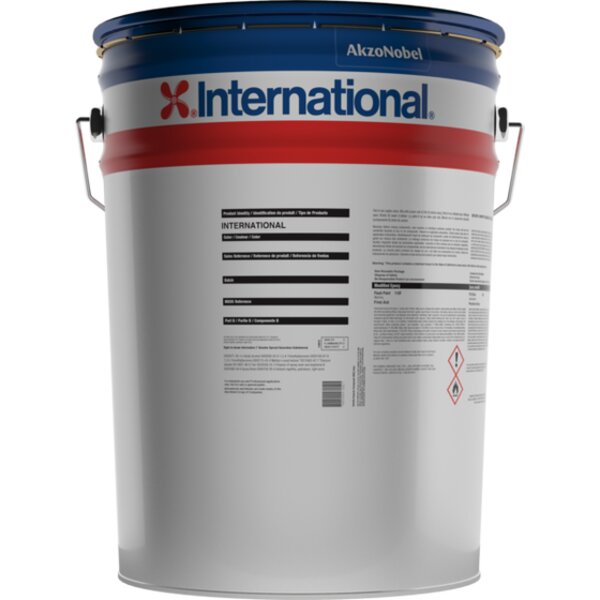
Intertuf 203 by International Marina is a one-pack, tar-free vinyl anticorrosive coating designed for marine environments. It can be applied at steel temperatures down to -5°C and is suitable for both above and below the waterline. In addition to providing anticorrosive protection, it can be used as a sealer coat over existing Tributyltin (TBT) antifouling layers, helping to control TBT leaching from underlying coatings. Intertuf 203 is compatible with controlled cathodic protection systems and is suitable for newbuilding projects, maintenance and repair, and on-board maintenance.
Main features
- One-pack, tar-free vinyl anticorrosive coating.
- Usable at low temperatures down to -5°C substrate temperature.
- Suitable for both above and below the waterline.
- Acts as a sealer coat over existing TBT antifouling systems, forming a barrier to TBT leaching when tested to ASTM D5108-96 (modified).
- Compatible with controlled cathodic protection systems.
- Intended for Newbuilding, Maintenance and Repair, and On Board Maintenance.
- Colours: JVA202 Aluminium and JVA207 Black (JVA204 Bronze available in Mercosul countries only).
- Application methods: airless spray (recommended), brush and roller for small areas.
- Touch-dry and hard-dry times tested in accordance with ISO 9117/3:2010 and ISO 9117-1:2009.
- Certified for Food Contact – Carriage of Grain (NOHH) when used as part of an approved scheme.
Technical specifications
- Product type: Vinyl anticorrosive, single pack.
- Brand: International Marina.
- Product name: INTERTUF 203.
- Colours: JVA202 Aluminium, JVA207 Black (JVA204 Bronze for Mercosul countries only).
- Volume solids: 40% ±2% (ISO 3233:1998).
- Typical dry film thickness (DFT): 75 microns (188 microns wet).
- Theoretical coverage: 5.33 m²/litre at 75 microns DFT (allow appropriate loss factors).
- Finish/Sheen: Not applicable.
- Mix ratio / Part B: Not applicable (single-pack product).
- Flash point (typical): 26°C single pack. Product produced and supplied in Korea has a flash point of 21°C due to locally sourced solvent.
- Induction period: Not applicable.
- VOC:
- 529 g/lt as supplied (EPA Method 24).
- 498 g/kg of liquid paint as supplied (EU Solvent Emissions Directive 1999/13/EC).
- 473 g/lt as supplied (Korea Clean Air Conservation Act).
- Drying times (typical):
- At -5°C: Touch dry 4 h, Hard dry 24 h.
- At 5°C: Touch dry 4 h, Hard dry 12 h.
- At 25°C: Touch dry 2 h, Hard dry 8 h.
- At 35°C: Touch dry 60 min, Hard dry 4 h.
- Recommended application methods:
- Airless spray (recommended): tip range 0.53–0.66 mm (21–26 thou); minimum fluid pressure at tip 211 kg/cm² (3000 psi).
- Brush: for small areas only; multiple coats may be required.
- Roller: for small areas only; multiple coats may be required.
- Conventional spray: not recommended.
- Thinner: International GTA007 only in exceptional circumstances (thinning not generally recommended; do not exceed limits of local environmental legislation).
- Cleaner: International GTA007.
- Substrate preparation (steel):
- Newbuilding: weld spatter removed, weld seams and damaged areas blast cleaned to Sa2½ (ISO 8501-1:2007) or power tooled to Pt3 (JSRA SPSS:1984).
- PVB and unapproved shop primers: blast to Sa2½ (ISO 8501-1:2007).
- Iron oxide epoxy shop primers: ensure intact primer is clean and dry; weld seams and damaged areas to specified standard.
- High zinc primers: grit sweep to AS2 (International Paint Sweep Blast Standards) or power tool to Pt3 (JSRA SPSS:1984).
- Major refurbishment: abrasive blast clean to Sa2½ (ISO 8501-1:2007); if oxidation occurs, reblast to specified standard.
- Overcoating (minimum / maximum intervals): dependent on substrate temperature and selected overcoat; typical examples include Interfine 599, Interlac 665, Intersheen 579, various Intersmooth SPC and Interswift 6800HS antifoulings, and Intertuf 203 itself. Consult the detailed overcoating table for precise intervals.
- Optimum substrate condition: blasted steel. Intertuf 203 JVA202 Aluminium should be specified as the first coat in an anticorrosive system.
- Unit sizes: 20 litre and 5 US gallon packs.
- Typical unit shipping weight:
- 20 litre: 24.04 kg.
- 5 US gallon: 50.2 lb.
- Shelf life: 24 months at 25°C, subject to reinspection thereafter. Store in dry, shaded conditions away from heat and ignition sources.
Applications and use cases
Marine steel structures
- Protection of ship hulls both above and below the waterline.
- Use as the first anticorrosive coat over blasted steel in multi-coat systems.
- Suitable as part of systems protected by controlled cathodic protection.
Sealer over existing TBT antifouling
- When used according to ASTM D5108-96 (modified), forms a barrier to TBT leaching from underlying TBT-containing antifouling coatings.
- Intended for use as a sealer coat where older TBT antifouling layers remain in place.
Project stages
- Newbuilding: Applied over properly blasted and prepared steel as part of a specified marine coating system.
- Maintenance and Repair: Used during dry-docking or major refurbishment after abrasive blasting to Sa2½ or equivalent standards.
- On Board Maintenance: Localised touch-up by brush or roller in small areas, observing minimum/maximum overcoating intervals.
FAQ
1. What type of coating is Intertuf 203?
Intertuf 203 is a single-pack, tar-free vinyl anticorrosive coating designed primarily for marine steel protection.
2. Can Intertuf 203 be used below the waterline?
Yes. It is specified for use both above and below the waterline as part of an appropriate coating scheme.
3. At what minimum temperature can Intertuf 203 be applied?
It can be applied at substrate temperatures down to -5°C, provided all other application conditions are suitable.
4. Is thinning required or recommended?
Thinning is not recommended. International GTA007 may be used only in exceptional circumstances and within the limits of local environmental legislation.
5. Which application method is preferred?
Airless spray is recommended for most applications. Brush and roller are intended for small areas only and may require multiple coats to reach the specified film thickness.
6. Can Intertuf 203 be applied over existing TBT antifouling?
Yes. When applied according to ASTM D5108-96 (modified), Intertuf 203 forms a barrier that reduces TBT leaching from underlying TBT antifouling coatings.
7. What surface preparation is required for steel?
For optimum performance, steel surfaces should be abrasive blast cleaned to Sa2½ (ISO 8501-1:2007) or prepared to Pt3 (JSRA SPSS:1984) by power tooling, depending on the area and system.
8. How should equipment be cleaned after application?
All application equipment should be thoroughly flushed with International GTA007 thinner/cleaner immediately after use.
9. What storage conditions are recommended?
Store unopened containers in dry, shaded conditions away from heat and ignition sources at around 25°C. Shelf life is 24 months, subject to reinspection thereafter.
10. Is special ventilation required during application?
Yes. Adequate ventilation must be provided during application and drying to keep solvent vapour concentrations within safe limits and to prevent toxic or oxygen-deficient atmospheres.
Section 14 – Transport information
Consultar ficha técnica del fabricante.
Section 8 – Exposure controls and personal protection
During application and drying of INTERTUF 203, the following general protective measures are indicated in the technical data:
- Provide proper ventilation and local exhaust to keep solvent vapour concentrations within safe limits and to avoid toxic or oxygen-deficient atmospheres.
- Use appropriate personal protective equipment to avoid skin and eye contact, such as gloves, goggles, face masks and barrier creams.
- When welding or flame cutting on metal coated with this product, dust and fumes will be emitted; use suitable personal protective equipment and adequate local exhaust ventilation. In North America, comply with ANSI/ASC Z49.1 “Safety in Welding and Cutting”.
For specific exposure limits, respirator types or detailed PPE configurations: Consultar ficha técnica del fabricante.
Contenido generado por IA