What it is and why choose it
INTERZINC 42 PART B INDIVISIBLE KIT by International Marina is the curing agent (Part B) of the two-component epoxy-zinc primer system Interzinc 42. This component is specifically formulated for professional, industrial use as part of a high-performance anti-corrosive coating system for steel structures in aggressive environments, including offshore facilities, petrochemical plants, pulp and paper mills, bridges and power plants. When correctly mixed with Part A in the supplied ratio, it helps develop the chemical resistance, adhesion and durability required for long-term protection of steel.
Main features
- Two-component epoxy-zinc system component: Part B curing agent designed to be mixed with Interzinc 42 Part A as supplied.
- Professional-grade performance: Intended for industrial and professional applicators, both in maintenance and new construction projects.
- Excellent anti-corrosive system performance: Contributes to achieving a minimum dry film thickness of 50 microns (2 mils) when the complete system is applied, supporting long-term corrosion protection.
- Suitable for aggressive environments: The full Interzinc 42 system is specified for offshore platforms, petrochemical plants, pulp and paper mills, bridges and power-generation facilities.
- Multiple application methods (system level): Designed for application by airless spray, air spray, and brush (roller not recommended for build on small areas) when used as the complete primer mix.
- Matt zinc-rich primer system: The complete Interzinc 42 coating delivers a matt finish available in red, grey and green when correctly mixed and applied.
- Regulatory-compliant formulation: VOC values determined according to EPA Method 24, EU Solvent Emissions Directive and Chinese National Standard GB23985.
- Indivisible kit: Supplied as a matched unit size that must be mixed in full, ensuring correct mix ratio and consistent performance.
Technical specifications
System-level data (Interzinc 42 mixed A+B)
- Product type: Epoxy-zinc metallic zinc primer (two components).
- Intended use: Zinc primer as part of a coating system for steel structures in aggressive environments; suitable for maintenance and new construction.
- Colours: Red, Grey, Green.
- Gloss: Matt.
- Volume solids: 55%.
- Typical dry film thickness: 50–75 microns (2–3 mils) dry, equivalent to 91–136 microns (3.6–5.4 mils) wet.
- Theoretical coverage: 7.33 m²/litre at 75 microns d.f.t. with stated volume solids (294 sq.ft/US gallon at 3 mils d.f.t.).
- Practical coverage: Subject to appropriate loss factors depending on application conditions.
- Recommended application methods: Airless spray, air spray, brush; roller not recommended for build.
- Recommended surface profile (steel): 40–75 microns (1.5–3.0 mils) after abrasive blast cleaning.
- Minimum dry film thickness for anti-corrosive performance: 50 microns (2 mils).
- Maximum recommended dry film thickness per coat: 150 microns (6 mils).
- Surface temperature during application: At least 3°C (5°F) above the dew point.
- Minimum curing temperature: Product will not cure adequately below 5°C (41°F); for maximum performance ambient temperature should be above 10°C (50°F).
- Drying times (mixed system) and overcoating intervals with recommended topcoats:
- At 10°C (50°F): touch dry 90 minutes; hard dry 5 hours; minimum overcoat 4 hours; maximum overcoat extended.
- At 15°C (59°F): touch dry 60 minutes; hard dry 4 hours; minimum overcoat 3 hours; maximum overcoat extended.
- At 25°C (77°F): touch dry 45 minutes; hard dry 150 minutes; minimum overcoat 2 hours; maximum overcoat extended.
- At 40°C (104°F): touch dry 30 minutes; hard dry 90 minutes; minimum overcoat 90 minutes; maximum overcoat extended.
- Flash point (typical): Part A 31°C (88°F); Part B 32°C (90°F); Mixed 32°C (90°F).
- Product weight (mixed): 1.94 kg/l (16.2 lb/gal).
- VOC (mixed): 3.43 lb/gal (412 g/L) EPA Method 24; 226 g/kg EU Solvent Emissions Directive; 389 g/L Chinese National Standard GB23985.
Part B (curing agent) data
- Physical state: Liquid.
- Colour: Yellow.
- Odor: Solvent.
- Boiling point (initial): 119°C (246.2°F).
- Flash point: 32°C (89.6°F) closed cup (Pensky-Martens).
- Density: 0.898 g/cm³ (DIN EN ISO 2811-1).
- Kinematic viscosity (room temperature): 200 mm²/s (DIN EN ISO 3219).
- Kinematic viscosity (40°C): 180 mm²/s (DIN EN ISO 3219).
- Solubility in cold water: Not soluble (OESO TG 105).
- Explosive limits (driven by butan-1-ol content): Lower 1.4%; Upper 11.3%.
- Chemical stability: Stable under normal conditions of storage and use.
- Incompatible materials: Oxidizing materials.
Supply, packaging and storage
- Unit sizes (kit):
- 10 litre kit: Part A 8 L pack; Part B 2 L pack (2.5 L pack size).
- 5 US gallon kit: Part A 4 US gal pack; Part B 1 US gal pack.
- Typical shipping weight:
- 10 litre: Part A 19.6 kg; Part B 2.1 kg.
- 5 US gal: Part A 78.7 lb; Part B 8.4 lb.
- Shelf life: 12 months minimum at 25°C (77°F), subject to re-inspection thereafter.
- Storage conditions: Store in dry, shaded conditions away from sources of heat and ignition. Keep containers tightly closed and in original packaging. Store locked up and segregated from oxidizing materials and food and drink.
Applications and use cases
When mixed with Part A and applied as the full Interzinc 42 system, INTERZINC 42 PART B INDIVISIBLE KIT is suitable for:
- Offshore facilities: Structural steel and support steelwork exposed to marine and splash-zone environments.
- Petrochemical and chemical plants: Process structures and pipe racks exposed to aggressive industrial atmospheres.
- Pulp and paper mills: Steel subject to high humidity and chemically challenging environments.
- Bridges: Steel bridge structures requiring durable, zinc-rich primer systems.
- Power plants: Structural steel and ancillary steelwork in power-generation facilities.
- Maintenance and repair: Recoating of correctly prepared steel or approved zinc shop-primed surfaces where high-performance corrosion protection is needed.
Surface preparation (system level)
- All surfaces must be clean, dry and free from contamination, assessed and treated in accordance with ISO 8504:2000.
- Oil and grease should be removed by solvent cleaning in accordance with SSPC-SP1.
- Abrasive blast cleaning: Blast to Sa2½ (ISO 8501-1:2007) or SSPC-SP6. Reblast if oxidation occurs before coating.
- Repair or treat surface defects revealed by blasting; ensure a surface profile of 40–75 microns (1.5–3.0 mils).
- Shop-primed steel: Suitable over fresh zinc silicate shop primers, provided breakdown is not excessive; sweep blasting may be required. Other shop primers are not suitable and must be fully removed by abrasive blasting.
Mixing and application (system level)
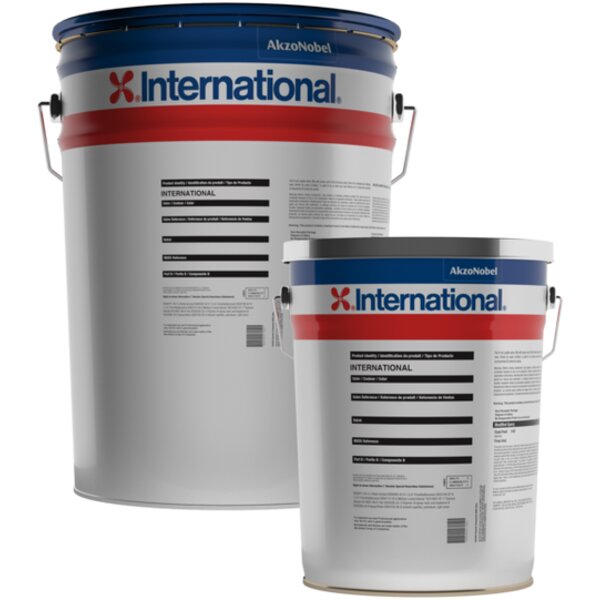
- Supply form: Material is supplied in two containers (Part A and Part B) as a single kit. Always mix a complete unit in the supplied proportions.
- Mix ratio (by volume): 4 parts Part A : 1 part Part B.
- Mixing method:
- Agitate Base (Part A) with a power agitator.
- Add the entire contents of Curing Agent (Part B) to Part A and mix thoroughly with power agitation.
- Working pot life (mixed material):
- 10°C (50°F): 24 hours.
- 15°C (59°F): 16 hours.
- 25°C (77°F): 10 hours.
- 40°C (104°F): 5 hours.
- Airless spray (recommended): Tip range 0.43–0.53 mm (17–21 thou); minimum total fluid pressure at tip 162 kg/cm² (2304 psi).
- Conventional spray (pressure pot, recommended): DeVilbiss MBC or JGA gun, air cap 704 or 765, fluid tip E.
- Brush: Suitable for small areas only; typically 50 microns (2.0 mils) d.f.t. can be achieved.
- Roller: Not recommended.
- Thinner: International GTA220; thinning normally not required and must not exceed limits of local environmental legislation.
- Cleaner: International GTA822 for flushing and cleaning all equipment immediately after use and during work stoppages.
- Work stoppages: Do not allow material to remain in hoses, guns or spray equipment. Flush thoroughly with recommended cleaner. Once units are mixed they must not be resealed; after prolonged stoppages, restart with freshly mixed units.
- Overcoating and system compatibility: Designed for overcoating with a wide range of recommended topcoats including Intercryl 530, Intercure 200/420, Interfine 629HS, Intergard 251/269/475HS, Intergard 740, Interseal 670HS, Interthane 990/990E, Interzone 505/954/1000.
FAQ
-
What is INTERZINC 42 PART B INDIVISIBLE KIT used for?
It is the curing agent (Part B) of the Interzinc 42 epoxy-zinc primer. When mixed with Part A in the correct ratio, it forms a zinc-rich primer used to protect steel structures in aggressive industrial and marine environments.
-
Can Part B be used on its own as a coating?
No. Part B is designed only to be mixed with Part A of Interzinc 42. It must not be used alone.
-
What is the correct mix ratio for Interzinc 42?
The correct mixing ratio is 4 parts Base (Part A) to 1 part Curing Agent (Part B) by volume. Always mix a complete unit.
-
How long can I use the mixed material?
The working pot life ranges from approximately 24 hours at 10°C to 5 hours at 40°C. After this time the material should be discarded.
-
What surface preparation is required before applying the mixed primer?
Steel surfaces should be abrasive blast cleaned to Sa2½ (ISO 8501-1:2007) or SSPC-SP6 with a surface profile of 40–75 microns, and must be clean, dry and free from contamination.
-
Is the product suitable for underwater or immersion service?
Interzinc 42 is not normally recommended for underwater use. For immersion conditions, International Protective Coatings should be consulted.
-
What is the minimum dry film thickness for effective corrosion protection?
A minimum dry film thickness of 50 microns (2 mils) is required for good anti-corrosive performance.
-
Can I apply the primer over zinc shop primers?
Yes, Interzinc 42 can be applied over freshly coated zinc silicate shop primers, provided breakdown is limited and any excessive corrosion or damage is corrected, often by sweep blasting.
-
What happens if too much film thickness is applied?
Dry film thicknesses above 150 microns can affect adhesion, extend minimum overcoating and handling times, and may be detrimental to long-term performance.
-
Who is allowed to use this product?
The product is intended for use only by professional applicators in industrial environments, following the Safety Data Sheet (SDS) and all relevant regulations.
Section 14 – Transport information
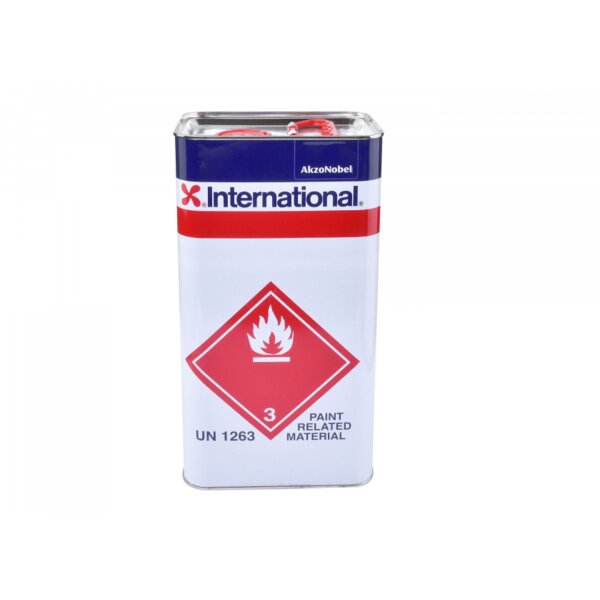
- UN number or ID number: UN1263.
- UN proper shipping name: PAINT.
- Transport hazard class: Class 3 (flammable liquids).
- Packing group: III.
- Environmental hazards: Classified as environmentally hazardous for transport (ADR/RID and IMDG); the environmentally hazardous / marine pollutant mark is not required for pack sizes ≤5 L or ≤5 kg.
- ADR/RID additional information: Tunnel code (D/E).
- IMDG additional information: Emergency schedules F-E, S-E; identified marine pollutants include fatty acids C18-unsaturated dimers/oligomeric reaction products with tall-oil fatty acids and triethylenetetramine, and solvent naphtha (petroleum), light aromatics.
- IATA: Classified as PAINT, Class 3, Packing group III; the environmentally hazardous substance mark may appear if required by other regulations.
- Special precautions for user: Within user’s premises always transport in closed containers that are upright and secure; ensure personnel know what to do in case of accident or spillage.
- Transport in bulk according to IMO instruments: Not applicable.
Section 8 – Personal protective measures
The following information is summarised from the Safety Data Sheet for Interzinc 42 Part B and is intended for professional users performing handling, mixing and application.
Engineering controls and hygiene
- Use only with adequate ventilation. Employ process enclosures, local exhaust ventilation or other engineering controls to keep airborne concentrations below occupational exposure limits and below lower explosive limits.
- Use explosion-proof ventilation and electrical equipment.
- Ensure eyewash stations and safety showers are close to the workstation.
- Wash hands, forearms and face thoroughly after handling, before eating, drinking or smoking, and at the end of the working period.
- Do not eat, drink or smoke in areas where the product is handled or stored. Remove contaminated clothing and protective equipment before entering eating areas.
Eye and face protection
- Wear chemical splash goggles and/or face shield complying with an approved standard when there is a risk of exposure to liquid splashes, mists, gases or vapors.
- If inhalation hazards exist, a full-face respirator may be required instead of separate eye protection.
Hand protection
- Wear chemical-resistant, impervious gloves complying with an approved standard.
- For prolonged or frequently repeated contact: gloves with protection class 6 (breakthrough time > 480 minutes according to EN374) are recommended; suitable materials include Viton or nitrile with thickness ≥ 0.38 mm.
- For brief contact: gloves with protection class ≥ 2 (breakthrough time > 30 minutes according to EN374) are recommended; nitrile gloves with thickness ≥ 0.12 mm are suggested.
- Replace gloves regularly and immediately if damaged. The user must confirm final glove selection based on the specific conditions of use.
Skin and body protection
- Wear suitable protective clothing selected according to the task and associated risks.
- Where there is a risk of ignition from static electricity, wear anti-static protective clothing including anti-static overalls, boots and gloves (see EN 1149 for material and design requirements).
- Use appropriate footwear and any additional skin protection measures as required by the risk assessment.
Respiratory protection
- Select a respirator that meets applicable standards based on hazard and exposure potential.
- Wear a respirator conforming to EN140 with type A/P2 filter or better when ventilation is insufficient.
- Dry sanding, flame cutting and/or welding of the dry paint film can generate hazardous dust and fumes; use wet methods where possible or appropriate respiratory protection if exposure cannot be avoided.
Environmental exposure controls
- Emissions from ventilation and process equipment should be checked for compliance with environmental regulations.
- If necessary, use fume scrubbers, filters or engineering modifications to reduce emissions to acceptable levels.
*Contenido generado por IA