What it is and why choose it
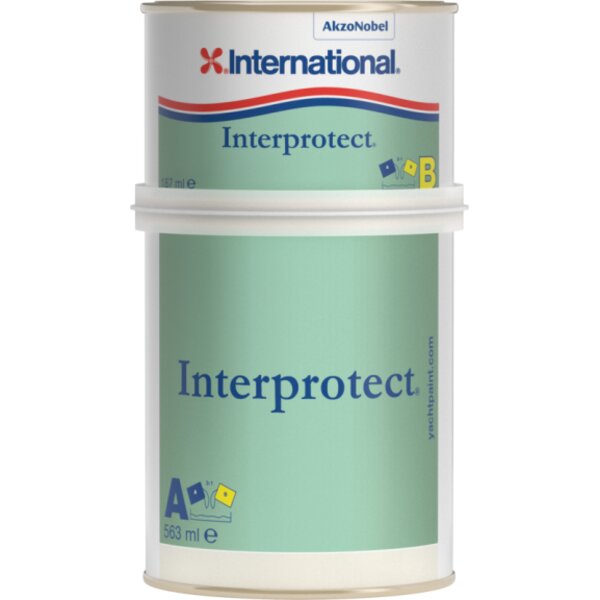
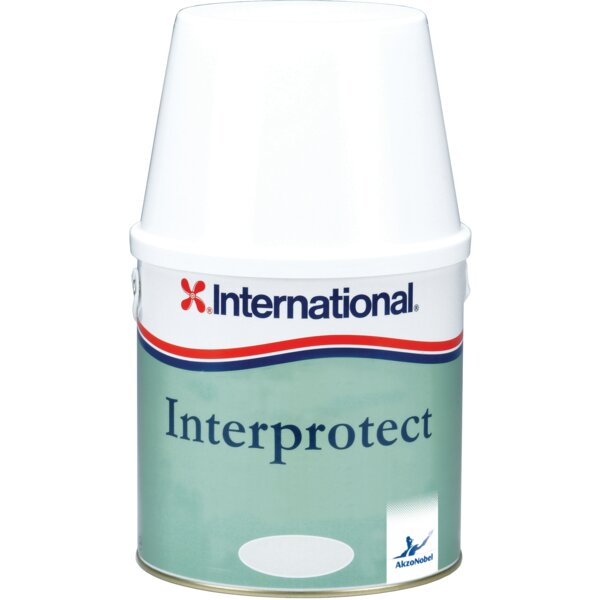
Interprotect Converter (Interprotect Part B, code YPA404) is the hardener component of the high‑performance Interprotect epoxy primer system from International Náutica. Designed for professional use, it forms, together with the base component, a fast‑drying two‑component coating that delivers durable anti-corrosion protection on steel, aluminium and wood above and below the waterline.
The converter activates the epoxy base, providing excellent adhesion, high mechanical strength and a tough, abrasion‑resistant film that also acts as a reliable tie coat for a wide range of antifoulings.
Main features
- Two-component epoxy converter specifically formulated for Interprotect epoxy primer systems.
- Fast drying, allowing short recoat intervals and quick application of antifouling or further epoxy layers.
- High corrosion protection when used as directed over properly prepared steel, aluminium and wood.
- Excellent abrasion resistance for demanding marine environments.
- Good tie‑coat properties between epoxy primers and a wide range of antifouling products from International.
- Professional performance for both interior and exterior use on boats and marine structures.
Technical specifications
General product data
- Product type: Two‑component epoxy converter (Part B of Interprotect system).
- Use: Interior and exterior coating as part of a two‑component system.
- Finish of the complete primer system: Matt.
- Pack sizes: 750 ml, 2.5 l, 5 l.
- Storage time (typical): 2 years.
Colour and appearance (converter)
- Colour (Part B): Orange.
- Physical state: Liquid.
- Odour: Amine‑like.
Mixed system data (Interprotect primer)
- Available colours: White (YPA400), Grey (YPA403).
- Density: 1.4.
- Volume solids: 45%.
- Mixing ratio: 3:1 by volume (base : converter) using converter/hardener YPA404.
- VOC: 464 g/l.
Drying and recoat times (mixed product)
The following values are indicative for the mixed Interprotect system.
- Hard dry [ISO]:
- 5°C: 4 h
- 15°C: 2 h
- 23°C: 1 h
- 35°C: 30 min
- Immersion (minimum time before immersion):
- 5°C: 24 h
- 15°C: 18 h
- 23°C: 12 h
- 35°C: 8 h
- Pot life (useful application time):
- 5°C: 10 h
- 15°C: 5 h
- 23°C: 3 h
- 35°C: 2 h
Recommended film thickness and coverage (mixed product)
- Recommended dry film thickness (DFT): 50 microns by brush.
- Recommended wet film thickness (WFT): 110 microns by brush.
- Theoretical coverage: 9.10 m²/l by brush.
- Practical coverage: 8.10 m²/l by brush.
Application methods (mixed product)
- Application tools: Brush, roller.
- Thinners: YTA061 Thinner No. 7, GTA220.
- Equipment cleaner: GTA822.
- Recommended number of coats:
- Steel/Aluminium/Alloys: 4–5 coats.
- Lead: 5 coats.
- Bare wood: 3 coats.
- As tie coat over Interprime 820: 1 coat.
Applications and use cases
Suitable substrates
- Steel.
- Aluminium and aluminium alloys.
- Zinc/galvanised steel (with appropriate pre‑primer).
- Lead.
- Bare wood.
- Previously coated surfaces with compatible epoxy primers.
Typical marine uses
- Underwater hulls: as an epoxy anti‑corrosive primer and tie coat under antifouling systems.
- Topsides and superstructures: as a high‑build epoxy base on steel or aluminium prior to finishing systems.
- Bilges and lockers: interior protection where high chemical and abrasion resistance are required.
- Wooden hulls and structures: sealing and protecting bare timber before antifouling or other coatings.
Surface preparation (summary)
- Steel: Degrease, then abrasive blast to Sa 2.5 near white metal. If blasting is not possible, machine sand to a clean bright profile of 50–75 microns.
- Aluminium (topsides): Degrease, then pre‑prime with Etch Primer or lightly abrade/low‑pressure blast with aluminium oxide.
- Aluminium (underwater areas): Degrease and sand or blast.
- Zinc/galvanised steel: Thorough degreasing, then pre‑prime with Etch Primer.
- Lead: Abrade with emery cloth or power brush, degrease, then pre‑prime with Etch Primer.
- Bare wood: Sand with 80–280 grit and, for oily timbers such as teak, remove oil with solvent No. 9 using frequently changed cloths.
Mixing and application notes
- Stir each component thoroughly.
- Add the correct volume of Interprotect Converter (Part B) to the base component at a 3:1 volume ratio.
- Mix well and allow the mixture to stand for approximately 10 minutes to let bubbles disperse.
- Apply within the specified pot life for the ambient temperature.
- Do not use below 5°C. For best performance, drying temperature should be above 10°C.
- Do not apply over conventional one‑component coatings.
- Avoid application when condensation may form on the substrate.
- Ambient temperature: 5–35°C; product temperature: 10–35°C; substrate temperature: 5–35°C.
FAQ
-
What is Interprotect Converter used for?
It is the hardener (Part B) for the Interprotect two‑component epoxy primer system, used to achieve full cure, adhesion and mechanical performance on steel, aluminium and wood in marine environments.
-
What is the correct mixing ratio?
Mix 3 parts Interprotect base to 1 part Interprotect Converter by volume.
-
How many coats of the mixed system are recommended?
Typically 4–5 coats on steel, aluminium and alloys, 5 coats on lead and 3 coats on bare wood. When used as a tie coat over Interprime 820, 1 coat is sufficient.
-
What are the recommended application methods?
Application by brush or roller is recommended. Use the specified thinners (YTA061 Thinner No. 7 or GTA220) and clean equipment with GTA822.
-
Can Interprotect be applied over one‑component paints?
No. The product must not be applied over conventional single‑component coatings.
-
What is the minimum time before immersion in water?
After the final coat of the mixed system, wait at least 24 h at 5°C, 18 h at 15°C, 12 h at 23°C or 8 h at 35°C before immersion.
-
How should the product be stored?
Store in the original, tightly closed container, protected from air and direct sunlight, between 5°C and 35°C. Keep away from sources of ignition and out of reach of children.
-
Is Interprotect Converter suitable for use on bronze or mixed‑alloy propellers?
No. Interprotect is not intended for use on bronze or mixed‑alloy propellers.
-
Who is allowed to use this product?
The safety data sheet specifies that it is for professional use only.
Section 14 – Transport information
The following data are taken from the safety data sheet for Interprotect Part B (Interprotect Converter).
- UN number: UN1263.
- UN proper shipping name: Paint (PINTURAS / PAINT).
- Transport hazard class: 3 (flammable liquids).
- Packing group: III.
- Environmental hazards: Not classified as hazardous to the environment for transport.
- ADR/RID: Class 3, Packing group III, UN1263, tunnel code D/E.
- IMDG: Class 3, Packing group III, UN1263, emergency schedules F-E, S-E.
- IATA: Class 3, Packing group III, UN1263.
- Special precautions for users: During on‑site transport, always carry the product in closed, upright and secure containers. Ensure that personnel transporting the product know what to do in case of accident or spillage.
Section 2 – Hazard pictograms and classification
According to Regulation (EC) No. 1272/2008 (CLP), Interprotect Part B (Interprotect Converter) is classified as a hazardous mixture with the following hazard classes:
- Flam. Liq. 3, H226: Flammable liquid, Category 3 – flammable liquid and vapour.
- Acute Tox. 4, H302: Harmful if swallowed.
- Acute Tox. 4, H332: Harmful if inhaled.
- Skin Irrit. 2, H315: Causes skin irritation.
- Eye Dam. 1, H318: Causes serious eye damage.
- Skin Sens. 1, H317: May cause an allergic skin reaction.
- STOT SE 3, H335: May cause respiratory irritation.
- STOT SE 3, H336: May cause drowsiness or dizziness.
- STOT RE 2, H373: May cause damage to organs through prolonged or repeated exposure.
- Aquatic Chronic 3, H412: Harmful to aquatic life with long lasting effects.
Pictograms (textual description)
The label for Interprotect Converter includes the following hazard pictograms:
- Flame symbol (GHS02): Indicates flammable liquid.
- Corrosion symbol (GHS05): Indicates serious eye damage and skin corrosion/irritation potential.
- Exclamation mark (GHS07): Indicates acute toxicity, skin irritation and respiratory tract irritation.
- Health hazard silhouette (GHS08): Indicates specific target organ toxicity from repeated or single exposure and sensitisation.
Key precautionary statements (summary)
- Keep out of reach of children.
- Keep away from heat, hot surfaces, sparks, open flames and other ignition sources. No smoking.
- Use only outdoors or in a well‑ventilated area.
- Do not breathe vapours.
- Wear protective gloves and eye or face protection.
- Avoid release to the environment.
- In case of inhalation, skin contact or eye contact, follow the first‑aid measures indicated on the label and safety data sheet.
Section 8 – Individual protection measures
The following personal protection guidance is summarised from Section 8 of the safety data sheet for Interprotect Part B and applies during professional handling, mixing and application.
Engineering controls
- Use only with adequate ventilation.
- Apply local exhaust ventilation or other engineering controls to keep airborne concentrations below statutory exposure limits and below the lower explosion limit.
- Use explosion‑proof ventilation and equipment.
General hygiene measures
- Wash hands, forearms and face thoroughly after handling and before eating, drinking, smoking or using the lavatory.
- Remove contaminated clothing and protective equipment before entering eating areas.
- Contaminated work clothing must not be taken off‑site and should be washed before reuse.
- Ensure eye‑wash stations and safety showers are close to the work area.
Eye and face protection
- Use chemical splash goggles and/or a face shield approved for chemical protection to prevent eye contact with liquid, mists or vapours.
- If there is a risk of inhalation exposure, a full‑face respirator may be required instead of goggles.
Hand protection
- Wear chemical‑resistant, impermeable gloves complying with relevant standards.
- For frequent or prolonged contact, gloves with protection class 6 (breakthrough time > 480 minutes according to EN374) are recommended, such as Viton or nitrile gloves with thickness ≥ 0.38 mm.
- For short‑term contact, at least protection class 2 (breakthrough time > 30 minutes according to EN374) is recommended, such as nitrile gloves with thickness ≥ 0.12 mm.
- Replace gloves regularly and immediately if damaged or showing signs of degradation.
Skin and body protection
- Select protective clothing based on the specific task and risk assessment, and have it approved by a specialist.
- Where there is a risk of ignition due to electrostatic charges, wear antistatic protective clothing including coveralls, boots and gloves with anti‑static properties (see EN 1149).
- Use suitable protective footwear and any additional skin protection required by the work situation.
Respiratory protection
- Choose a respirator according to exposure level and applicable standards as part of a respiratory protection programme.
- Where ventilation is insufficient, wear a half‑mask respirator compliant with EN140 fitted with an A/P2 filter or better.
- When sanding or cutting dry paint films, wet sanding is preferred. If exposure cannot be avoided, use appropriate respiratory protection suitable for dusts and fumes.
Environmental exposure controls
- Check ventilation and process emissions to ensure compliance with environmental regulations.
- Where necessary, install filters, scrubbers or modify process equipment to reduce emissions.