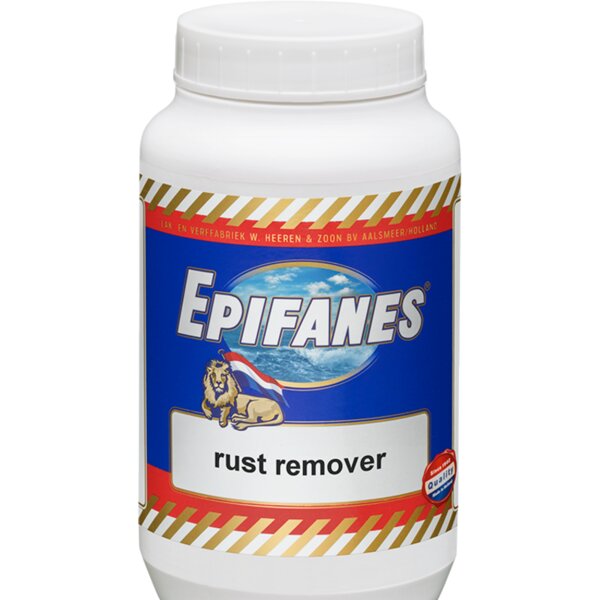
What is Epifanes Rust Remover and why choose it?
Epifanes Rust Remover is a waterbased rust converter designed for removing rust in difficult areas on steel surfaces. Based on water-repelling polymers, it reacts with corroded steel to create a blue/black layer that is suitable for subsequent painting and helps stop the corrosion process for some time. It can be applied on wet steel and under humid conditions, making it especially practical for marine and industrial maintenance where ideal conditions are not always available.
Main features
- Waterbased rust converter: Specifically formulated to react with corroded steel and convert rusted areas.
- Improves paint adhesion: Leaves the steel surface in a condition suitable for overcoating with anticorrosive primers.
- Temporary corrosion stop: The chemical reaction helps to stop the corrosion process for some time.
- Ideal for difficult areas: Developed for manually derusted steel in corners and for punctiform (localised) rust.
- Versatile marine use: Suitable for use on steel surfaces both above and below the waterline.
- Can be used on wet steel: Application is possible on wet steel and under humid conditions with limited ventilation.
- Zero VOC: VOC content is 0.00 g/litre.
- Easy application: Can be applied by brush, roller or spray.
- Single treatment: One treatment is sufficient and should not be repeated.
Technical specifications
- Product type: Waterbased rust converter, water-repelling polymers.
- Colour (wet): Milky off white.
- Appearance after reaction: Steel looks blue/black.
- Density: 1.02 kg/dm³ (approx. 1.02 g/cm³).
- pH value: 1.5.
- VOC level: 0.00 grams/litre (0.0 % organic solvents).
- Form: Fluid.
- Odour: Characteristic.
- Flash point: > 100 °C.
- Water solubility: Fully miscible.
- Packing: 500 ml.
- Shelf life: At least 3 years in closed container stored in a dark location between 5–25 °C. Store frost free.
- Application temperature: Minimum 5 °C – maximum 28 °C.
- Relative humidity during application: Minimum 50 % – maximum 90 %.
- Surface temperature: Must be at least 3 °C above freezing.
- Drying/overcoating time: Between minimum 3 hours and maximum 2 days before applying the first (thinned) anticorrosive primer.
- Recoatability: Can be overcoated with all Epifanes one- and two-component primers and coatings.
Applications and use cases
Recommended field of application
- Removing rust in difficult places on manually derusted steel.
- Treatment of corners and hard-to-reach areas where mechanical derusting is limited.
- Localised (punctiform) rust spots on steel substrates.
- Steel surfaces above and below the waterline.
Surface preparation and application
- Remove all loose rust using a wire brush and/or coarse abrasive paper (P40–60). Ensure the entire bare steel surface is coarsely abraded.
- Hose the surface with fresh water to remove remaining contamination.
- Degrease thoroughly with Epifanes Cleaning Solution.
- Shake Epifanes Rust Remover well before use.
- Apply one thin coat by brush, roller or spray.
- Allow the product to react. Rusted areas will turn blue/black.
- After a minimum of 3 hours and within 2 days, apply the first (thinned) anticorrosive primer.
Important application notes
- The product must react with rust; do not apply on primers, paints or coatings.
- If spilled on existing paint or primer, remove immediately with a cloth.
- One treatment is sufficient; do not repeat.
- Epifanes Rust Remover is not a replacement for a primer coat.
FAQ
1. What type of surfaces can I treat with Epifanes Rust Remover?
It is intended for steel surfaces that have been manually derusted, particularly in corners and areas with punctiform rust. It is suitable for use above and below the waterline.
2. Can I apply it on wet steel or in high humidity?
Yes. Epifanes Rust Remover may be applied on wet steel and under humid conditions with limited ventilation, provided the temperature conditions are respected.
3. How should I prepare the surface before application?
Remove loose rust with a wire brush and/or P40–60 abrasive paper, coarsely abrade all bare steel, rinse with fresh water, and degrease thoroughly with Epifanes Cleaning Solution before applying one thin coat.
4. How long do I have to wait before painting over the treated surface?
The blue/black surface can be painted with the first (thinned) anticorrosive primer after a minimum of 3 hours and within a maximum of 2 days.
5. Do I still need a primer after using this product?
Yes. Epifanes Rust Remover is not a replacement for a primer coat. The surface should be overcoated with a suitable anticorrosive primer.
6. With which coatings can I overcoat the treated steel?
The converted surface can be recoated with all Epifanes one- and two-component primers and coatings.
7. Is the product solvent-free?
Yes. The VOC content is 0.00 g/litre and the organic solvent content is 0.0 %.
8. How should I store Epifanes Rust Remover?
Store in a closed container in a dark location between 5–25 °C, protected from frost. Under these conditions the shelf life is at least 3 years.
9. What happens if the product gets on existing paint?
If spilled on paint or primer, remove Epifanes Rust Remover with a cloth as soon as possible. It is designed to react with rust and should not be applied on coatings.
10. Is special respiratory protection required during normal use?
According to the safety data, respiratory protection is not required under normal conditions of use. However, general protective and hygienic measures should always be observed.
Section 14 – Transport information
- UN number (ADR, ADN, IMDG, IATA): Void.
- UN proper shipping name (ADR, ADN, IMDG, IATA): Void.
- Transport hazard class (ADR, ADN, IMDG, IATA): Class Void.
- Packing group (ADR, IMDG, IATA): Void.
- Environmental hazards: Not classified as a marine pollutant.
- Special precautions for user: Not applicable.
- Transport in bulk according to Annex II of MARPOL and the IBC Code: Not applicable.
- UN “Model Regulation”: Void.
Section 8 – Personal protective measures
- General protective and hygienic measures: Immediately remove all soiled and contaminated clothing.
- Protection of skin and body: Wear protective clothing as indicated by precautionary statement P280.
- Hand protection: Use protective gloves resistant to the product.
- Recommended glove materials for permanent contact: Nitrile rubber, recommended glove thickness > 0.45 mm, permeation time > 480 min (according to EN 374).
- Recommended glove materials for splash protection: Chloroprene, thickness > 0.7 mm, penetration time > 60 min (EN 374); or nitrile rubber, thickness > 0.3 mm, penetration time > 60 min (EN 374).
- Eye/face protection: Goggles are recommended during refilling; follow P280 to use suitable eye and face protection.
- Respiratory protection: Not required under normal conditions of use.
- Additional precautionary statements: P262 – Do not get in eyes, on skin, or on clothing. P301+P310 – If swallowed, immediately call a poison centre or doctor. P303+P361+P353 – If on skin (or hair), take off contaminated clothing immediately and rinse with water/shower.
*Contenido generado por IA