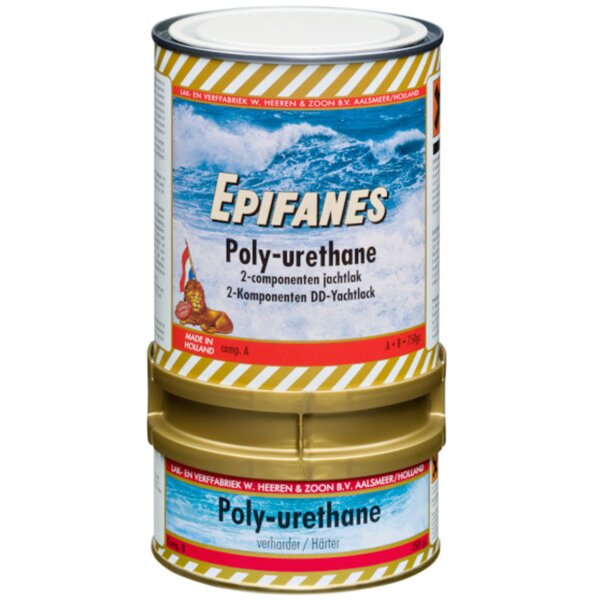
What is Epifanes Poly-urethane Yacht Paint and why choose it?
Epifanes Poly-urethane Yacht Paint is a two-component, chemically drying, high gloss polyurethane coating for yachts and other marine applications. Formulated with advanced UV filters, it protects the underlying paint system against discoloration and loss of gloss, even under strong sunlight and tropical conditions. The cured coating is scratch resistant, highly water resistant and can be polished after full cure for an extra-deep gloss.
This system is suitable for professional users and demanding boat owners who want a long-lasting, high-end finish on wood, steel, aluminium and GRP substrates, using the appropriate Epifanes primers. It can also be applied directly to intact GRP gelcoat without primer.
Main features
- Two-component PU system based on polyester resin with isocyanate hardener.
- Extreme high gloss finish with excellent flow and long-term gloss retention.
- High-performance UV filters to minimise discoloration and chalking.
- Scratch and abrasion resistance suitable for demanding marine environments.
- Excellent water resistance, designed to withstand all natural elements, including tropical climates.
- Polishable after full cure (approx. 7 days at 20°C); for maximum gloss, finish with Epifanes Poly-urethane Clear Gloss.
- Versatile over existing systems: can be applied over existing epoxy and polyurethane paints, regardless of brand, after correct preparation.
- Direct-to-gelcoat option: can be used directly on intact GRP gelcoat without cracks or hairline damage (after degreasing and sanding).
- Wide colour range: 24 standard colours (800-series plus RAL 9010) and custom colours in gloss and satin (RAL K7 and maritime related).
- Available as a full system: base colour component A and curing agent component B.
Technical specifications
Base and appearance
- Type: Chemical drying, two-component polyurethane.
- Base (component A): Polyester resin.
- Hardener (component B): Isocyanate resin in organic solvent.
- Gloss level: High gloss.
- Colours: 24 standard colours (Epifanes colour fan 800-numbers + RAL 9010); custom-made colours available in high gloss and satin (RAL K7 and maritime related).
- Physical state: Fluid liquid.
Physical properties (mixed system)
- Density at 20°C: approx. 1.10 – 1.30 g/cm³.
- Kinematic viscosity at 20°C: approx. 30 s (ISO-cup 6 mm).
- Solids content: approx. 65 ± 2 % by weight / 55 ± 2 % by volume.
- Recommended wet film thickness per coat: 60 – 70 µm.
- Recommended dry film thickness per coat: 35 – 40 µm.
- Theoretical coverage: approx. 10 m² per 750 g at 40 µm dry film thickness (practical coverage depends on surface and application conditions).
- VOC content (component A example): approx. 366 – 588 g/l (depending on specific colour and SDS version).
Packaging and shelf life
- Standard sets:
- 500 g Component A + 250 g Component B (total 750 g).
- 2 kg Component A + 1 kg Component B (total 3 kg).
- Shelf life in unopened containers (5–30°C, dry storage):
- Base component A: 3 years after production date.
- Curing component B: 1 year after production date.
Application conditions and tools
- Substrate temperature: minimum 10°C / 47°F, maximum 30°C / 86°F.
- Relative humidity: 50 – 75%.
- Recommended tools: longhaired soft brush or foam roller (replace foam rollers regularly).
- Thinner for brushing: Epifanes Poly-urethane Brush Thinner or Epifanes PU Slow Reducer.
- Thinner for spraying: Epifanes Poly-urethane Spray Thinner. For spray applications, Epifanes recommends using Epifanes PU Speedcoat Colour.
- Induction time after mixing (20°C / 65°F): approx. 10 minutes before application.
- General thinning: depends on product temperature and working conditions; avoid over-thinning.
Drying and pot life (35 µm dry film, 65% R.H.)
- 10°C / 50°F:
- Dust dry: 4 hours.
- Sandable / recoatable: 48 hours.
- Pot life after mixing: 5 hours.
- 15°C / 59°F:
- Dust dry: 3 hours.
- Sandable / recoatable: 30 hours.
- Pot life after mixing: 4 hours.
- 20°C / 68°F:
- Dust dry: 2 hours.
- Sandable / recoatable: 24 hours.
- Pot life after mixing: 3 hours.
- 25°C / 77°F:
- Dust dry: 1 hour.
- Sandable / recoatable: 20 hours.
- Pot life after mixing: 1.5 hours.
Higher wet film thicknesses and/or poor ventilation will extend drying times, especially on horizontal surfaces. Do not apply wet-on-wet; always allow sufficient drying time between coats.
System build-up (guideline)
The following build-up is indicated for achieving at least 100 µm total dry film thickness of the PU topcoat. Primer choice depends on substrate and condition.
- GRP (intact gelcoat, without cracks):
- Degrease with Epifanes Fibreglass Cleaner and sand P220.
- Apply Epifanes Poly-urethane Yacht Paint directly (no primer) or use Epifanes Epoxy Primer / Poly-urethane Primer where needed.
- Apply at least 3 coats Poly-urethane Yacht Paint (total 100 µm dry).
- Steel:
- Primer: Epifanes Epoxy Primer or Epoxy HB Coat, 3 coats (final primer coat sanded P180–220).
- PU Primer: 1 coat.
- Poly-urethane Yacht Paint: at least 3 coats, total 100 µm dry.
- Wood:
- Primer: Epifanes Epoxy Primer or Epoxy HB Coat, 2 coats.
- PU Primer: 1 coat.
- Poly-urethane Yacht Paint: at least 3 coats, total 100 µm dry.
- Aluminium:
- Primer: Epifanes Epoxy Primer or Epoxy HB Coat, 2 coats.
- PU Primer: 1 coat.
- Poly-urethane Yacht Paint: at least 3 coats, total 100 µm dry.
- Existing paint work:
- Degrease with Epifanes Cleaning Solvent and sand P220.
- Suitable for maintenance of discoloured or dull PU finishes.
Applications and use cases
- Yacht topsides and superstructures where high gloss, colour stability and durability are required.
- Cabin roofs, wheelhouses and deckhouses exposed to strong UV and weather.
- Metal and aluminium parts above the waterline in combination with suitable epoxy primers.
- Varnished wood systems over epoxy/PU primed wood for a coloured high-gloss finish.
- Refurbishment of existing epoxy or polyurethane systems, regardless of brand, after proper cleaning and sanding.
- GRP boats, directly over intact gelcoat or over primed and repaired gelcoat where cracking is present.
For extra high gloss or after polishing, one or more finishing coats of Epifanes Poly-urethane Clear Gloss can be applied once the system has cured (approx. 7 days at 20°C / 65°F).
FAQ – Frequently Asked Questions
1. On which substrates can I use Epifanes Poly-urethane Yacht Paint?
It can be used on wood, steel, aluminium and GRP, in combination with the appropriate Epifanes primers. It is also suitable over existing epoxy and polyurethane paints, regardless of brand, after correct degreasing and sanding.
2. Can I apply it directly to gelcoat?
Yes, after degreasing with Epifanes Fibreglass Cleaner and sanding P220, it may be applied directly to intact GRP gelcoat without hairline cracks. On older or cracked gelcoat, an appropriate primer must be used first.
3. Is spraying recommended?
Spray application is possible but described as far from optimal for this product. For professional spray results, Epifanes recommends using Epifanes PU Speedcoat Colour, which is specifically formulated for spray application.
4. How many coats do I need?
The guideline is at least three coats of Poly-urethane Yacht Paint, providing a minimum of 100 µm total dry film thickness, applied over the appropriate primer system.
5. When can I recoat without sanding?
You can recoat with itself within approximately 24–48 hours without sanding. If more than 48 hours have passed, sand with about P220. For an extra smooth finish, intercoat sanding with waterproof P360 is advised.
6. Can the coating be polished?
Yes. After full cure (around 7 days at 20°C / 65°F), the coating can be polished. After polishing, it is recommended to apply one or more coats of Epifanes Poly-urethane Clear Gloss.
7. What drying times should I expect?
At 20°C / 68°F and 65% relative humidity, the coating is typically dust dry in about 2 hours and sandable/recoatable after about 24 hours. Lower temperatures or thicker films will increase drying time.
8. How should I prepare existing paintwork?
Degrease thoroughly with Epifanes Cleaning Solvent, then sand with P220. Ensure the old coating is sound and compatible. Remove any loose or defective paint before applying the new system.
9. Is the product water hazardous?
According to the safety data sheets, the product and its components are classified as hazardous to water (Water hazard class 2, self-assessment). Avoid release into surface water, ground water or sewage systems.
10. What alternatives exist within the Epifanes range?
Alternative topcoats mentioned include Epifanes Yacht Enamel (1-component high gloss), Epifanes Mono-urethane Yacht Paint (1-component high gloss), Epifanes Satin Finish (1-component matt), Epifanes Poly-urethane Colour Satin (2-component satin with UV filter) and Epifanes PU Speedcoat Colour (2-component spray finish).
Section 14 – Transport information
The Poly-urethane Yacht Paint system (components A and B) is classified as dangerous goods for transport.
- UN number / ID: UN1263.
- UN proper shipping name:
- ADR: 1263 PAINT.
- IMDG / IATA: PAINT.
- Transport hazard class:
- ADR: Class 3 (F1) Flammable liquids.
- IMDG, IATA: Class 3 Flammable liquids.
- Label: 3.
- Packing group: III.
- Environmental hazards: Not classified as a marine pollutant.
- Special precautions for user:
- Warning: Flammable liquids.
- Hazard identification number (Kemler code): 30.
- EMS number (IMDG): F-E, S-E.
- Stowage category (IMDG): A.
- Limited quantities (LQ): 5 L (ADR / IMDG).
- Excepted quantities (EQ): Code E1 (max. 30 ml per inner packaging, 1000 ml per outer packaging).
- Tunnel restriction code (ADR): D/E.
- Bulk transport: Maritime transport in bulk according to IMO instruments is not applicable.
Section 8 – Individual protection measures
When using Epifanes Poly-urethane Yacht Paint, observe all national regulations on health, safety and environmental protection. The following personal protective measures are indicated in the safety data sheets for the components.
General hygiene measures
- Keep away from food, drinks and animal feed.
- Immediately remove any soiled or contaminated clothing.
- Wash hands before breaks and after finishing work.
- Avoid contact with eyes and skin.
Respiratory protection
- Suitable respiratory protective device is recommended, especially in poorly ventilated areas or when spraying.
- For short or low exposure: use an appropriate filter respirator. A half-face mask for organic vapours and solvents according to EN140 type A1 or A2 with filter type AX is recommended.
- For intensive or prolonged exposure: use breathing apparatus independent of the surrounding air.
Hand protection
- Wear protective gloves that are impermeable and resistant to the product.
- Butyl rubber gloves are indicated as suitable; for component A, butyl rubber is suitable for permanent contact up to 15 minutes, and for component B a butyl rubber glove of approx. 0.7 mm thickness with breakthrough time > 480 minutes (EN374) is indicated for prolonged contact.
- Exact breakthrough times must be confirmed with the glove manufacturer and observed in practice.
Eye and face protection
- Use tightly sealed safety goggles.
Additional protective measures
- Ensure good ventilation / local exhaust at the workplace to avoid inhalation of vapours and aerosols.
- Prevent the formation of aerosols; avoid spraying where possible with this product.
*Contenido generado por IA