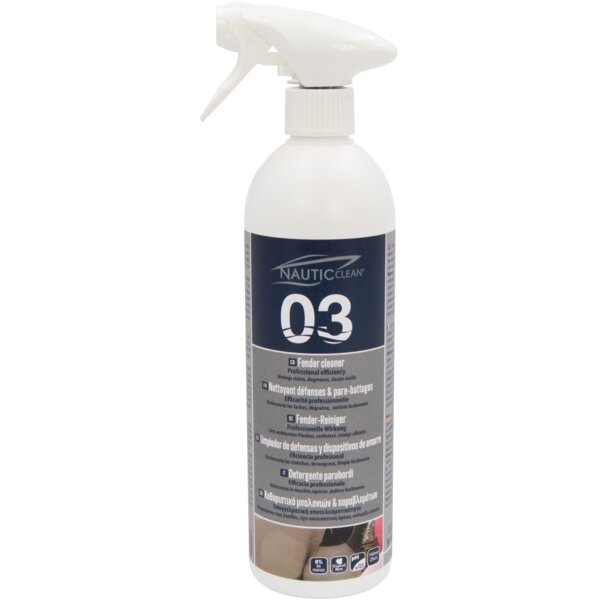
What is NAUTICCLEAN 03 FENDER CLEANER and why choose it?
NAUTICCLEAN 03 FENDER CLEANER is an alkaline, high-performance cleaner developed specifically for cleaning and maintaining marine fenders and boat defenses. Its powerful stain-removing formula eliminates embedded black rubbing marks, marine pollution residues, waste oils and other dirt while remaining safe for common inflatable and rigid fender materials such as Hypalon, Neoprene and PVC, as well as rubber and plastic parts.
The product is available as a ready-to-use 750 ml spray and as a 1 L concentrated formula. It contains biodegradable surfactants of vegetal origin, is free from phosphates, chlorine and NTA, and is designed to be effective without being toxic for health or the environment when used as directed.
Main features
- Specially developed for marine fenders and defenses.
- Efficiently removes black scuff marks, oil stains and marine contamination residues.
- Safe for Hypalon, Neoprene, PVC, rubber and plastic surfaces.
- Easy application: available as spray (ready to use) and as a concentrated bottle.
- Stain-removing agents penetrate deeply into embedded dirt.
- Phosphate-free, chlorine-free and NTA-free formulation.
- Contains surfactants of vegetal origin.
- Not toxic for health and respectful of the environment when used according to instructions.
- Does not attack rubber or plastic.
Technical specifications
Chemical and physical data
- Physical state: liquid
- Colour: blue
- pH: approx. 13.5 (20 °C)
- Density (ready-to-use spray): approx. 1.04
- Density (concentrated formula): approx. 1.09
- Product type: alkaline cleaner
Composition (according to available information)
- Contains <5% phosphonates
- Contains <5% non-ionic surfactants
- Contains <5% anionic surfactants
- Surfactants of vegetal origin
Environmental information
- The surfactants contained in this preparation comply with the biodegradability criteria defined in Regulation (EC) No 648/2004 on detergents.
Packaging and references
- 03-750: 750 ml trigger spray, ready for use.
- 03-1: 1 L bottle, concentrated formula.
Applications and use cases
Designed uses
- Regular cleaning and maintenance of marine fenders and boat defenses.
- Removal of black rubbing marks caused by docks, hulls or other contact surfaces.
- Degreasing of oil stains and residues on fenders.
- Cleaning of traces of marine pollution on inflatable or rigid fenders.
Compatible surfaces
- Hypalon
- Neoprene
- PVC
- Rubber
- Plastic
Instructions for use
Ready-to-use spray (03-750)
- Use the product ready for use; no dilution is required.
- Spray the cleaner directly onto the surface to be treated.
- Allow it to penetrate the dirt.
- Scrub with a brush or sponge.
- Rinse thoroughly with clear, fresh water.
- Repeat the operation if necessary until the desired result is obtained.
Concentrated formula (03-1)
- Dilute 1 part product in 3 parts water.
- Apply with a brush or spray onto the surface to be treated.
- Allow the solution to penetrate the dirt.
- Scrub with a brush or sponge.
- Rinse thoroughly with fresh water.
Do not discharge product residues into sewers or watercourses. Use appropriate collection and disposal systems.
FAQ
1. On which surfaces can NAUTICCLEAN 03 FENDER CLEANER be used?
The cleaner is indicated as safe for Hypalon, Neoprene, PVC, rubber and plastic surfaces.
2. Is the product ready to use or does it need dilution?
The 750 ml spray (03-750) is ready to use and does not require dilution. The 1 L bottle (03-1) is a concentrated formula that should be diluted at 1 part product to 3 parts water before application.
3. Does it contain phosphates, chlorine or NTA?
No. The formulation is indicated as phosphate-free, chlorine-free and NTA-free.
4. Is the product harmful to rubber or plastic?
No. It is specifically stated that the cleaner does not attack rubber or plastic.
5. Are the surfactants biodegradable?
Yes. The surfactants in this preparation comply with the biodegradability criteria of Regulation (EC) No 648/2004 on detergents and are of vegetal origin.
6. Is NAUTICCLEAN 03 FENDER CLEANER safe for health and the environment?
The product is described as not toxic for health and respectful of the environment when used according to the safety instructions.
7. Can I dispose of the product in the sewer?
No. Residues must not be discharged into sewers or watercourses. Use suitable disposal facilities and containers.
8. What is the appearance and pH of the product?
The cleaner is a blue liquid with an approximate pH of 13.5.
9. How should the product be stored?
Keep the container tightly closed and protected from cold, frost, UV rays, heat and high temperatures, in a ventilated place.
10. What should I do if I need more detailed safety information?
Consultar ficha técnica del fabricante.
Section 14 – Transport information
- UN number: UN3267
- UN proper shipping name (ADR): 3267 CORROSIVE LIQUID, BASIC, ORGANIC, N.E.P. (SODIUM HYDROXIDE, N,N-diacetic glutamic acid tetrasodium salt)
- UN proper shipping name (IMDG, IATA): CORROSIVE LIQUID, BASIC, ORGANIC, N.O.S. (SODIUM HYDROXIDE, N,N-diacetic glutamic acid tetrasodium salt)
- Transport hazard class: Class 8, corrosive substances
- Label: 8
- Packing group: III
- Marine pollutant: No
- Kemler number: 80
- EMS number (IMDG): F-A, S-B
- Segregation group: Alkalis
- Stowage category: A
- Stowage code: SW2 – Clear of living quarters.
- Segregation code: SG35 – Stow "separated from" acids.
- Transport in bulk according to MARPOL Annex II and the IBC Code: Not applicable.
- ADR limited quantities (LQ): 5 L
- ADR excepted quantities (EQ): Code E1 – maximum net quantity per inner packaging 30 ml; maximum net quantity per outer packaging 1000 ml.
- Transport category (ADR): 3
- Tunnel restriction code: E
Section 8 – Personal protective measures
General hygiene measures
- Keep away from food, drink and animal feeding stuffs.
- Remove immediately any contaminated clothing.
- Wash hands before breaks and at the end of work.
- Do not breathe dust, mist or spray.
- Avoid contact with eyes and skin.
Personal protective equipment (PPE)
- Respiratory protection: For short or low-level exposure, a respiratory mask is recommended. For more intensive or longer exposure, use self-contained breathing apparatus.
- Hand protection: Protective gloves made from material impermeable and resistant to the product. The choice of glove material must consider breakthrough times, permeability and degradation; follow glove manufacturer recommendations.
- Eye protection: Tightly sealed safety goggles.
- Body protection: Protective clothing or suit appropriate to prevent skin contact.
*Contenido generado por IA