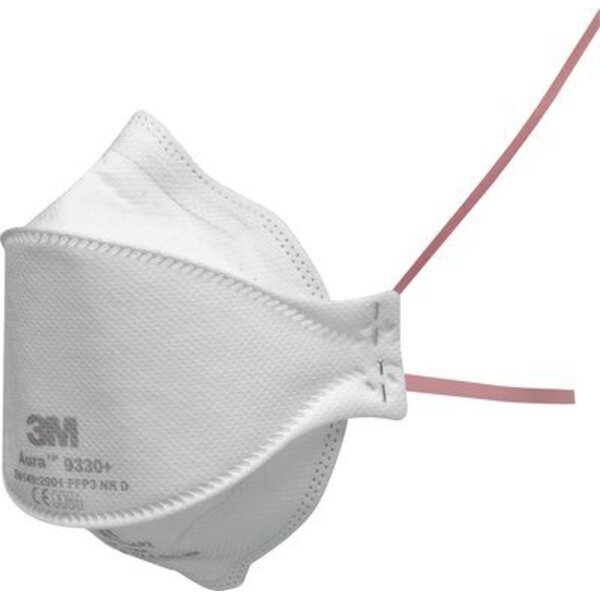
What is the 3M 9330 FFP3 self-filtering mask and why choose it
The 3M Aura 9330 is a self-filtering particulate respirator in FFP3 class, without exhalation valve, designed to provide high-efficiency protection against fine dusts and mists in demanding industrial and professional environments. Its flat-fold three-panel design improves comfort, fit and communication, while the absence of a valve helps protect both the wearer and the environment around them.
According to publicly available 3M documentation, this model is certified under EN 149:2001+A1:2009 as FFP3 NR D and offers a high nominal protection factor for properly fitted users. Some details may vary depending on batch or revision and should be checked against the official 3M technical datasheet.
Main features
- FFP3 protection without valve: Filtering facepiece for solid and liquid particles, classified as FFP3 NR D for high filtration efficiency.
- Three-panel Aura design: Original 3-panel construction that adapts to facial movements and improves comfort when speaking or working for extended periods.
- Flat-fold, individually wrapped: Foldable design that is easy to store and carry; each respirator is hygienically individually wrapped to help protect it from contamination before use (according to 3M information).
- Moulded, embossed upper panel: Shaped nose panel designed to follow facial contours, improve sealing around the nose and help reduce fogging of eyewear.
- Low breathing resistance filter media: Advanced filtration media designed to combine high particle capture efficiency with relatively low breathing resistance.
- Chin tab for easy donning: Integrated chin tab that helps position and adjust the mask more easily, contributing to a better fit.
- Colour-coded braided straps: Braided headbands with red colour code to identify FFP3 protection level within the Aura 9300+ family.
- Compatible with other PPE: Low-profile design around the nose and cheeks to improve compatibility with 3M eye and hearing protection (as indicated in 3M product literature).
- Single-use (NR): Non-reusable filtering half mask, intended for single-shift use under normal conditions, in line with EN 149 marking “NR”.
Technical specifications
Note: The following specifications are based on generic 3M Aura 9330+/9300+ series technical documentation available as of 2026 and may not be exhaustive. Always verify against the latest official 3M datasheet for this exact model.
- Brand: 3M
- Series: 3M Aura 9300+ series (model 9330 / 9330+)
- Product type: Self-filtering particulate respirator (filtering half mask)
- Protection class: FFP3 NR D (non-reusable, dolomite-tested)
- Exhalation valve: No (unvalved)
- Standard: EN 149:2001+A1:2009
- Nominal Protection Factor (NPF): typically 50 for FFP3 class filtering half masks, according to 3M technical documentation for the Aura 9330 model.
- Design: Flat-fold, three-panel respirator
- Size: Standard (one size, designed to fit many adult face shapes)
- Typical weight: around 10 g (approximate value based on 3M 9330 series datasheets)
- Nose clip: Adjustable, moulded upper panel with integrated nose region to improve seal and comfort.
- Headbands: Braided headbands, colour-coded red for FFP3 level within the Aura family.
- Packaging: Flat-fold respirator, usually supplied individually wrapped; outer packaging composition and recycled content may vary by production date and region.
- Intended use: Protection against solid and non-volatile liquid aerosols (dusts and mists), in accordance with EN 149 FFP3 classification, when used as part of an appropriate risk assessment and fit-tested respiratory protection programme.
Applications and typical use cases
Important: Actual suitability must be confirmed by a competent safety professional based on local regulations and a workplace risk assessment. The following are common example applications for FFP3-class particulate respirators of this type and are not product approvals for specific substances.
- Industrial dust exposure: Tasks with high levels of fine mineral, metal or process dust where FFP3 is required under applicable standards.
- Construction and renovation: Activities such as sanding, grinding, cutting or drilling where high-efficiency particulate filtration is necessary.
- Pharmaceutical and chemical powder handling: Handling of certain active powders or bulk substances, when compatible with EN 149 FFP3 filtering half masks and local occupational hygiene requirements.
- Metal industry operations: Exposure to fine metallic particulate and fumes where an FFP3 respirator is considered appropriate by site risk assessments.
- General workplace respiratory protection: Situations with elevated particulate concentrations where an unvalved FFP3 mask is desired to protect both the wearer and their surroundings.
This product is not designed for protection against gases or vapours and should not be used in oxygen-deficient atmospheres, confined spaces without proper evaluation, or in any environment not compatible with the limitations of EN 149 filtering half masks.
FAQ – 3M 9330 FFP3 self-filter mask without valve
-
Is the 3M 9330 mask reusable?
No. The 3M 9330 is typically marked as FFP3 NR D, meaning it is a non-reusable, single-shift disposable respirator. It should be discarded after each work shift or sooner if it becomes damaged, soiled or difficult to breathe through.
-
Does this model have an exhalation valve?
No. The 9330 version is unvalved. Within the same 3M Aura family, models with a “2” in the last digit (such as 9332) usually include an exhalation valve, but this specific mask does not.
-
What level of protection does FFP3 offer?
FFP3 is the highest particulate filtration class in EN 149 for filtering half masks, generally associated with a nominal protection factor of 50 when the respirator is correctly fitted and used as part of an appropriate respiratory protection programme.
-
Is the 3M 9330 suitable for gases or vapours?
No. This is a particulate respirator and is designed only for protection against solid and non-volatile liquid aerosols. It does not protect against gases or vapours and must not be used in oxygen-deficient atmospheres.
-
Can I wear glasses with this mask?
The low-profile embossed upper panel is specifically shaped to improve compatibility with many types of safety eyewear and to help reduce fogging, provided the mask is properly fitted and nose area is well sealed.
-
How do I know if the mask fits correctly?
In professional settings, a quantitative or qualitative fit test according to local regulations should be performed. Each time you put the mask on, you should also carry out a user seal check following 3M’s instructions for use. If a good seal cannot be achieved, the mask should not be used.
-
Does the 9330 mask help protect people around the wearer?
Because it has no exhalation valve, all inhaled and exhaled air passes through the filter media, which can help reduce the spread of respiratory particles from the wearer compared with similar masks that include valves, assuming a proper fit.
-
How should the mask be stored before use?
It should be stored in its original packaging in a clean, dry environment, away from direct sunlight, extreme temperatures and chemicals. Respect the storage conditions and expiry date indicated by 3M on the packaging.
-
Is all the information about this mask fully verified?
The information provided here is based on publicly accessible 3M product pages and generic 9300+ series datasheets available as of 2026. There may be updates or regional variations. For critical applications, always confirm key parameters (certifications, limitations, approvals) using the official 3M technical documentation for the exact product reference you are purchasing.
Section 14 – Transport information
The following information is general guidance for typical disposable FFP3 filtering half masks such as the 3M Aura 9330. It is not a substitute for the official transport classification from 3M.
- In normal conditions of shipment and storage, this type of particulate respirator is usually not classified as a dangerous good for transport by road (ADR/RID), sea (IMDG) or air (IATA/ICAO), because it does not contain substances that meet the criteria for hazardous materials when supplied as a finished consumer/industrial product.
- Masks should be transported in their original packaging or equivalent protective packaging to prevent mechanical damage, deformation or contamination of the respirators.
- Avoid exposure of transport packages to extreme temperatures, moisture, direct sunlight or compressive loads that could affect product integrity.
- Follow any specific storage and transport instructions printed on the 3M packaging (orientation, stacking limits, temperature or humidity ranges, etc.).
For formal transport classification and any region-specific requirements, consult the latest official 3M safety or product documentation for this model.
Section 8 – Individual protection measures
This section provides general information on personal protective measures when using an FFP3 filtering half mask like the 3M 9330. It is not a complete risk assessment and does not replace the official instructions for use.
- Respiratory protection: The 3M 9330 FFP3 mask is intended to be the primary respiratory protective device against suitable particulate hazards, provided that it has been properly selected, fit-tested and used according to EN 149 and applicable workplace regulations.
- Face fit and seal: Facial hair (beards, significant stubble, some types of piercings) and certain facial shapes can prevent an adequate seal. For effective protection, the sealing area must be free of hair and other elements that interfere with the mask-to-face contact.
- Additional PPE: Depending on the specific task and risk assessment, additional personal protective equipment may be required, such as safety goggles or face shields, hearing protection, protective gloves, or protective clothing. The selection of this additional PPE should be made by a competent safety professional.
- Hygiene measures: Wash or disinfect hands before putting the mask on and after removing it. Do not touch the inside of the mask. Avoid reusing a disposable respirator once removed from the face, and discard it in accordance with local regulations.
- Use limitations: Do not use this filtering half mask in oxygen-deficient environments, in atmospheres immediately dangerous to life or health (IDLH), or for protection against gases and vapours, unless explicitly allowed by the manufacturer and competent authorities, which is generally not the case for standard EN 149 FFP3 filtering half masks.
For precise and binding instructions on individual protection measures for this specific model, the official 3M documentation and local occupational safety regulations must always be followed.
*Contenido generado por IA