What is the 3M™ Air Supply Equipment S-200+ and why choose it?
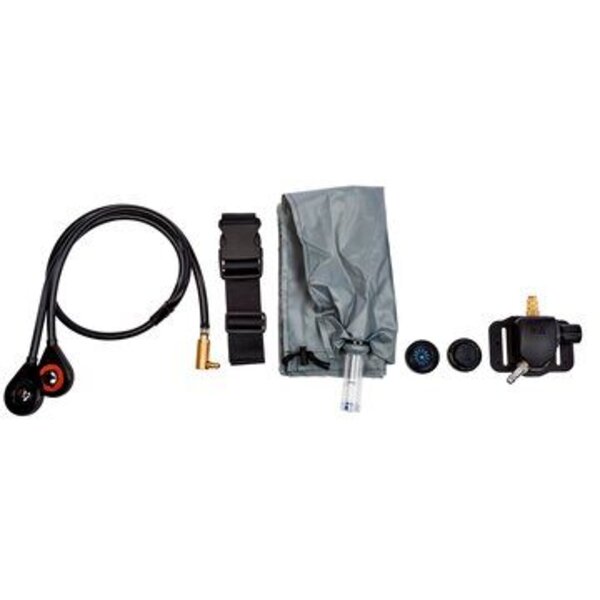
The 3M™ Air Supply Equipment S-200+ is a belt-mounted supplied air regulator system designed to deliver a constant, adjustable flow of clean compressed air to compatible 3M half and full face masks. When connected to an appropriate compressed air source and used with approved 3M facepieces and filters, it provides reliable respiratory protection against particles, gases, vapours and combination hazards in industrial environments.
This system is an efficient choice for users who need continuous-flow respiratory protection during demanding tasks such as spray painting, powder coating, fiberglass work or chemical handling, while maintaining comfort and mobility thanks to its lightweight design and narrow-bore breathing tube.
Main features
- Supplied air respirator system S-200+ for use with compatible 3M half and full face masks (e.g. 3M 6000 and 7000 Series, depending on local approvals and configurations).
- Continuous, adjustable airflow to the facepiece, helping improve comfort and reduce breathing resistance during long shifts.
- Dual-mode capability (unverified detail): some S-200+ configurations are described as usable with filters as back-up when the air supply is disconnected; confirm in the official 3M technical datasheet for your specific configuration.
- Belt-mounted regulator for good weight distribution and easy access to controls.
- Narrow-bore, low-profile breathing tube designed to minimise interference with other PPE and allow greater freedom of movement.
- Double-action couplings on the regulator (as indicated in manufacturer information) to help reduce the risk of accidental disconnection during use.
- High protection levels when used with approved 3M face masks, in line with EN 14594:2005 classifications (Class 3A/B for half masks and Class 4A/B for full face masks, based on 3M data).
- ATEX-tested system (unverified for this exact sales unit): 3M describes S-200+ systems assessed for use in certain IIB 2GD environments when used with a specific antistatic compressed air supply tube; verify exact suitability in the official datasheet for your configuration.
Technical specifications
Important: The following technical data is compiled from publicly available 3M documents and may vary by configuration or region. For safety-critical use, always verify these values in the official 3M technical datasheet supplied with the product.
- Product type: Supplied air regulator system for compressed air line use.
- Mounting type: Belt-mounted unit.
- Operating pressure range (typical 3M data):
- Approx. 3.0–7.0 bar (airline operation, without auxiliary air tool).
- Approx. 4.5–7.0 bar (with auxiliary air tool connected).
- Maximum inlet pressure (typical): around 10 bar.
- Airflow characteristics (typical 3M data):
- Manufacturer’s minimum design flow: around 120 l/min.
- Maximum flow: greater than 350 l/min (depending on supply conditions).
- Approximate weight: around 690 g (including regulator, belt and breathing tube), based on 3M documentation.
- Typical dimensions (approximate):
- Length: about 0.395 m.
- Width: about 0.21 m.
- Height: about 0.075 m.
- Materials (typical for S-200+ system):
- Housing and belt bracket: polypropylene.
- Inlet fitting: stainless steel.
- Outlet fitting: brass.
- Breathing tube: TPE with polypropylene components.
- Belt: polyester or similar textile belt material.
- Connections (typical):
- Inlet port: industrial quick-connection type (e.g. CEJN 346 style, depending on model).
- Auxiliary port: typically 1/4" BSP thread for compatible air tools (if present).
- Operating temperature range (typical): approx. 0 °C to +40 °C, up to 90 % RH.
- Storage conditions (typical): approx. -10 °C to +50 °C, below 90 % RH.
- Standards and approvals (to be verified for the exact model):
- EN 14594:2005 continuous flow supplied air respirators.
- EN 14594:2005 Class 3A/B when used with specified 3M half face masks.
- EN 14594:2005 Class 4A/B when used with specified 3M full face masks.
- CE-marked according to applicable European PPE regulations.
- ATEX assessment according to EN 13463-1 for certain configurations with an approved antistatic supply tube (verify for your specific set).
- Compressed air quality: The compressed air supply must comply with EN 12021 or equivalent local standards for breathable air quality (value to be confirmed in 3M official documentation).
- Typical nominal protection factors (NPF) indicated by 3M data, not fully verified for this sales unit):
- Up to NPF 500 when used with approved 3M half face masks.
- Up to NPF 2000 when used with approved 3M full face masks.
Applications and use cases
The 3M™ Air Supply Equipment S-200+ is suitable for a wide range of industrial applications where workers are exposed to airborne contaminants and require continuous-flow respiratory protection when used with compatible 3M facepieces and filters.
Typical contaminants
- Fine dusts and solid particles.
- Mists and aerosols.
- Paint spray and solvent-based overspray (when used with suitable filters and masks).
- Metal fumes from welding, cutting or similar processes (with proper filter selection).
- Gases and vapours within the limits of the selected facepiece and filters.
- Combination hazards of particles, gases and vapours, provided the complete system is correctly configured.
Typical industries
- Automotive and aerospace manufacturing and refinishing.
- General transport and heavy vehicle refinishing.
- Metal fabrication and shipbuilding.
- Oil and gas related operations where compressed air line systems are available.
- Fiberglass and composite fabrication.
- Powder coating and industrial painting.
- Chemical, agrochemical and pharmaceutical production and laboratories, where compatible with local risk assessments.
Example use scenarios
- Workers performing spray painting in a body shop, using a 3M full face mask and S-200+ connected to a filtered compressed air network.
- Operators in powder coating lines requiring continuous respiratory protection without the weight of a powered air blower on their back.
- Technicians handling resins and solvents in composite manufacturing, benefiting from a constant supply of breathable air.
FAQ – Frequently Asked Questions
1. Is the 3M™ S-200+ a complete respirator by itself?
No. The S-200+ is a supplied air regulator system. It must be used together with compatible 3M half or full face masks and connected to a suitable compressed air supply that meets breathable air standards.
2. Which 3M masks are compatible with the S-200+?
3M public documentation indicates compatibility with certain 3M 6000 and 7000 Series half and full facepieces. Exact compatibility may vary by region and configuration. Always confirm with the official 3M technical datasheet or your safety supplier.
3. Can I use the S-200+ in oxygen-deficient atmospheres or confined spaces?
No. Manufacturer documents clearly state that the S-200+ must not be used in atmospheres with less than 19.5% oxygen, nor in confined spaces with poor ventilation, nor in atmospheres that are immediately dangerous to life or health (IDLH).
4. Does the S-200+ replace gas or particle filters?
The system supplies breathable air from a suitable source, but for many applications filters are still required on the facepiece, especially if dual-mode back-up is used or if specified by local regulations. Always follow 3M instructions and your workplace risk assessment when selecting filters.
5. What air quality is required for the compressed air supply?
The compressed air must meet relevant standards for breathable air quality, such as EN 12021 in Europe. This includes limits for oil, water, carbon monoxide, carbon dioxide and other contaminants. An appropriate filtration and monitoring system is required on the compressed air line.
6. Can I connect air tools to the S-200+?
Certain S-200+ regulators include an auxiliary air outlet (for example with a 1/4" BSP port) designed to supply compatible air tools, within specified pressure and flow ranges. Check the exact configuration and limits in the official 3M datasheet before connecting any tools.
7. Is the S-200+ suitable for use in explosive atmospheres (ATEX)?
Some S-200+ configurations have been assessed for use in specified IIB 2GD environments when used with a dedicated antistatic compressed air supply tube and within defined conditions. However, suitability for explosive atmospheres is highly application-specific and must be confirmed in the official 3M documentation and through your site’s ATEX risk assessment.
8. How should I maintain and clean the S-200+?
3M recommends regular inspection, cleaning with suitable solutions, and replacement of worn parts according to the user instructions. Only original spare parts should be used. For detailed maintenance procedures and intervals, refer to the official 3M user manual.
9. Does the S-200+ provide eye and face protection?
Eye and face protection depend on the selected facepiece. When used with a full face mask, it provides combined respiratory and face/eye protection. When used with a half mask, separate eye protection (such as safety goggles or a face shield) is required.
10. Where can I find fully verified technical data and certifications?
For fully verified and up-to-date technical data, limits of use, certifications and approvals, it is essential to consult the official 3M technical datasheet and user instructions supplied with the product or available from 3M.
Section 14 – Transport information
Based on typical safety data for respiratory protective equipment like the 3M™ S-200+ system and in the absence of a dedicated hazardous classification in public documents, this product is generally considered not classified as dangerous goods for transport under common regulations (ADR/RID, IMDG, IATA/ICAO) when shipped as equipment.
However, this general statement is not fully verified for every kit configuration (for example if packaged together with lubricants or accessories that might have their own classifications). For definitive transport classification, packaging group, UN number and labelling requirements, always check the official 3M safety data or transport information specific to the exact product set supplied.
Section 8 – Individual protection measures
The S-200+ is part of a respiratory protection system. Proper individual protective measures must be applied at workplace level. The following points summarise typical recommendations derived from general PPE practice and manufacturer information. They are indicative only and must be confirmed in the official 3M documentation and the site-specific risk assessment.
8.1 Respiratory protection
- Use the 3M™ S-200+ only with compatible and approved 3M half or full face masks and, where required, suitable gas and/or particle filters.
- Ensure the compressed air supply meets breathable air standards (e.g. EN 12021) and is properly filtered, monitored and maintained.
- Adjust airflow within the recommended range to ensure comfort and sufficient cooling, while staying within manufacturer limits.
- Do not use the system in oxygen-deficient atmospheres, confined spaces without appropriate controls, or IDLH environments.
- Perform pre-use checks according to 3M instructions, verifying couplings, hose condition, belt fixation and mask fit.
8.2 Eye and face protection
- When used with a full face mask, the system helps provide eye and face protection against splashes and particles within the mask’s certification limits.
- When used with a half mask, additional eye protection such as safety goggles or visors is required, selected according to the nature of the hazard (chemical splash, mechanical impact, etc.).
8.3 Hand protection
- Use suitable protective gloves compatible with the substances handled (e.g. solvent-resistant, chemical-resistant or cut-resistant gloves), selected based on permeation data and local risk assessment.
8.4 Skin and body protection
- Wear appropriate protective clothing such as coveralls, chemical-resistant suits, aprons or sleeves depending on the exposure scenario (spray painting, chemical handling, metalworking, etc.).
- Ensure clothing and the belt-mounted S-200+ do not interfere with each other and that all parts of the body likely to be exposed are adequately covered.
8.5 General hygiene measures
- Do not eat, drink or smoke while using respiratory protection.
- Wash hands and exposed skin thoroughly after handling hazardous substances or removing PPE.
- Store the system and masks in a clean, dry area away from contamination when not in use.
*Contenido generado por IA